
One million impressions, thousands of likes, hundreds of comments, and a growing number of followers. At first glance, it is hard to imagine better results from a marketing campaign. But what if those impressive statistics do not translate into a single new customer?
This is one of the biggest paradoxes of modern online marketing. Brands have never had so many ways to reach audiences, while creators and publishers have never had so many tools for building their own communities. At the same time, user attention alone does not guarantee revenue. This is where monetization comes in – the process of turning specific assets, such as content, website traffic, reach, community, or technology, into real financial value. For a publisher, this may mean earning money from a blog, YouTube channel, or their own website. For an advertiser, however, monetization has another highly important dimension. It helps explain why independent creators and website owners can become valuable partners in customer acquisition.
In a world where consumers discover products across different platforms, read reviews, compare prices, and rely on recommendations from others, it is becoming increasingly important not only to capture their attention, but also to create a mechanism that turns that interest into a specific business outcome.
Simply put, monetization is the process of turning existing resources or activities into revenue. Online, almost anything that has value for a specific audience can become a monetizable asset: knowledge, content, a community, website traffic, a user base, an app, or access to a particular niche.
A good example is a website focused on healthy eating. Its owner regularly publishes recipes, guides, and product reviews. Over time, the website begins attracting tens of thousands of users each month. Traffic alone does not generate income. Only by choosing the right monetization model can the website’s popularity be turned into a source of revenue.
Let Publishers Earn by Recommending Your Products
The website owner can sell advertising space, publish paid sponsored content, offer a premium subscription, or recommend products from online stores in exchange for a commission on generated sales. Each of these models uses the same asset – access to an interested community – but in a different way. From an advertiser’s perspective, the most interesting aspect is that a publisher’s monetization can simultaneously support another company’s sales. A brand does not need to build a healthy eating website itself or attract its audience from scratch. It can partner with a publisher who already has their attention and trust.
In online marketing, it is easy to confuse popularity with effectiveness. Large numbers may look impressive in reports, but they do not always translate into financial results.
Imagine two creators promoting sports accessories. The first runs a large lifestyle profile and publishes a piece of content that reaches 500,000 views. The second has a much smaller community focused on running and generates only 30,000 views. Which collaboration will be more valuable for a store selling professional running shoes? Reach alone is not enough to answer that question. The second creator may be reaching people who are actively interested in buying sports equipment. Their audience may be more likely to click recommended products, compare different models, and complete purchases. As a result, a smaller publication can generate more sales than content with many times the reach.

This highlights an important difference between monetizing attention and monetizing genuine purchase intent. This does not mean that reach-focused campaigns have no value. Building brand awareness also matters, and its effects may appear over time. The problem begins when an advertiser evaluates a sales campaign solely on the basis of impressions instead of checking what happened after the audience interacted with the advertisement.
The growing importance of monetization is no coincidence. The internet has become a space where almost every form of attention can have commercial value. Websites earn money from advertising, creators from brand collaborations, newsletter authors from subscriptions, and affiliate publishers from commissions on generated transactions. The scale of this market is well illustrated by data from the IAB Polska/PwC AdEx study. In 2025, the value of online advertising in Poland reached PLN 10.9 billion, which was 14.6% more than the year before. This means an increase of approximately PLN 1.4 billion in just twelve months.
For advertisers, this is an important signal. More and more budget is flowing into digital channels, but at the same time, competition for users’ attention is increasing. In these conditions, buying reach alone is no longer enough. Advertisers need to understand more precisely which activities build brand awareness, which generate interest, and which actually lead to sales.
Expectations regarding collaboration with creators are also changing. In 2026, IAB Polska published standards for reporting influencer marketing campaigns, emphasizing the need to standardize metrics and evaluate results based on data that goes beyond the statistics provided by social media platforms alone. This represents an important shift in perspective. Popularity still matters, but it is becoming increasingly important to understand how that popularity translates into specific business goals.
Not every publisher earns money in the same way. The monetization model depends on the type of content, the size of the community, the nature of the audience, and the opportunities offered by a particular channel. Large online publishers often use display advertising, where revenue is tied to ad delivery or the number of impressions. Creators may be paid for sponsored posts, while owners of specialized websites can make part of their content available through a paid subscription.
Performance-based monetization is also becoming an increasingly interesting option. Instead of earning solely by providing advertising space, a publisher can be compensated for a specific user action – a click, a generated lead, or a purchase.
Turn Publisher Potential Into Real Business Results
Affiliate marketing uses models such as CPC (Cost Per Click), CPL (Cost Per Lead), and CPS (Cost Per Sale). Each of them defines differently the result for which a partner is compensated. From an advertiser’s perspective, the CPS model is particularly interesting because the publisher’s commission is linked to the sales generated. This aligns the interests of both parties: the publisher earns money from effective promotion, while the brand gains orders. This does not mean that one model will always be better than the others. Brand awareness campaigns may require broad reach, lead generation activities may focus on valuable contacts, while online stores may prioritize transactions. The key is to match the payment model to the goal of the collaboration.
Imagine an online store selling home furnishings. The brand starts working with an interior design website that publishes a guide on how to furnish a small living room. The article receives 40,000 views. Some readers visit the store, browse the offer, and some of them make a purchase. In a traditional advertising model, the website could be paid for displaying an ad or publishing the content. In an affiliate model, however, it can earn money from transactions attributed to its activities. Let’s look at a hypothetical example:
EXAMPLE CONTENT CAMPAIGN

In this case, 40,000 views were only the beginning of the process, while the 36 orders make it possible to evaluate the direct sales result. Of course, not everyone who reads the article will purchase a product immediately. Some users may return to the store later, compare prices, or use another channel. That is why monetization analysis should also take into account the customer journey and the rules used to attribute transactions. The key takeaway, however, is simple: a high number of views shows reach potential, but only the next stages reveal its actual business value.
In the next part of the article, we will look at how advertisers can use publishers’ monetization models to grow their own sales, how to evaluate the profitability of such partnerships, and why affiliate marketing can become an important part of a broader marketing strategy.
At first glance, monetization may seem like a topic that primarily concerns online creators, bloggers, and website owners. They are the ones looking for ways to earn money from their content, traffic, and communities. In reality, however, this mechanism is just as important for advertisers.
Any publisher with a valuable audience can become a potential business partner for a brand. They do not need to reach millions of people. In some cases, a small specialist website whose users regularly search for information about specific products can be far more valuable. Imagine an online store selling professional coffee machines. Instead of limiting promotion to its own advertising, it can work with coffee bloggers, home appliance comparison websites, or creators publishing coffee machine reviews. Each of these partners reaches users at a different stage of the purchasing process. A blogger may inspire interest in home coffee brewing, a reviewer may help users choose a specific model, while a comparison website can make it easier to find the right offer. For the advertiser, this means being present in multiple places where potential customers look for information before making a purchase. For the publisher, it creates an opportunity to monetize content they already produce. That is why a well-designed partnership is not simply about buying access to an audience. It is about creating a model in which both sides benefit from the value delivered to the user.

One model that particularly well illustrates the connection between monetization and business results is affiliate marketing. Its mechanism is based on cooperation between an advertiser and publishers who promote products or services using dedicated promotional materials and affiliate links. A tracking system makes it possible to attribute specific user actions to individual partners and then calculate the commissions due according to the program terms. In the CPS model, the publisher’s compensation is linked to sales. If a user visits the store through an affiliate link and completes a purchase that meets the program conditions, the transaction can be attributed to the publisher.
It is worth remembering, however, that affiliate marketing is not merely a technical system for calculating commissions. It is also a way to organize cooperation with many partners at the same time. An online store can work with bloggers, influencers, niche websites, price comparison services, coupon websites, or publishers running their own product databases. Each of these groups reaches users in a different way and can support different stages of the purchasing process. As a result, the advertiser does not have to rely solely on its own advertising channels to grow sales. Instead, it can build a network of partners whose activities are tied to the effectiveness of the promotion.
Importantly, a publisher does not need to be employed by the brand or receive a fixed fee for every publication. In a commission-based model, their income depends on the results of the collaboration, which allows financial risk to be distributed differently than in traditional campaigns based on fixed fees. Of course, this does not mean that affiliate marketing eliminates all marketing costs. Advertisers should still take into account commissions, program management costs, product margins, and the quality of the transactions generated.
When evaluating monetization effectiveness, it is important to consider not only how much traffic a publisher generates, but also the nature of that traffic. A user who accidentally clicks an ad while browsing a news website may have very different intentions from someone reading a detailed review of a product they have been considering buying for several days. Both clicks may look similar in a basic report, but their sales potential can differ significantly. For this reason, advertisers should pay attention to the context in which their offer appears. A publisher creating buying guides may reach users who are actively looking for specific solutions. A coupon website, on the other hand, may reach consumers who are already close to completing a purchase and are checking available promotions. However, the value of individual traffic sources depends on the goal of the program. If a brand primarily wants to acquire new customers, it should analyze which partners genuinely help reach new audiences and which mainly participate in the final stages of the purchasing process.
Publishers Monetize Their Reach, While You Increase Sales
The highest number of transactions does not always mean the greatest incremental value for the business. Some purchases might have happened even without the involvement of a particular publisher. That is why it is becoming increasingly important to analyze not only sales volume, but also the quality and incrementality of those sales – in other words, the extent to which marketing activities generated results that probably would not have occurred without them.
A publisher may evaluate monetization primarily based on the revenue generated. An advertiser should take a broader view and assess how the collaboration affects the economics of the business.
In practice, the following metrics are particularly useful:
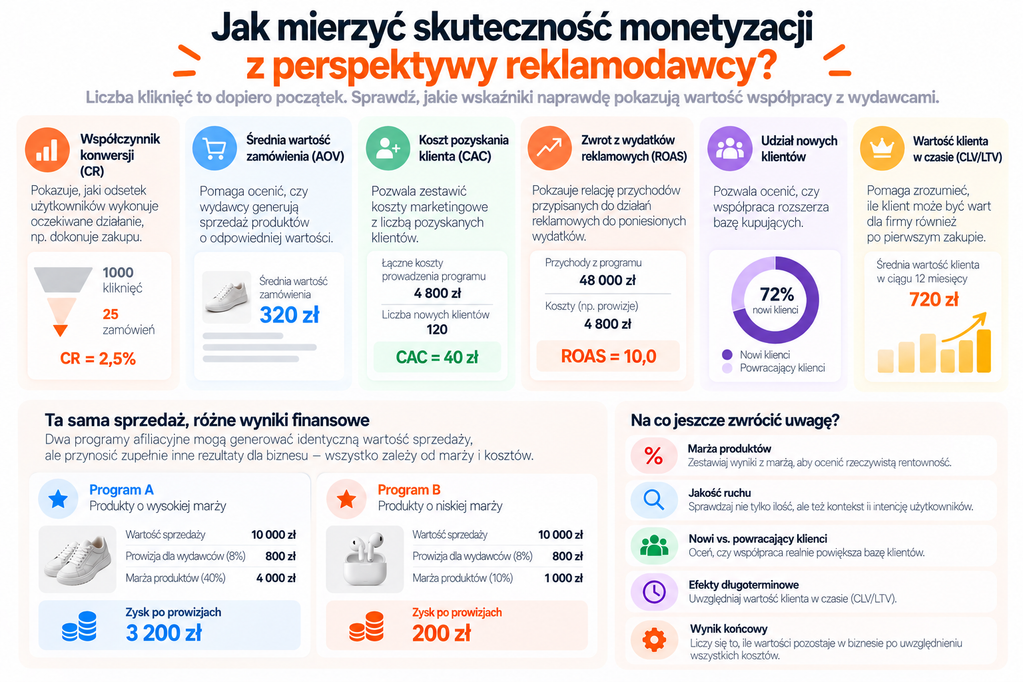
It is particularly important to compare these metrics with product margins. Two affiliate programs may generate the same sales value but deliver very different financial results. For example, selling high-margin products may allow an advertiser to offer publishers a more attractive commission. With low-margin products, even a seemingly modest cost of acquiring an order can significantly reduce profitability. That is why effective monetization should not be evaluated solely on the basis of clicks or order value. What matters is how much value remains in the business after the costs of generating the sale are taken into account.
Launching an affiliate program is only the beginning. Its potential depends on whether the advertiser creates the right conditions for partners to promote the products effectively. The first step is matching the right types of publishers to the store’s offer. A cosmetics brand may achieve strong results by working with beauty creators, advice websites, and platforms featuring promotions. An electronics store, on the other hand, may benefit more from technology reviewers, comparison websites, and publishers specializing in product rankings and comparisons.
Promotional materials are equally important. Not every partner needs the same tools. An influencer may use an individual discount code or a link to a recommended product, while a price comparison website may need an up-to-date XML product feed. It is also worth providing publishers with information about promotions, bestsellers, new collections, and seasonal shopping opportunities. These materials make it easier to create content that responds to the real needs of the audience.
Your Brand Deserves More Than Impressions
The store itself should not be overlooked either. Even high-quality traffic will not deliver the expected results if the website loads too slowly, the purchasing process is complicated, or the offer does not meet customer expectations. The effectiveness of an affiliate program is therefore the result of several elements working together: the quality of publishers, the attractiveness of the offer, a reliable tracking system, and a well-designed purchasing process.
For an advertiser looking to grow sales through partnerships with external partners, acquiring and managing multiple publishers independently can be time-consuming. This is where affiliate networks such as WebeAds play an important role. The network connects advertisers with publishers interested in promoting products and services. As a result, an online store can launch an affiliate program, define compensation terms, and develop partnerships with different groups of publishers within a single system.
In the CPS model, commission is calculated on sales attributed to the publisher that meet the program conditions. This makes it possible to link partner compensation directly to specific sales results. For advertisers, the ability to analyze performance is equally important. Data on clicks, transactions, and commissions helps identify which publishers generate sales and which activities are worth developing further. WebeAds can be particularly valuable for online stores looking to diversify their customer acquisition sources. Instead of relying solely on Google Ads, social media advertising, or their own content campaigns, they can include independent partners who promote the offer through their own channels as part of the broader strategy. One of the key advantages of this approach is the potential to build long-term partnerships. A publisher who sees strong earning potential in a program has an incentive to continue developing promotional activities, while the advertiser can gradually scale the collaboration.
Online monetization will continue to evolve alongside changes in consumer behavior, the development of new content formats, and the growing role of technology. Artificial intelligence makes it easier to create and analyze content, automation helps manage campaigns more efficiently, and increasingly advanced analytics tools make it possible to better understand customer journeys. At the same time, the growing volume of published content means that simply being present online is no longer enough to stand out. Source credibility, subject-matter specialization, and the ability to reach audiences at the right moment may become increasingly important. For advertisers, this means the need for a more thoughtful approach to partner selection. Instead of focusing solely on follower counts or impressions, it is worth analyzing audience fit, content quality, and the publisher’s actual contribution to the purchasing process.

Affiliate marketing fits well with this direction because it makes it possible to link partner compensation to measurable user actions. It does not replace all other forms of marketing, but it can be a valuable complement to them.
Impressions, clicks, and reach are important elements of online marketing. They show whether content is reaching audiences and whether it is able to capture their interest. However, they should not be the only criteria used to evaluate effectiveness. The true value of monetization becomes visible when user interest can be translated into concrete results: sales, customer acquisition, valuable leads, or long-term business growth. For publishers, this means the opportunity to earn money from the content they create and the communities they build. For advertisers, it is a chance to benefit from the potential of those communities without having to build every acquisition channel themselves. A well-designed affiliate program connects these two worlds. Publishers gain a way to monetize their activity, while brands gain partners whose efforts can translate into measurable sales.
Turn Clicks Into Customers and Interest Into Sales
Want to grow sales beyond your own advertising campaigns? Join WebeAds, launch an affiliate program, and start working with publishers who can help your brand turn customer interest into real business results.