

An online store may have several thousand products, each with its own name, price, description, images, category, variants, and availability information. This data changes every day – one product goes on sale, another sells out, while dozens of new items are added to the catalog.
Now imagine that information about the entire product range needs to be shared with a price comparison website, an affiliate partner, or another external service. Manually updating every product would be practically impossible. This is where an XML file comes in. In e-commerce, an XML file can serve as a structured source of product data. The store generates information according to a defined structure, and an external system can automatically read and use it. As a result, a single product catalog can support multiple activities carried out outside the store itself.
For an advertiser, this may sound like a technical detail working somewhere in the background. In reality, the quality of product data can directly affect how easily partners can promote the offer and whether potential customers see the right product, the current price, and a correct link leading to the store. That is why an XML file should be treated not only as an integration component, but also as part of the e-commerce marketing infrastructure.
XML stands for Extensible Markup Language. The standard was developed to make it possible to store and exchange structured data between different systems. Unlike a website, XML does not need to be designed with an attractive visual appearance for users in mind. What matters most is its structure. In very simplified terms, a single product can be stored in the following way:
<product>
    <id>12345</id>
    <name>Buty do biegania XYZ</name>
    <price>349.99</price>
    <availability>in_stock</availability>
    <url>https://sklep.pl/buty-xyz</url>
</product>
For a person, this type of format is relatively easy to read. For a computer system, it is even more useful – a program can recognize that 349.99 is the product price, 12345 is its identifier, and the specified URL leads to the correct page. Of course, an actual online store XML file can contain thousands of products and much more information. It may include categories, manufacturer details, EAN codes, promotional prices, descriptions, image URLs, product variants, or stock availability. It is precisely this structured organization of data that makes XML so useful in e-commerce.
These terms are often used interchangeably, but they do not mean exactly the same thing. XML is a data format, while a product feed is a collection of information about a store’s offer that is transferred to another system. Such a feed can be stored in XML format, but depending on the use case, the data may also be provided in other formats. From an advertiser’s perspective, the function is more important than the terminology itself.
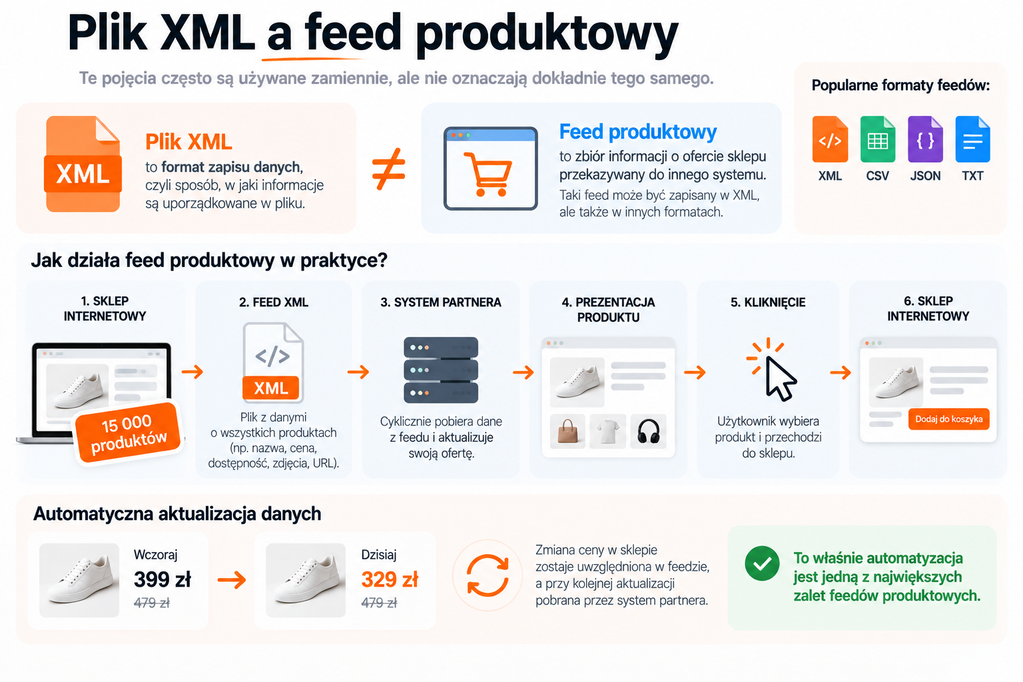
Imagine an online store with 15,000 products. Instead of sending a partner a spreadsheet and sharing a new version every time prices change, the store provides a product feed URL. The partner’s system can periodically retrieve the data and update the displayed offer automatically. The process is simple:
STORE → XML FEED → PARTNER SYSTEM → PRODUCT DISPLAY → CLICK → STORE
If a product cost PLN 399 yesterday and has been reduced to PLN 329 today, the change can be reflected in the store’s source data and retrieved during the next update by the system using the feed. This automation is one of the biggest advantages of product feeds.
There is no single universal structure suitable for every system. The range of required fields depends on where the data will be used. However, some types of information appear particularly often in e-commerce. The foundation is a unique product identifier. Thanks to it, an external system knows that the product retrieved today is the same one that appeared in the feed yesterday – even if its price or description has changed.
The product name, category, current price, availability, and direct product page URL are also important. In many applications, images play a major role as well. Depending on the product category, useful information may also include the brand, EAN/GTIN code, variant, color, size, or additional technical specifications. A good feed should above all answer the basic questions of both the potential customer and the system presenting the offer: What is it? How much does it cost? Is it available? What does it look like? And where can it be purchased? The more complete and structured this information is, the easier it becomes to use the store’s product catalog outside its own website.
Your XML File Can Help Drive Sales
Having an XML file does not automatically mean that the feed is good. Imagine a situation where a price comparison website displays a jacket for PLN 299. The customer clicks the offer, visits the store, and sees a price of PLN 379. Or they find an attractive product that has already been out of stock for several days. Technically, the feed exists. From a marketing perspective, however, it is not fulfilling its purpose.
Outdated prices, incorrect URLs, missing images, or products that remain in the feed long after they have been discontinued can worsen the user experience and make it more difficult for partners to promote the offer effectively. That is why the quality of a feed should be assessed in much the same way as the quality of a product page. The data should be up to date, complete, unambiguous, and structured in a way that allows the system using it to process it correctly. Automatic updates become particularly important for large catalogs. With tens of thousands of products, even a small percentage of incorrect records can result in hundreds of inaccurate offers.
The greatest value of an XML file becomes clear when we stop treating it as a simple product export. Well-prepared product data can be used across different parts of the e-commerce ecosystem, including price comparison websites, advertising platforms, marketplaces, and partners involved in product promotion. This means that a store does not have to prepare its product catalog from scratch every time. It changes a product price in its system. Updates availability. Adds a new model. The information is added to the feed and can then be retrieved by connected systems.
In practice, an XML file becomes a bridge between the store’s product catalog and the places where potential customers discover and compare products. This leads to a particularly interesting use case from an advertiser’s perspective – using a product feed in affiliate marketing.
In affiliate marketing, a publisher can promote not only the store itself, but also specific products from its offer. This is where an XML file starts to play a very practical role.
Imagine a publisher running a sports equipment comparison website. The store’s affiliate program includes 8,000 products. Manually adding every model, its price, image, and link would be time-consuming, while keeping all of that information up to date would be practically impossible. Access to a product feed makes it possible to automate a large part of this process. The publisher can retrieve product data and use it on their own website in accordance with the program rules. If the store expands its offer, changes a price, or updates product availability, the new information can appear during the next data synchronization. For the advertiser, this primarily means easier scalability of the partnership. Instead of providing partners with information about each product separately, the advertiser gives them access to a structured source of product data. The easier it is for a publisher to work with the store’s offer, the fewer barriers there are to starting and scaling promotional activities.
The way product data is used depends primarily on the publisher’s business model. A comparison website, for example, can display similar products side by side and direct users to the selected store. A product-focused website can build a catalog that allows users to filter products by price, manufacturer, or category. A publisher running a niche or thematic website can also use product data as part of its own tools or offer presentation.
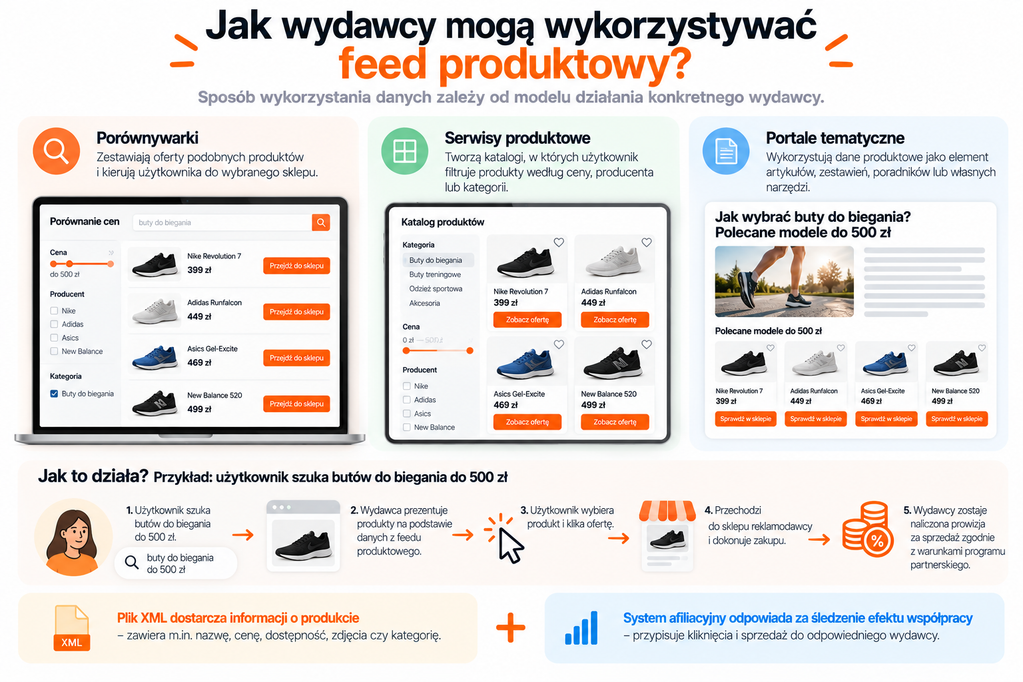
Let’s assume a user is looking for running shoes priced under PLN 500. Based on data from the feeds of different stores, a publisher can present models that meet specific criteria. The user selects a product, clicks the offer, and is redirected to the advertiser’s store. If the visit is correctly attributed to the publisher and the user completes a purchase in accordance with the affiliate program rules, the publisher may earn a commission. In this scenario, the XML file provides product information, while the affiliate system is responsible for tracking the results of the collaboration. These are two separate elements that together make it possible to build a scalable model for promoting the offer.
Advertisers often wonder what they can do to encourage more publishers to actively promote their affiliate program. Of course, factors such as commission rates, brand recognition, product appeal, and partnership terms all matter. However, the tools available to partners are important as well. If two advertisers offer a similar product range, but one provides a complete and regularly updated feed while the other requires product information to be collected manually, the first program will simply be easier for some publishers to implement. This is particularly important for partners working with large product catalogs. With only a few products, manual updates may not be a problem. With several thousand or tens of thousands of items, automation becomes essential for efficient operations.
An XML file can therefore be treated as part of the affiliate program infrastructure – just like affiliate links, advertising materials, information about promotions, or discount codes.
Give Publishers the Right Tools and Help Them Promote Your Products More Effectively
Problems with a feed are not always obvious. Sometimes everything works correctly from a technical perspective, but the quality of the data prevents publishers from using the offer effectively. One common issue is outdated prices and availability. Other problems include missing images, low-quality images, incorrect product URLs, unclear product names, and incomplete categories.
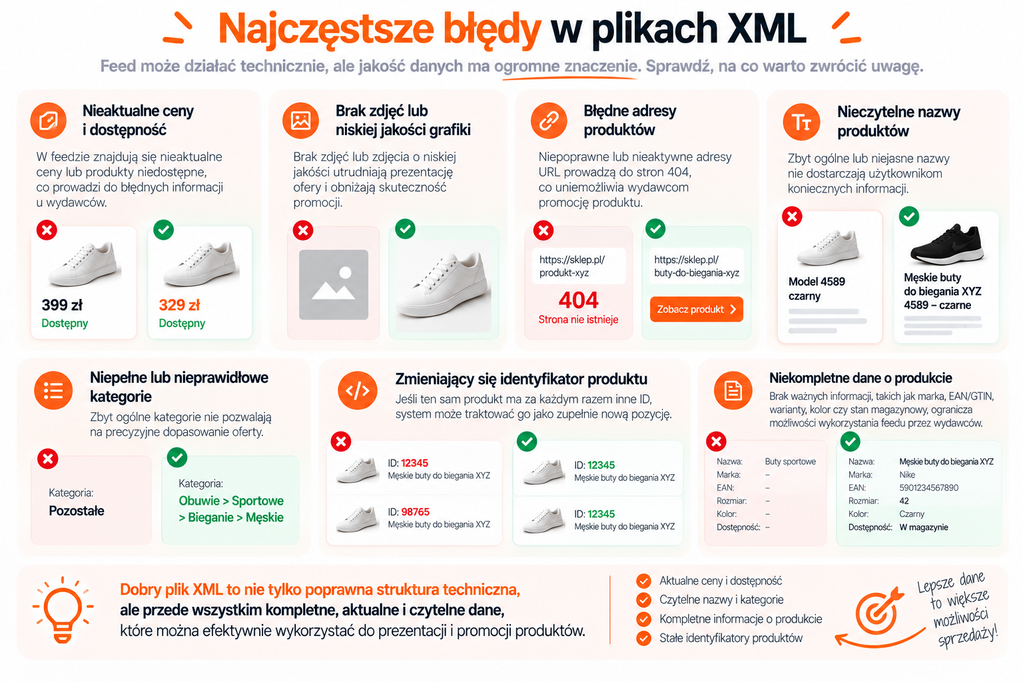
Another problem may be a changing identifier for the same product. If the system receives a different ID every time the feed is generated, it may treat an existing product as a completely new item. It is also worth paying attention to the category structure. A category name such as:
“Footwear > Sports > Running > Men’s”
provides an external system with much more information than simply:
“Other”.
The same applies to product names. “Model 4589 black” may be understandable within the store’s internal system, but outside of it, it says very little. “Men’s XYZ 4589 Running Shoes – Black” provides much more context. A good feed should therefore be more than just technically correct. It should provide data that can actually be used to present and promote products effectively.
A store’s offer is constantly changing. Prices, promotions, availability, images, variants, and the product range itself all evolve over time. The product feed should reflect these changes. That is why, once it has been launched, it is worth regularly checking whether the data is still being generated correctly.
A sudden drop in the number of products in the feed, a large number of items without images, missing prices, or URLs leading to 404 pages can all be useful warning signs. It is also worth checking whether unavailable products are marked according to the agreed structure and whether promotions appear in the data at the right time. This matters not only from a technical perspective. If users repeatedly arrive from a partner’s website at unavailable products or see a different price after reaching the store, the issue also affects trust, conversion rate, and the overall effectiveness of the campaign.
Make It Easier for Publishers to Promote Your Offer
Not always.
A store with only a few products and working exclusively with individual creators may not need an extensive product feed. An influencer promoting one specific cosmetic product can easily use a prepared product link.
The situation changes as the business scales. The larger the catalog, the more frequent the price changes, and the broader the group of partners using product data, the more valuable automation becomes. For stores with hundreds or thousands of products, an XML file can make it much easier to provide partners with an up-to-date offer. There is no point in creating a feed simply because “every e-commerce business should have one.” The first question should be who will use it and what data that person or system actually needs.
An affiliate program becomes more attractive to publishers when the advertiser provides not only the opportunity to earn commission, but also the right promotional tools. For one publisher, a discount code may be the most important asset. Another may need banners. A creator may rely mainly on deeplinks leading to specific products, while a comparison website or product-focused service may need an XML file containing the store’s full product catalog. This is an important distinction.
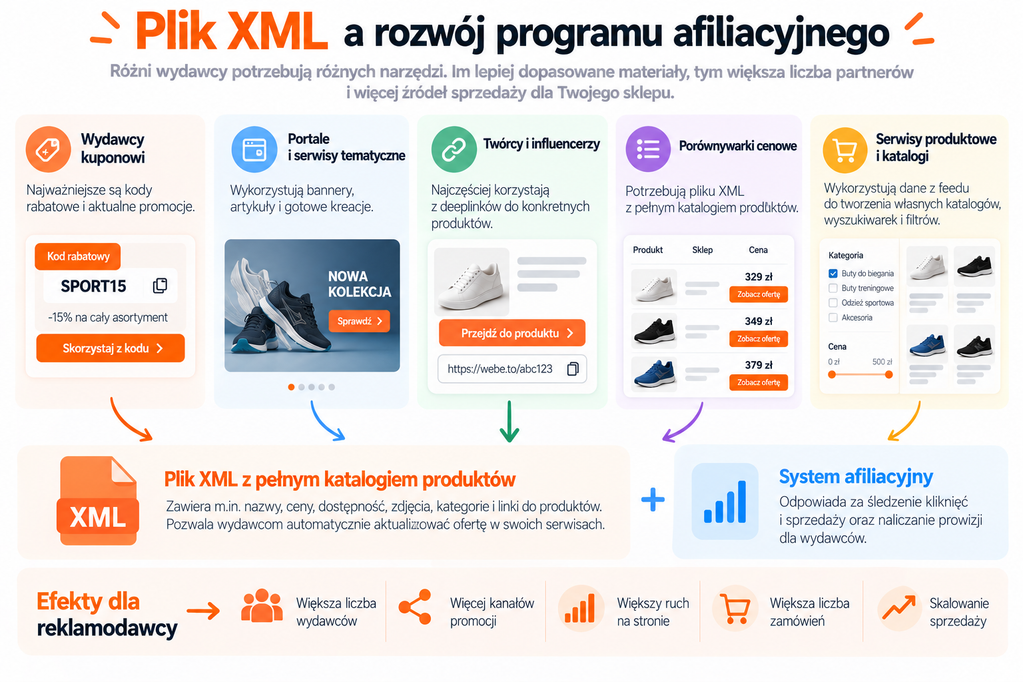
The goal is not simply to provide as many promotional materials as possible, but to create conditions that allow different types of partners to promote the offer in a way that matches their business model. This enables the advertiser to gradually expand the program with new publishers and additional sources of sales.
With WebeAds, advertisers can launch an affiliate program and provide publishers with the tools they need to promote their offer. For stores with a large product range, one of these resources can be a product feed.
Publishers can then use the offer in line with their business model and the terms of the specific program, directing interested users to the store through affiliate links. This gives advertisers the opportunity to grow sales beyond their own marketing channels, while compensation can be tied to the result generated – for example, a sale in the CPS model.
An XML file does not sell products on its own. However, it makes it much easier for partners to use the store’s offer and direct potential customers to it.
Your Product Catalog Can Reach Further
At first glance, an XML file may seem like a topic intended primarily for developers. From an advertiser’s perspective, however, its importance is highly practical.
It helps organize the product catalog, automatically transfer data to external systems, and reduce the need to manually update thousands of offers. A well-prepared feed can support comparison websites, product-focused services, and affiliate publishers. What matters most is not simply having the file itself, but the quality, completeness, and freshness of the data it contains. If you want to grow sales through external partners, it is worth treating the product feed as one of the tools that can make their work easier.
Join WebeAds, launch an affiliate program, and make your offer available to publishers who can turn product data into an additional source of traffic and sales.