

In today’s dynamic world of e-commerce, online store owners face the challenge of increasing traffic to their website and improving brand recognition. Effective marketing tools that are easy to use are becoming essential. An XML file, as one of these tools, plays an important role in affiliate marketing, making it easier to cooperate with price comparison websites and product search engines. In this article, we explain what an XML file is, what data it contains, and how it can be used to meet the challenges of the e-commerce market.
The name XML comes from the English term Extensible Markup Language (source). It is a type of language used to clearly present various data. An XML file, also known as a product feed, is a type of online document that contains all the most important data about each product available in a given online store.
A product feed contains a list of products with a specific set of attributes, which vary depending on the assortment. Different features will matter to someone buying a dress for a wedding, and different ones to someone looking for a mattress for a child. XML files are primarily used by price comparison websites and product search engines, which can significantly improve the effectiveness of a business program.
What data is included in an XML file? A product feed describes the key features of each product, most often these include:
It should be remembered that this is not a rule — what is included in an XML file depends on the industry and the offer of a given store.
An XML file is a must-have for every online store. It allows you to control the most important elements of your product offer and automate some of the processes taking place in the store. In affiliate marketing, its role is especially important because it enables cooperation with price comparison websites, online marketplaces, and product search engines. Thanks to the XML file, these publishers receive detailed information about which products are included in a given store’s offer.
Stores use different schemas to share XML files. Their structure is determined by the market, meaning the biggest players such as Ceneo or Google Shopping. It is worth knowing that preparing a product feed according to one of these schemas does not limit access to it only to a specific portal. If the file is properly prepared, it can be used by any publisher. Websites provide special instructions that significantly simplify the process of generating XML files.
A product feed contains a detailed store offer, from which information such as size, color, or material can be extracted. As I mentioned earlier, it is not possible to clearly impose what exactly should be included in it. This depends entirely on the specifics of the assortment offered by the store. Below is an example fragment of a correctly generated XML file from one of the stores in the clothing industry:
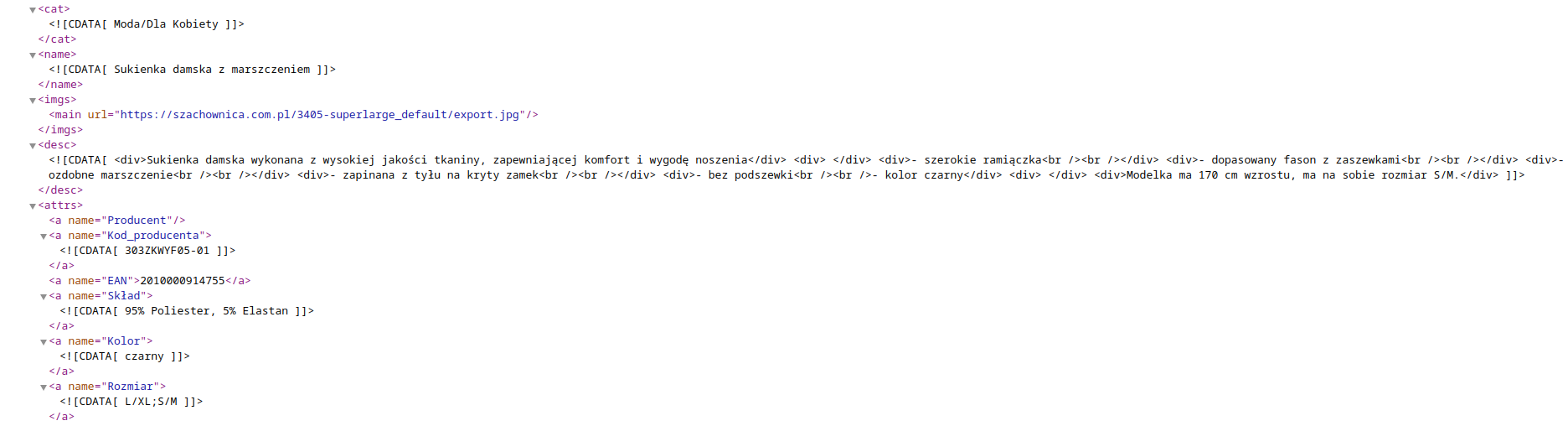
The more details included in the file, the better. From this short fragment, we can extract all the key data about one of the dresses: category, name, description, manufacturer information, composition, color, or size. Importantly, the XML file also contains a link to the image. The example provided was created using the Ceneo schema.
Thanks to XML files, publishers can quickly search and filter information about a store’s offer. Analyzing a product feed makes it possible to compare offers and prices, as well as search for niche products. An XML file also allows for more diverse ways of presenting a store’s product offer in publishers’ channels and for creating widgets.
A product feed is most often available in XML format, while CSV format is less common. It can be opened using:
Every advertiser cooperating with our network is required to provide an XML file. To do this, you need to generate a product feed in your store’s panel and carefully check whether it contains any errors. If not, simply send it to the program manager, who will upload the file to the advertiser’s panel. The XML will be visible to publishers immediately after being added.
Advertisers are relieved to learn that XML files update automatically. This means there is no need to add new files every time a price or product changes.
Here are some of the most important points to pay special attention to:
XML files are one of the most important tools in affiliate marketing. Alongside affiliate links and discount codes, they are the foundation of cooperation with publishers. However, handling them requires slightly more knowledge of programming or website development. But don’t worry, we are always happy to answer any questions and help clear up any doubts!