

Imagine two situations. In the first, you see a product advertisement with the message: “the best choice in its category.” In the second, a friend tells you: “I’ve been using it for several months and it’s really worth it.” Which message would you trust more? This is exactly the mechanism behind word-of-mouth marketing. People have always shared their experiences with products, stores, and services. The internet has simply increased the scale of this phenomenon. In the past, a recommendation might reach a few friends. Today, a single opinion, review, TikTok video, or social media discussion can reach thousands of potential customers. This is extremely important for advertisers, because the purchasing decision increasingly does not end with exposure to an ad. A consumer may see a product on Google or Instagram, then check reviews, watch a YouTube video, read comments from other users, and compare the experiences of several people. Only then do they make a decision.
BrightLocal research shows the scale of the importance of online recommendations: in a study on consumer behavior, 97% of respondents said they used online reviews when making decisions about local businesses, while 74% looked for reviews in at least two places. The data mainly concerns local businesses and should not be automatically applied to the entire e-commerce sector, but it clearly shows how natural it has become for consumers to check other people’s experiences as part of the decision-making process. That is why the question for a brand is no longer only: “How can we reach more customers?” An equally important one is: “What will a potential customer hear about our brand before deciding to buy?”
Word-of-mouth marketing (WOM) refers to activities that use recommendations, conversations, and opinions about a brand, product, or service. Its greatest strength is that the message does not have to come directly from the advertiser.
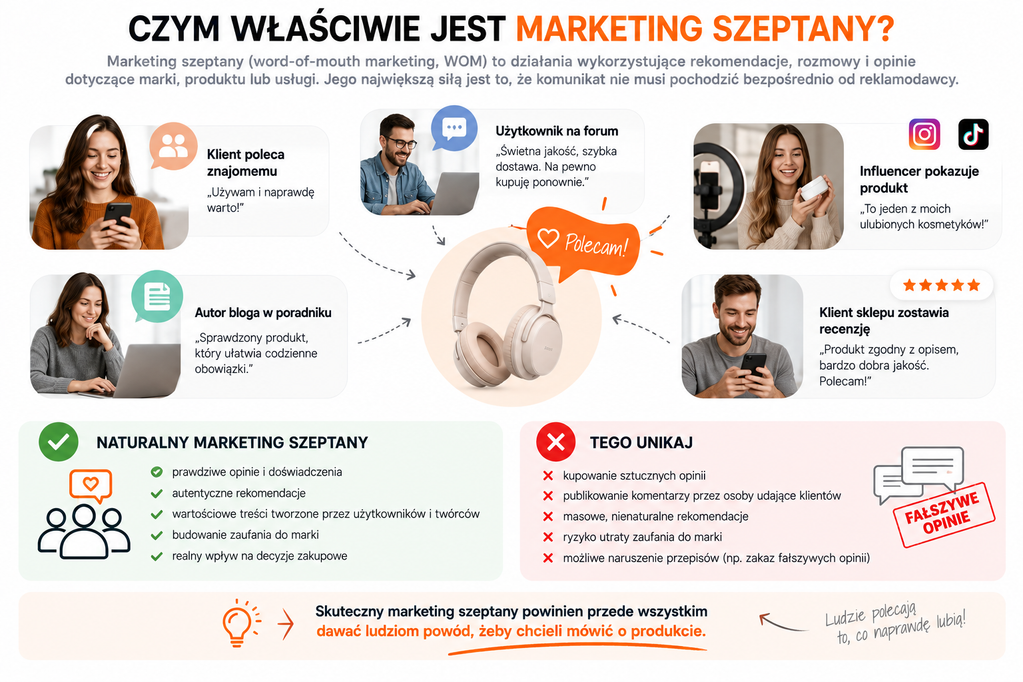
A customer may recommend a product to a friend. A user may describe their experience on a forum. An influencer may show a cosmetic product they genuinely use. A blog author may include a specific product in a guide, while a store customer may leave a detailed review that helps others make a decision. All of these situations create touchpoints where the product is being discussed by someone other than the brand itself. However, two things should be clearly separated from the start. Word-of-mouth marketing should not be confused with buying hundreds of fake reviews or publishing comments through people pretending to be customers. Instead of building trust, such activities can have the opposite effect – damaging the brand’s credibility and, in certain cases, also violating consumer protection regulations. EU rules prohibit, among other things, publishing or commissioning fake consumer reviews for the purpose of promoting products. Effective word-of-mouth marketing should therefore primarily give people a reason to want to talk about the product.
Advertisers are in a specific position. They can say that their product is comfortable, effective, durable, or worth the price. However, consumers are fully aware that the purpose of this message is to sell. A recommendation from another user works differently.
Let’s assume someone wants to buy a robot vacuum cleaner for PLN 2,500. The manufacturer highlights strong suction power, intelligent room mapping, and automatic dustbin emptying. These are important details, but before spending several thousand złoty, the customer may want to know more. Does the device really handle pet hair well? Is the app easy to use? Does the robot get stuck under furniture? What is it like after six months of use? These are the kinds of questions that are often answered by other customers, reviewers, and online creators. Their experience reduces the uncertainty that comes with making a purchase.
That is why word-of-mouth marketing can work particularly well when a product requires careful consideration, comparison of different options, or trust-building. It does not replace the information provided by the brand, but it can give consumers something that traditional advertising cannot create on its own – social proof that the advertising promise is backed by the real experiences of other people.
Turn Recommendations Into Sales. Launch an Affiliate Program With WebeAds
One of the biggest mistakes is starting the strategy with the question: “where can we write about our product?” A much better question is: “why would someone want to recommend it?” The reason may be exceptional quality, solving a specific problem, interesting design, outstanding customer service, fast delivery, an attractive price, or simply an experience that the customer wants to share with others.
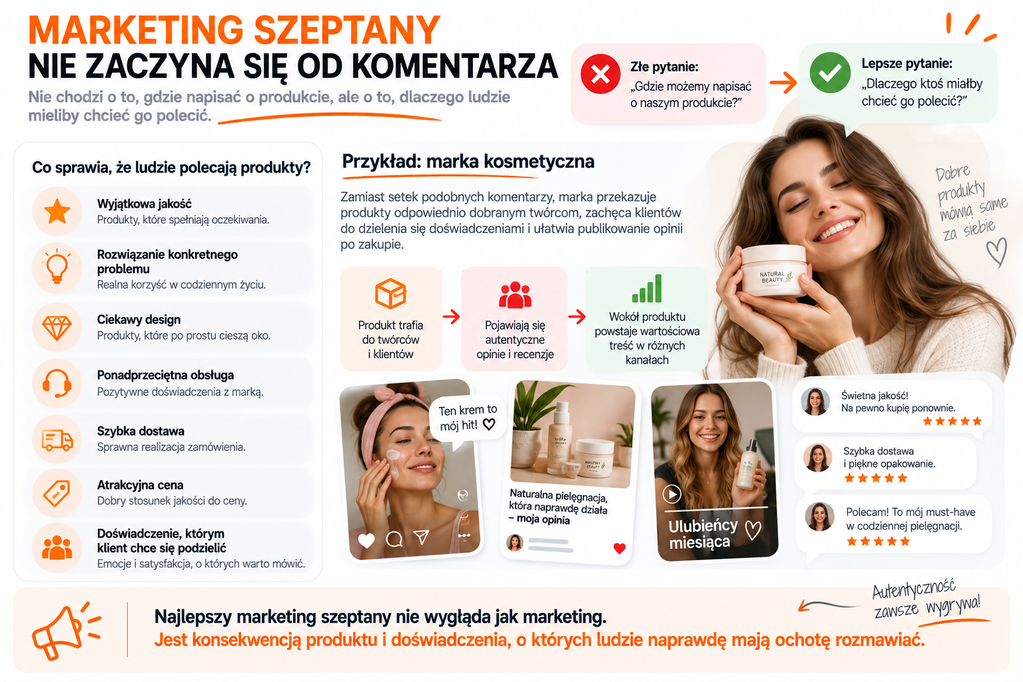
A good example is a cosmetics store launching a new product line. Instead of publishing dozens of similar comments in different places, the brand can provide products to carefully selected creators, encourage customers to share their experiences, and make it easier to leave reviews after purchase. As a result, content around the product begins to emerge from different people and across different channels. This is much more difficult than ordering a package of comments. But that is exactly why it can be much more valuable.
The best word-of-mouth marketing does not look like marketing. It is the result of a product and experience that people genuinely want to talk about.
Just over a decade ago, word-of-mouth marketing was associated mainly with online forums. Today, recommendations are scattered across the entire customer journey. Consumers may come across an opinion about a product in comments under a YouTube video, a Facebook group, influencer content, a store’s review section, a guide article, a review website, or a social media discussion. The form of recommendations has also changed. It no longer has to be a simple statement such as “I recommend this product.” A video showing the product in everyday use, a comparison of two models, or an answer to a specific audience question can provide much greater value.
Let’s assume a brand sells coffee machines. A potential customer may first see a short video showing how to make a cappuccino, then watch a full review of the device, read comments from people who own that model, and finally come across a ranking of coffee machines. Each of these pieces of content can move them one step closer to making a purchase. That is why modern word-of-mouth marketing should be understood more broadly – as an ecosystem of recommendations and experiences that appear wherever consumers look for information before making a decision.
In recommendation-based marketing, follower count should not be the most important criterion when choosing a partner. What matters far more is who is on the other side of the screen and what kind of relationship the creator has built with their community.
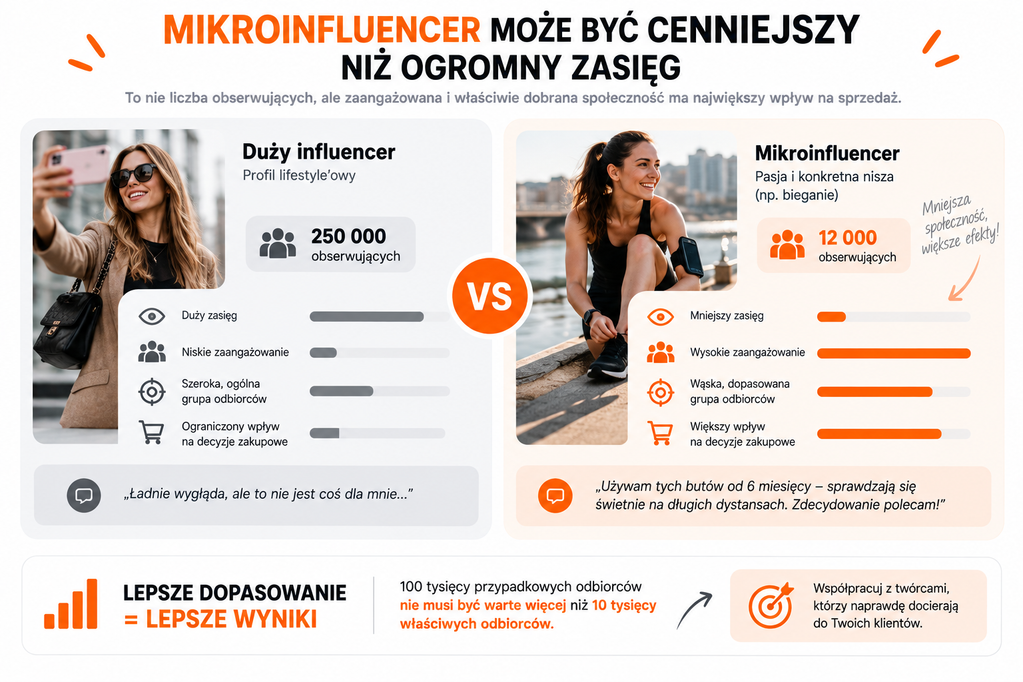
Imagine a brand producing professional running accessories. It can start working with a large lifestyle profile reaching several hundred thousand people, or with a smaller creator whose community consists mainly of runners preparing for half marathons and marathons. The second creator may generate significantly less reach, but their recommendation reaches people interested in exactly that product category. This is one of the reasons behind the growing importance of micro- and nano-influencers. IAB Polska highlights their smaller, but often more engaged communities and their potential to influence purchasing decisions. At the same time, the industry is shifting away from one-off collaborations focused mainly on reach toward more long-term relationships with creators.
For advertisers, the conclusion is simple: 100,000 random recipients do not necessarily have to be worth more than 10,000 relevant ones.
This is where an important boundary appears that advertisers should not overlook. If a consumer buys a product on their own and spontaneously shares their experience, that is a different situation from one in which a brand provides an influencer with payment, a product, or a service in exchange for a publication. UOKiK states that if a creator receives a material benefit for promoting a product or service, the content should be properly labeled as advertising material. This also applies to barter collaborations. The disclosure should be clear, unambiguous, and easy for the audience to understand. Importantly, disclosing an advertising collaboration does not make the recommendation inauthentic. An influencer can receive a product for testing and still present their own genuine experience. The problem begins when the audience is led to believe they are seeing a spontaneous opinion when, in reality, they are viewing paid promotion.
Find Publishers Who Will Reach the Right Audience With Your Brand
In the long term, it is therefore more beneficial to build transparency than to try to hide the commercial nature of a collaboration. After all, trust is the main currency of word-of-mouth marketing.
This is one of the biggest challenges in word-of-mouth marketing. A brand sends products to creators, reviews, comments, and discussions start appearing, but after a few weeks it can be difficult to answer a simple question: how much business value did this actually generate?
In a brand awareness campaign, you can analyze reach, the number of publications, brand mentions, user reactions, or sentiment. However, if the goal is sales, it is worth going a step further and tracking website traffic, code usage, conversion, and order value. This is where the attribution challenge appears. A user may read a recommendation today, search for the brand on Google tomorrow, and buy the product only a week later. The number of likes under the original publication alone will not show the full impact of the recommendation. That is why it is becoming increasingly valuable to combine recommendation-based activities with mechanisms that make it possible to attribute specific results to specific partners. One such mechanism is affiliate marketing.
Word-of-mouth marketing helps answer the question: who can talk about our product in a credible way? Affiliate marketing adds a second question: does that recommendation lead to a measurable result?
An online creator, blogger, or owner of a niche website can include an individual affiliate link in their content. If the audience becomes interested in the recommendation, visits the store, and makes a purchase in accordance with the program rules, the transaction can be attributed to the relevant publisher. For advertisers, this changes the way collaboration is evaluated. Two creators may generate similar reach, but their impact on sales can be completely different. A profile with 100,000 followers may generate a large number of reactions, while a niche creator with an audience of 20,000 may deliver more valuable visits and transactions. Affiliate marketing therefore does not replace the power of recommendations. It adds a layer of measurability.
For the creator, it also creates an opportunity to move from a one-time payment for a publication to a longer-term collaboration. If their content continues to help customers make decisions and generates sales, they can earn commission from subsequent results. In this way, a simple “I recommend it” can become the beginning of a long-term partnership between the brand and the publisher.
The most valuable recommendations cannot simply be ordered. However, you can create the right conditions that give customers a reason to share their experience.
The foundation, of course, is the product itself and the quality of customer service. If a delivery arrives faster than expected, the packaging makes a great first impression, the product solves a specific problem, or the customer service experience is surprisingly positive, the chances increase that the customer will tell someone else about it. Word-of-mouth marketing therefore often begins long before the marketing department gets involved – it begins with the customer experience. A brand can also make it easier for customers to share their opinions. A post-purchase message asking for a review, the option to add photos and videos, reposting customer content, or running campaigns that encourage people to show the product in real-life use can all help generate more user-created content around the brand.
Join WebeAds and Turn the Power of Recommendations Into Real Sales Results
However, it is worth avoiding excessive control. If every recommendation sounds identical and repeats the language used in the brand’s advertising materials, it quickly loses its greatest advantage – credibility.
A large number of publications within just a few days can give a brand visibility, but it will not necessarily build a lasting presence in consumers’ minds.
Imagine the launch of a new supplement. The brand sends the product to 100 creators, who publish similar content almost simultaneously. For a week, the product is everywhere. A month later, almost no one is talking about it anymore. An alternative is to develop collaborations with a smaller group of well-matched partners. A creator first introduces the product, then returns to it in everyday content, answers audience questions, and after a few weeks can share a more detailed opinion. The recommendation then becomes part of their content rather than a one-off advertisement. From the advertiser’s perspective, what is particularly valuable is being able to identify which partners actually influence audience behavior. If specific creators consistently generate interest, traffic, and sales, it is worth developing those relationships instead of starting the search from scratch every time. This is where word-of-mouth marketing can naturally evolve into a long-term affiliate partnership.
Fake reviews may temporarily increase the number of positive comments, but they do not build a real competitive advantage for the brand. What is more, consumers are increasingly paying attention to repetitive wording, unnaturally enthusiastic ratings, or a sudden flood of similar reviews.
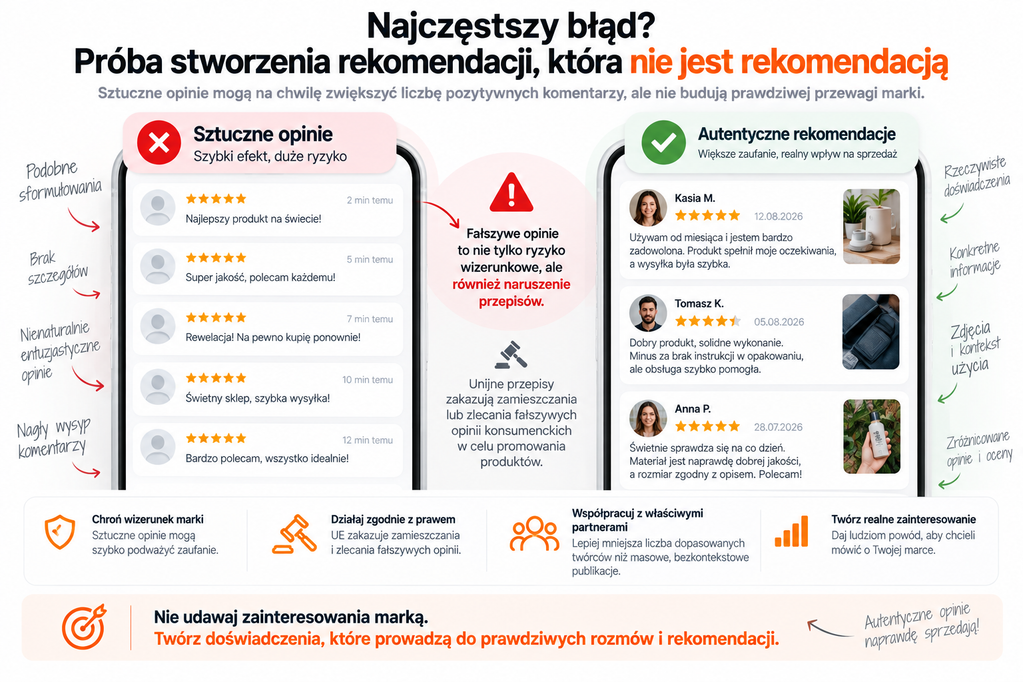
The risk is not limited to brand image. EU regulations require businesses to take reasonable and proportionate steps to verify whether displayed reviews come from consumers who have actually used or purchased the product. Publishing or commissioning fake consumer reviews and recommendations for the purpose of promoting products is also prohibited. That is why a word-of-mouth marketing strategy should move in the opposite direction: instead of pretending there is interest in the brand, it should create genuine interest that leads to real conversations and recommendations.
This is also an argument for carefully selecting influencers and publishers. It is better to work with a smaller number of partners whose audiences genuinely match the product than to generate a large volume of publications with little or no context.
If a brand wants to develop recommendation-based activities, scale quickly becomes a challenge. It is necessary to find the right partners, provide them with materials, create links, track generated transactions, and settle the results.
An affiliate network helps organize this process. With WebeAds, an advertiser can launch an affiliate program and develop cooperation with different types of online publishers. They can reach potential customers through their own websites, content, communities, and other promotional channels.
The most important difference, however, appears at the measurement stage. Instead of limiting the evaluation of a collaboration to views, likes, or comments, the advertiser can also observe whether partner activities lead to specific results. In the CPS model, publisher compensation can be directly linked to generated sales. This gives partners who are able to convince their audiences to buy an additional incentive to continue promoting the brand. Recommendations build interest. Affiliate marketing makes it possible to see whether that interest turns into sales.
Word-of-mouth marketing should not be about a brand trying to speak about itself through the voices of its customers. Its real value emerges when consumers, creators, and partners have a genuine reason to share their own experiences.
A good recommendation can dispel doubts, answer questions, show the product in real-life use, and provide social proof exactly when a potential customer is considering a purchase. For advertisers, however, the next step should be moving beyond simply generating conversations toward measuring their business impact. Which content attracts valuable users? Which creators generate sales? Which collaborations are worth developing? Combining recommendations with affiliate marketing helps answer these questions.
Join WebeAds and develop partnerships with publishers who not only talk about your brand, but can also genuinely support its sales.