
Influencer marketing has undergone a major transformation in recent years. Not long ago, the success of a collaboration with an online creator was assessed primarily based on the number of followers, views, likes, and comments. Today, advertisers increasingly expect more: sales, leads, new customers, and a measurable return on investment.
This is an important shift, especially for e-commerce. A brand can generate hundreds of thousands of views on a reel, but if the campaign does not guide the user toward the next step, high reach remains primarily a statistic. That is why effective influencer marketing should be designed not only around engaging content, but also around a specific business goal. The importance of creators in brand strategies continues to grow. As early as 2025, more than half of the brands analyzed planned to increase their influencer marketing budgets, while some companies allocated as much as 30-50% of their marketing spend to collaborations with creators. At the same time, long-term partnerships, authenticity, and smaller, specialized creators are becoming increasingly important.
So how can influencers be used not only to build brand awareness, but also to increase sales? The key is to combine the creator’s credibility with the measurability of performance marketing.
One of the most common mistakes advertisers make is starting the influencer selection process by looking at follower count. A profile with 500,000 followers may look attractive in a campaign presentation, but a large community does not automatically mean a large number of customers.
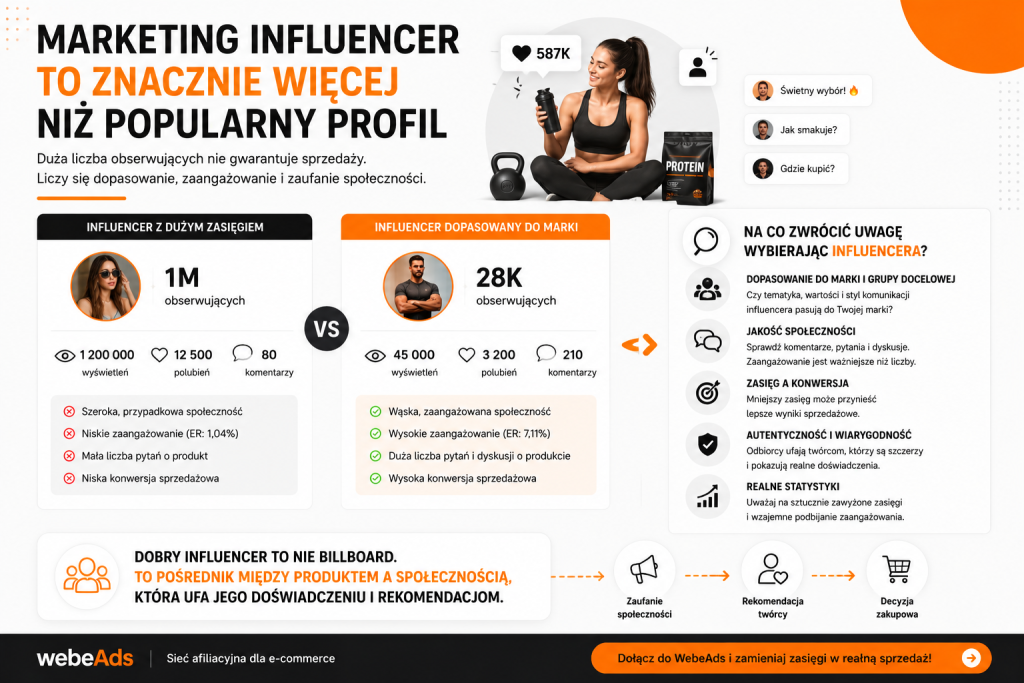
What matters far more is how well the creator matches the brand and its target audience. A store selling specialized sports equipment may achieve better results by working with several smaller creators focused on a specific discipline than with a single celebrity followed by one million people interested in completely different topics. The quality of the community also matters. It is worth checking whether followers actually comment on posts, ask questions about products, and respond to recommendations. The number of likes alone should not be treated as proof of effectiveness. Economic research has even highlighted the phenomenon of influencer groups artificially boosting one another’s engagement, which further shows why advertisers should look beyond basic profile statistics. A good influencer is therefore not merely an advertising space for a brand. They are an intermediary between the product and a community that trusts their experience, opinions, and communication style.
The biggest advantage of influencer marketing over many traditional advertising formats is context. Users do not see only a product on a banner. They can see how a creator uses it during a workout, decorates a home with it, tests a cosmetic product for several weeks, or compares a device with other models. As a result, the product stops being an abstract store offer and starts functioning in a real-life situation.
Imagine a cosmetics brand launching a new serum. A traditional advertisement can show the packaging, price, and several key features. An influencer, however, can explain why they chose the product, show its texture, demonstrate how to apply it, and present the results of using it. As a result, the audience receives much more information needed to make a purchasing decision. This is exactly why micro- and nano-influencers. are particularly interesting. A smaller profile does not necessarily mean less value for the advertiser. In 2026, the importance of micro-influencers continues to grow, as brands are paying increasing attention to relevance, authenticity, and community quality rather than profile size alone.
Imagine a campaign in which an influencer publishes a reel that reaches 300,000 views. The content receives thousands of likes and hundreds of comments. Was the campaign successful? Without additional data, it is difficult to say.
If the goal was to increase brand awareness, such a result could be very valuable. However, if the campaign was intended to increase sales, the advertiser should also know how many users visited the store, how many people made a purchase, what value of orders was generated, and what the customer acquisition cost was. That is why modern influencer marketing is moving increasingly closer to performance marketing. Affiliate links, individual discount codes, and tracking make it possible to connect a creator’s specific activity with user actions.
Instead of ending the report with the statement:
“The campaign generated 500,000 views.”
the advertiser can analyze:
“This creator generated 420 transactions of a specific value.”
And this is exactly where influencer marketing naturally begins to connect with affiliate marketing.
The affiliate model solves one of the biggest problems of traditional influencer campaigns: the difficulty of linking a specific creator’s activities to sales. The mechanism is relatively simple. The influencer joins the brand’s affiliate program and receives an individual link or code. They then present the product to their community in a format that feels natural to them: this could be a review, reel, guide, Stories, YouTube video, or blog post.
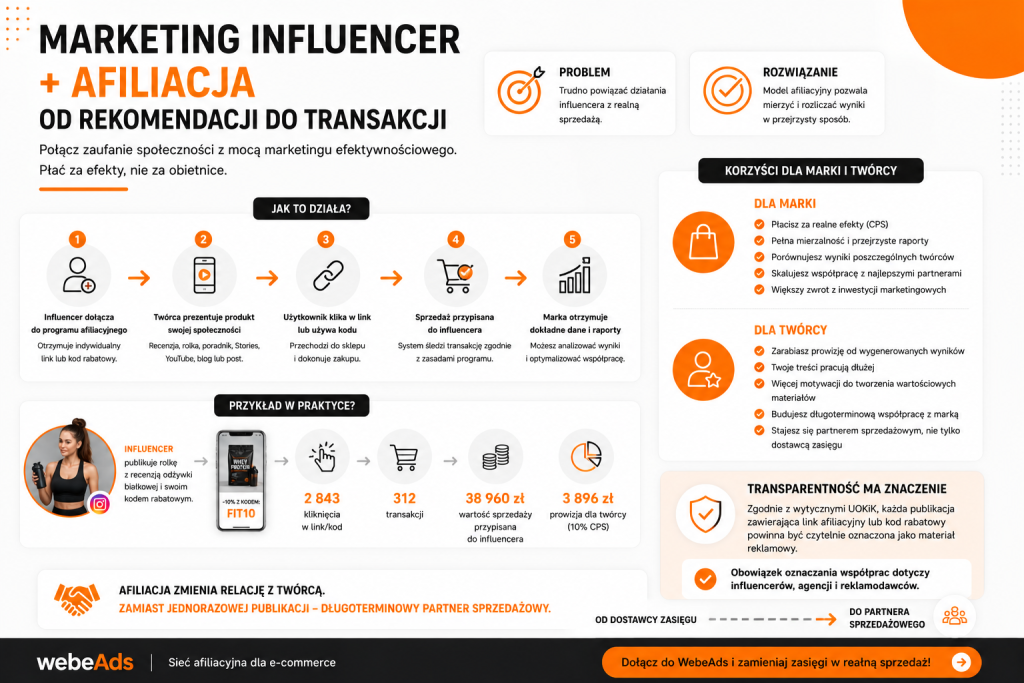
If a user follows the assigned link and completes a specified action, the system can attribute the result to the relevant source according to the program rules. This gives the advertiser access to data that makes it possible to assess the business value of the collaboration much more accurately. The creator also benefits from this model. Instead of receiving a one-time payment for a publication, they can earn commission based on the results they generate. Good content can therefore continue delivering value long after the first few hours following publication. This approach changes the relationship between the brand and the influencer. The creator is no longer just a provider of reach and can become a long-term sales partner. Transparency is also important. The Polish Office of Competition and Consumer Protection (UOKiK) indicates that a publication containing an affiliate link should be clearly labeled as advertising content, because the influencer may receive a financial benefit from the resulting sales. The obligation to clearly and unambiguously disclose commercial collaborations applies not only to influencers, but also to agencies and advertisers.
Choosing the right creator is one of the most important elements of a campaign. A large follower count may look attractive, but from an advertiser’s perspective, what matters far more is who is actually on the other side of the screen.
For example, a store selling professional running accessories may achieve better results by collaborating with a creator who has 30,000 active followers interested in sports than with a lifestyle influencer who has several hundred thousand followers. Before starting a collaboration, it is therefore worth analyzing not only the size of the profile, but also the topics covered in the content, the quality of comments, the frequency of sponsored collaborations, and how well the audience matches the brand’s target group. The ability to create sales-oriented content without making it feel overly promotional is also important. A good influencer can explain why they use the product, what problem it solves, and who it may be useful for. This type of content can have significantly greater value than simply showing the product in front of the camera.
One of the mistakes in influencer marketing is treating every collaboration as a one-off activity: the brand sends a product, the influencer publishes the content, and the campaign ends.
Audience trust is built through repetition. If a creator shows a product only once, the recommendation may be perceived as just another advertising campaign. If they use it regularly and return to it in subsequent content, the communication becomes more credible. Long-term collaboration also allows the advertiser to collect data. After several weeks or months, it becomes possible to identify which influencers generate traffic, sales, and new customers, and then scale cooperation with the best-performing partners. The affiliate model supports this approach particularly well. The creator is motivated to continue promoting the product even after the initial campaign ends, because additional transactions can mean additional commissions. From the advertiser’s perspective, this means moving away from buying individual publications toward building a network of ambassadors and sales partners.
Even a large budget does not guarantee success if the campaign is poorly planned. The first problem is the one already mentioned: focusing solely on follower count. Reach is important, but it does not show whether the creator’s audience actually matches the brand’s target group.
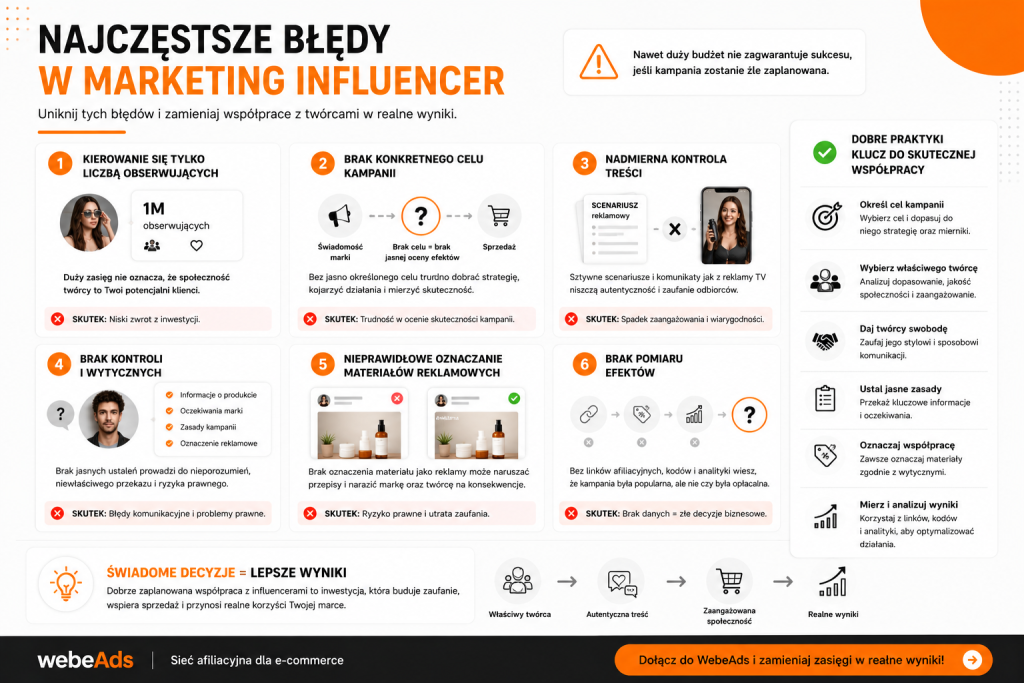
The second mistake is the lack of a specific goal. A campaign focused on brand awareness should be evaluated differently from a collaboration whose main objective is sales. If the advertiser does not define the goal before launching the campaign, assessing its effectiveness later will be very difficult. Another problem is excessive control over the content. Influencers understand how to communicate with their communities. Giving them a script that sounds like a traditional TV commercial can destroy the greatest advantage of the collaboration, which is authenticity. At the other end of the spectrum is a lack of control. The creator should know which product information is essential, what the brand expects, and what the campaign rules are. It is also important to label advertising content correctly in accordance with applicable regulations. However, the biggest business mistake remains the lack of performance measurement. Without affiliate links, codes, proper analytics, or other measurement mechanisms, an advertiser may know that the campaign was popular, but not necessarily whether it was profitable.
There is no single metric that can determine whether a campaign was successful. It all depends on its objective. If a brand wants to increase awareness, important metrics include reach, content views, engagement, and growth in brand interest. In a sales-focused campaign, clicks, conversion rate, number of orders, sales value, and customer acquisition cost become far more important. With affiliate activities, it is possible to go even further and compare the performance of individual creators. An advertiser may find that influencer A generated a large number of clicks but few transactions, while influencer B achieved a much higher conversion rate despite generating less traffic. This is valuable information when planning future campaigns. Budgets and collaboration terms can then be gradually adjusted toward partners who deliver the most valuable customers. Influencer marketing then stops relying on intuition. It starts relying on data.
Searching for creators independently, negotiating collaboration terms, generating links, monitoring results, and settling campaign payments can be time-consuming, especially when a brand wants to work not with just a few, but with dozens or even hundreds of partners.
An affiliate network helps organize this process. As part of the WebeAds affiliate program, advertisers can develop partnerships with different publishers and use performance marketing as an additional sales channel. Influencers can be one part of such an ecosystem, alongside content websites, niche publishers, coupon sites, cashback platforms, and other affiliate partners. This means the brand does not have to base its entire strategy on a single influencer or one-off campaign. Instead, it can build a broader partner network, analyze the results generated, and scale the activities that genuinely contribute to achieving business goals. This is particularly important for e-commerce. Influencer marketing can build interest and trust, while affiliate marketing adds measurability and performance to the equation.
As a result, the advertiser’s question changes from:
“How many people saw our product?”
to a much more business-focused one:
“Which partners are helping us acquire customers and generate sales?”
Influencer marketing is no longer just a way to generate reach on social media. A well-planned collaboration can support the entire purchasing process: from the first contact with the product, through building trust, to the customer’s final decision. The key is to change the way advertisers think. Instead of choosing creators solely based on follower count, they should analyze audience fit, credibility, content quality, and above all, results. Combining influencer marketing with affiliate marketing makes it possible to measure the effects of collaboration and build long-term relationships with creators who not only showcase products, but can also support their sales. For advertisers, this means greater control over marketing activities, the ability to compare partner performance, and the opportunity to scale collaborations that deliver the best results.
Don’t Stop at Reach. Join WebeAds, launch your affiliate program, and start building a network of partners who help turn audience attention into real business results.