
For years, Facebook has remained one of the most important advertising channels for companies selling online. Although platforms such as TikTok and Instagram have attracted a great deal of attention in recent years, Facebook still brings together billions of active users and offers advertisers advanced tools for reaching potential customers with precision. For many online stores, it continues to be one of the pillars of their marketing strategy.
At the same time, the way people use the platform is changing. Users are becoming increasingly aware of advertising, making purchasing decisions more cautiously, and expecting valuable content instead of intrusive sales messages. Simply launching a campaign no longer guarantees high sales – what matters is a well-thought-out strategy, proper targeting, and the ability to combine different marketing channels effectively. It is also worth remembering that Facebook is not used only to acquire new customers. The platform also works very well for building brand awareness, promoting new products, maintaining relationships with existing customers, and running remarketing activities. It is this versatility that means Facebook Ads still ranks among the most widely used advertising systems in the world despite growing competition.
But is investing in Facebook advertising still worthwhile? How have user behaviors changed, and what can advertisers do to make their campaigns deliver real sales results? In this article, we will take a closer look at the current capabilities of Facebook Ads and explain why more and more advertisers are combining paid campaigns with affiliate marketing to maximize their return on investment.
Although social media is constantly evolving, Facebook remains one of the largest platforms in the world. According to the DataReportal Digital 2025 report, it has more than 3 billion monthly active users, making it the largest social media platform in terms of audience size. For advertisers, this means enormous potential to reach both local and international customers.
One of the biggest advantages of Facebook Ads is the ability to target ads with remarkable precision. Campaigns can be tailored based on age, location, interests, purchasing behavior, or previous interactions with the brand. This allows ads to reach people who are most likely to be interested in the offer, helping advertisers use their marketing budget more efficiently.
Facebook also offers a wide range of advertising formats – from traditional graphics and product carousels to video content, catalog campaigns, and lead generation ads. This makes it possible to tailor communication to the campaign objective and the customer’s stage in the purchasing journey. However, campaign success does not depend solely on algorithms or budget. The way users make purchasing decisions is becoming increasingly important. Their behavior is exactly why Facebook advertising is often only the beginning of the entire process leading to a sale.
Grow Your E-Commerce Business With WebeAds
Just a few years ago, many users would click an ad, go directly to an online store, and make a purchasing decision almost immediately. Today, the process looks very different. Consumers are more informed, compare offers, and look for reassurance that they are choosing the best product.
For example, a user notices an ad for a new robot vacuum cleaner while browsing Facebook. Interested in the offer, they visit the online store but do not complete the purchase. Instead, they start looking for reviews on Google, watch reviews on YouTube, check comments in Facebook groups, and then compare prices across several stores. Only after a few days or even weeks do they return and place an order.
Such behavior is not an exception, but the norm. According to Google research, consumers today use multiple touchpoints with a brand before deciding to make a purchase. Social media advertising often only initiates the process by building product awareness and encouraging further research. For advertisers, this means one thing – effective sales should not rely solely on a single campaign. The more valuable interactions a user has with a brand at different stages of the purchasing journey, the greater the chance that they will ultimately choose that particular offer.
Facebook Ads offers enormous opportunities, but even a well-prepared campaign will not deliver the expected results if it is based on the wrong assumptions. One of the most common problems is focusing solely on metrics such as impressions, clicks, or likes. High reach does not always translate into high sales. A campaign may generate thousands of website visits, but if users are not properly matched to the offer or the store fails to convince them to make a purchase, the business results will remain limited.
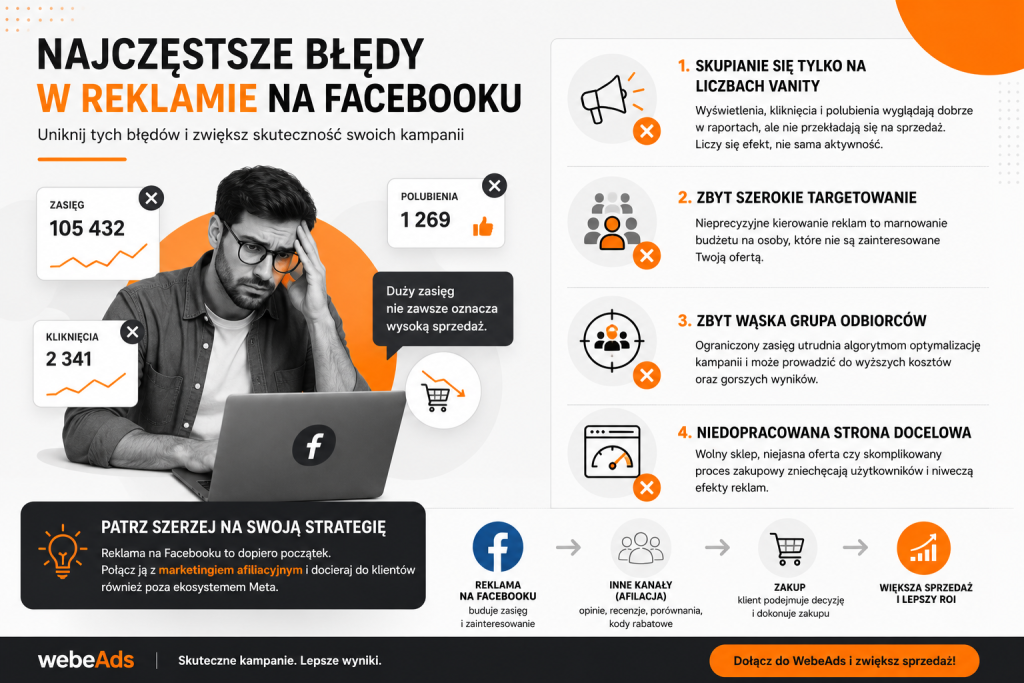
An equally common mistake is targeting ads to an audience that is too broad. The less precise the targeting, the greater the risk that the budget will be spent on people who will never become customers. On the other hand, an audience that is too narrow can also limit campaign effectiveness and make it more difficult for algorithms to optimize performance. The landing page should not be overlooked either. Even the best-prepared ad cannot compensate for a slow online store, a complicated purchasing process, or an unclear product presentation. Facebook is responsible for bringing users to the website, but the final purchasing decision is made within the online store.
That is why more and more companies view Facebook advertising not as a standalone sales tool, but as part of a broader marketing strategy. One of the most effective ways to complement it is affiliate marketing, which makes it possible to reach customers beyond the Meta ecosystem as well.
Facebook advertising works extremely well for building brand awareness and attracting new audiences. However, contact with an ad alone is increasingly not enough to convince a user to make a purchase. Customers need additional arguments – opinions, reviews, comparisons, or recommendations from people they trust. This is where affiliate marketing comes into play. Instead of relying solely on paid campaigns to drive sales, the brand gains support from partners who promote its products across different channels. These may include influencers, bloggers, niche websites, coupon platforms, price comparison sites, or newsletter creators. Each of them reaches audiences in a slightly different way and at a different stage of the purchasing process.
Imagine a user who clicked a Facebook ad but did not decide to make a purchase. A few days later, they come across a product review on a blog, then watch a YouTube test, and before completing the order, find a discount code on an affiliate website. Each of these touchpoints increases trust in the brand and brings the customer closer to making a purchasing decision. This is exactly why Facebook advertising and affiliate marketing do not compete with each other. On the contrary, they complement one another, creating a cohesive strategy that helps guide the user more effectively from the first interaction with the brand all the way to completing the transaction.
Reach Customers at Every Stage of the Purchasing Journey
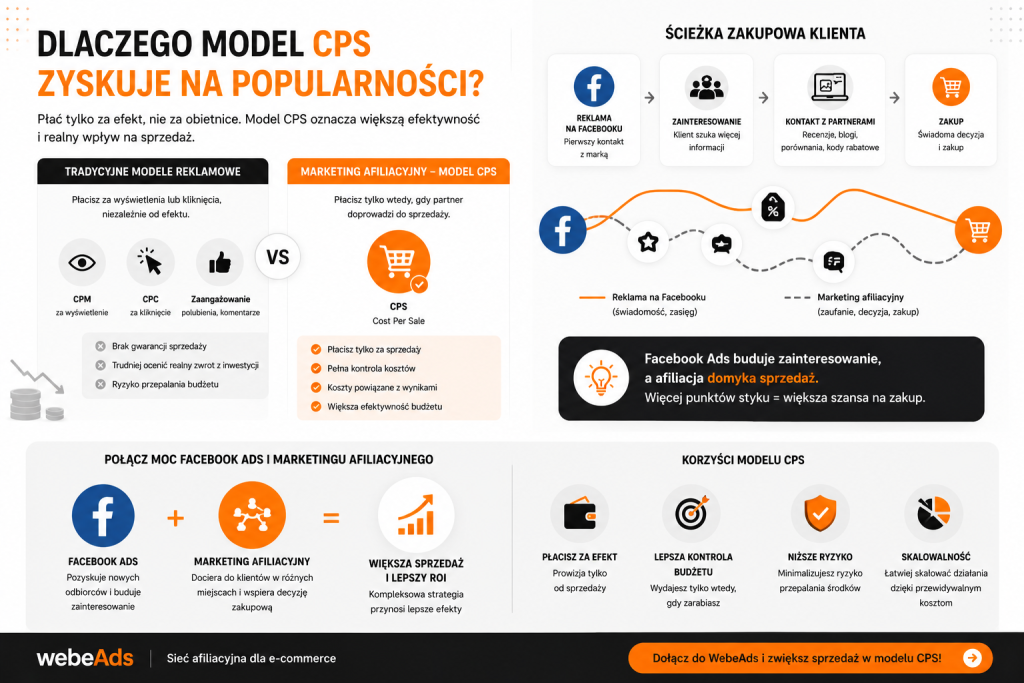
One of the reasons for the growing popularity of affiliate marketing is its payment model. In most advertising campaigns, the advertiser incurs a cost for an ad impression or click, regardless of whether the user ultimately makes a purchase. In affiliate marketing, the Cost Per Sale (CPS) model is most commonly used. This means that commission is charged only when the partner’s activities result in a sale. As a result, the marketing budget is spent more efficiently, and costs are directly linked to achieved results.
Of course, this does not mean that Facebook advertising should be abandoned. It is often responsible for the customer’s first contact with the brand and for building interest in the offer. Affiliate marketing, on the other hand, helps make better use of this potential by increasing the number of brand touchpoints and supporting the user at later stages of the purchasing journey. As a result, more and more online stores are choosing to combine both channels. Facebook Ads effectively attracts the attention of new audiences, while affiliate marketing helps turn that interest into real sales. With this approach, marketing activities become more comprehensive and deliver better results than running each channel separately.
Launching an affiliate program is not only about implementing the right sales tracking system. Equally important is access to publishers who know how to promote an offer effectively, as well as experience in campaign optimization. That is why many advertisers choose to work with an affiliate network.
WebeAds connects online stores with an extensive network of publishers representing different promotional models. Depending on campaign goals, offers can be promoted by influencers, online creators, bloggers, niche websites, coupon platforms, cashback sites, price comparison services, or partners specializing in content marketing. This allows the brand to reach customers across multiple touchpoints at the same time, increasing its chances of generating sales. Another major advantage of working with an affiliate network is full control over ongoing activities. Advertisers have access to detailed statistics, reports, and information about the performance of individual publishers. This makes it possible to continuously analyze campaign effectiveness and expand cooperation with partners who generate the best results.
Importantly, an affiliate program does not replace other marketing activities. The best results are achieved by brands that treat it as part of a broader strategy. Facebook advertising builds interest and attracts new audiences, while affiliate marketing helps maintain their attention and increase the likelihood of purchase.
See How to Increase Campaign Effectiveness
Despite the dynamic changes in the world of social media, Facebook advertising remains one of the most effective promotional tools for online stores. It offers enormous reach, advanced targeting capabilities, and a wide range of advertising formats, making it possible to reach new customers effectively. At the same time, it is worth remembering that today’s purchasing journey is far more complex than it was just a few years ago. Users compare offers, read opinions, watch reviews, and return to a product multiple times before deciding to make a purchase. For this reason, Facebook advertising alone is often not enough to fully leverage the sales potential of a campaign.
More and more advertisers are therefore choosing to combine Facebook Ads with affiliate marketing. This approach allows brands to build a presence at different stages of the purchasing process, reach customers through multiple channels, and use their marketing budget more efficiently. If you are looking for a way to increase sales through a performance-based model, join WebeAds. We will help you launch an affiliate program, reach trusted publishers, and grow sales with solutions tailored to the needs of your business.