
Online marketing today is not about choosing one channel and simply increasing the budget within it. A customer may first encounter a brand on Google, later see its product on Instagram, read an expert article, watch a review on YouTube, subscribe to a newsletter, and finally make a purchase after clicking an affiliate link. That is why the fundamentals of online marketing should be understood not as a list of tools, but as a system in which different channels perform different roles and work together to guide the user toward a purchasing decision.
The scale of the market shows just how important digital has become. According to the IAB Polska/PwC AdEx study, the value of online advertising in Poland reached PLN 10.9 billion in 2025, growing by 14.6% year over year. Almost all major formats recorded growth, with display advertising, video, and SEM accounting for a significant share of additional budgets. For advertisers, however, this also means greater competition for customer attention. Simply being present online is no longer a competitive advantage. What matters is whether the brand can reach the right audience, at the right moment, with a message tailored to the stage of their decision-making process.
Simply put, online marketing includes activities carried out online with the aim of building brand awareness, generating traffic, acquiring leads, and increasing sales. The most important areas include:
Each of these channels can serve a different purpose. SEO helps reach users who are actively searching for information. Social media helps build interest and strengthen the relationship with the brand. Google Ads makes it possible to quickly reach people with a specific intent, while affiliate marketing can increase sales through cooperation with independent publishers. That is why asking “which marketing channel is the best?” is the wrong question. A better one is: “What role should each channel play in the customer journey toward a purchase?”
One of the most common mistakes companies make when starting online marketing activities is choosing channels simply because “everyone is there.” A company creates a TikTok account, launches Facebook ads, invests in SEO, and sends newsletters, but never defines what each of these activities is actually supposed to achieve. In reality, the goals can be very different.
A new brand may primarily need greater awareness. An online store with high traffic but low sales should focus on improving conversion. A B2B company may need leads, while a mature e-commerce business may want to increase the share of returning customers and diversify its sales sources. Only after defining the goal should the tools be selected. If a company wants to increase sales here and now, it can use performance campaigns. If the priority is building visibility over the long term, SEO and content will be more important. If the goal is to reach new communities, the brand can work with influencers and affiliate publishers. Strategy should determine the choice of channel, not the other way around.
SEO helps increase a website’s visibility in organic search results, while content marketing provides users with content that answers their questions and meets their needs. These two areas very often work together. Let’s assume an online store sells professional coffee machines. Potential customers do not search Google only for the names of specific models. They also look for answers to questions such as:
“which automatic coffee machine should I choose?”,
“manual or automatic coffee machine?”,
“how to clean a coffee machine?”.
If a brand creates valuable content that answers these types of queries, it can reach customers long before the moment of purchase. The greatest advantage of content marketing is the ability to build long-term traffic and expert positioning. A good article, ranking, or guide can continue generating visits for many months or even years. However, this does not mean that every company should publish dozens of articles every month. What matters is quality, relevance to real customer questions, and connecting content with business goals.
Expand Your Marketing With an Additional Sales Channel
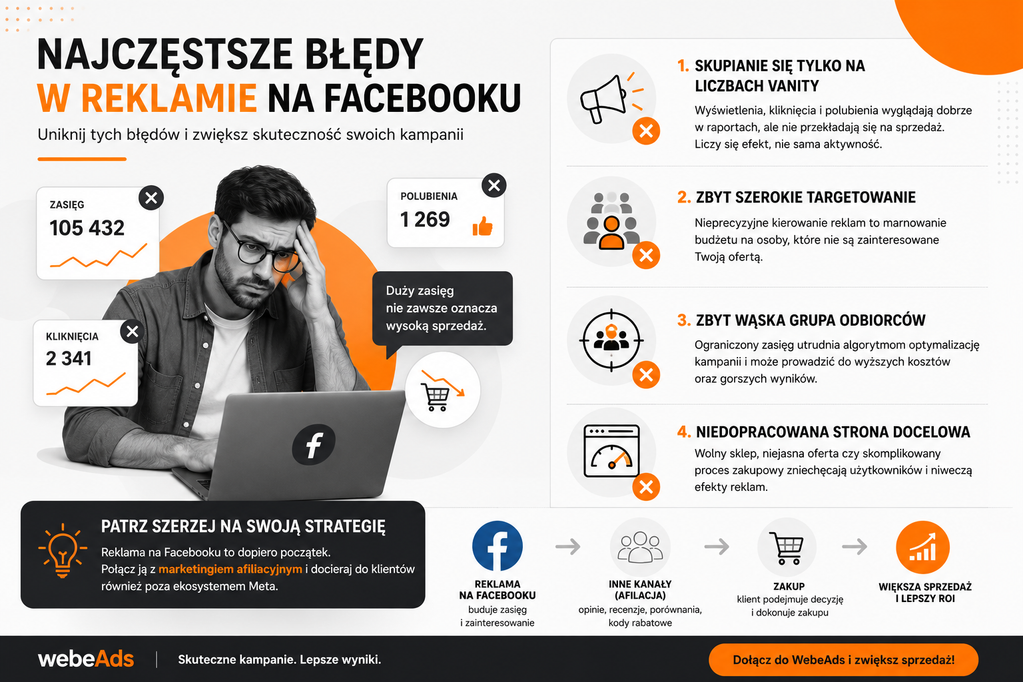
SEO takes time. Paid advertising, on the other hand, can bring users to an online store or landing page almost immediately. The most popular tools include Google Ads as well as campaigns on Meta, TikTok Ads, and LinkedIn Ads. Advertisers can reach users based on their search queries, interests, behaviors, or previous interactions with the brand. The greatest advantage of paid advertising is the ability to test quickly.
You can test:
However, it is important to remember that a click is not a business result. If a campaign generates a lot of traffic but users do not make purchases, increasing the budget may only increase the loss. That is why performance marketing should be evaluated using metrics such as customer acquisition cost, conversion rate, ROAS, and sales value, rather than CPC and the number of visits alone.
Social media today serves many more functions than simply building reach. It can inspire purchases, educate audiences, build communities, support customer service, and provide content that users share with others. However, not every brand needs to be present on every platform.
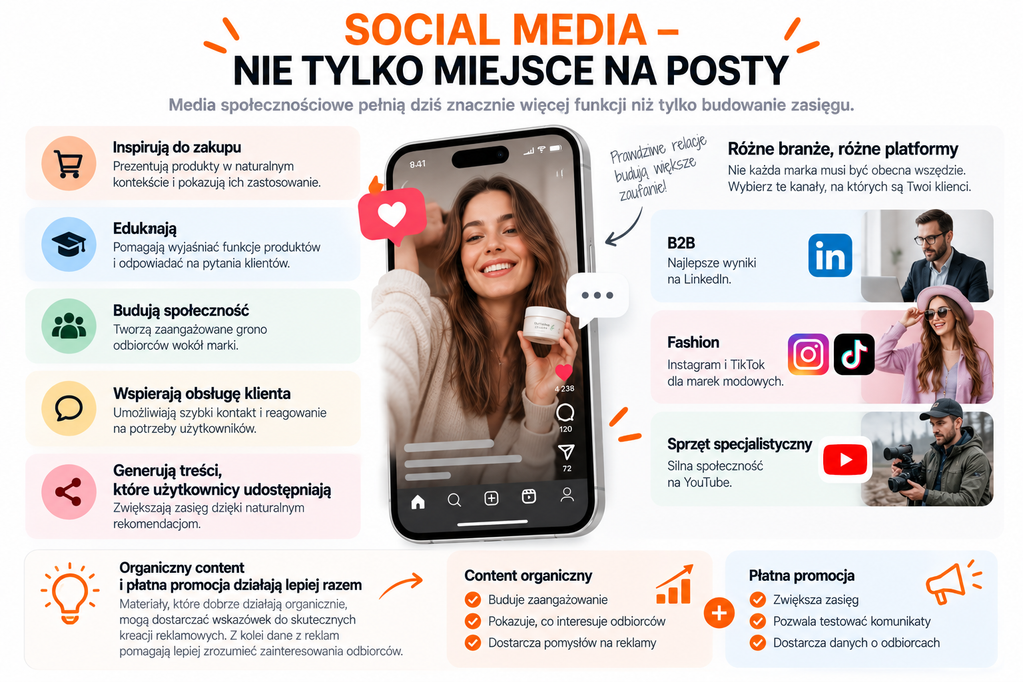
A B2B company may achieve the best results on LinkedIn, a fashion brand on Instagram and TikTok, while a manufacturer of specialized equipment may build a strong community on YouTube. The key is to be present where potential customers actually spend their time. It is also important to remember that organic content and paid promotion should not operate separately. Content that performs well organically can provide valuable insights into which advertising creatives are likely to be effective. In turn, advertising data can help brands better understand their audience’s interests.
This is one of the most important principles of online marketing: more traffic does not necessarily mean more sales. An online store can double the number of visitors, but if its conversion rate drops by half, the number of orders will remain the same. That is why optimizing what happens after a user lands on the website is just as important as acquiring traffic.
Factors such as website speed, the quality of product pages, customer reviews, available payment methods, delivery costs, the simplicity of the checkout process, and the overall credibility of the store all matter. Marketing therefore does not end when a user clicks an ad. It ends only when the user completes an action that delivers real value to the business.
In the age of social media and short-form video, email marketing may seem somewhat outdated. In practice, however, it remains one of the most important channels for building customer relationships, especially in e-commerce. Its greatest advantage is that the brand communicates with people who have already interacted with it before. These may include users who subscribed to a newsletter, purchased a product, downloaded a resource, or abandoned their shopping cart.
Thanks to segmentation and automation, email marketing can support not only sales but also customer retention. A new customer should receive a different message than a regular buyer, while a user who has not visited the store for several months should receive something different again. In practice, effective email campaigns can serve several purposes at the same time: remind customers about the offer, educate them, promote new products, recover abandoned carts, and encourage repeat purchases. This is important because online marketing should not end with the first transaction. The better a brand is at maintaining contact with its customers, the greater their potential long-term value.
Build Marketing That Generates Not Just Traffic, but Sales
Influencer marketing has become one of the most visible elements of modern digital marketing. Online creators can build highly engaged communities, and their recommendations often feel more natural to audiences than traditional advertising. For advertisers, however, this does not mean they should simply choose the largest profiles.
In many cases, the creator’s fit with the product, the quality of their community, their credibility, and their communication style are far more important. A micro-influencer may have a smaller reach, but their audience can be much better matched to a specific product category. That is why, when planning a collaboration, it is worth defining what the brand actually expects. Is the goal reach? Sales? UGC content? Reaching a new customer segment? Only then can the effectiveness of the campaign be properly evaluated. Measurability is also becoming increasingly important. Affiliate links and discount codes make it possible to check whether a creator not only generated interest, but also contributed to sales.
This brings us to one of the most interesting elements of modern online marketing. Affiliate marketing is based on cooperation between an advertiser and independent publishers who promote the advertiser’s offer through their own channels. These may include bloggers, influencers, content websites, comparison sites, coupon websites, cashback platforms, and other partners reaching specific audience groups. In the classic CPS model, the publisher earns a commission for each sale generated. This means that their compensation is directly tied to the result achieved. For advertisers, this is attractive primarily for two reasons.
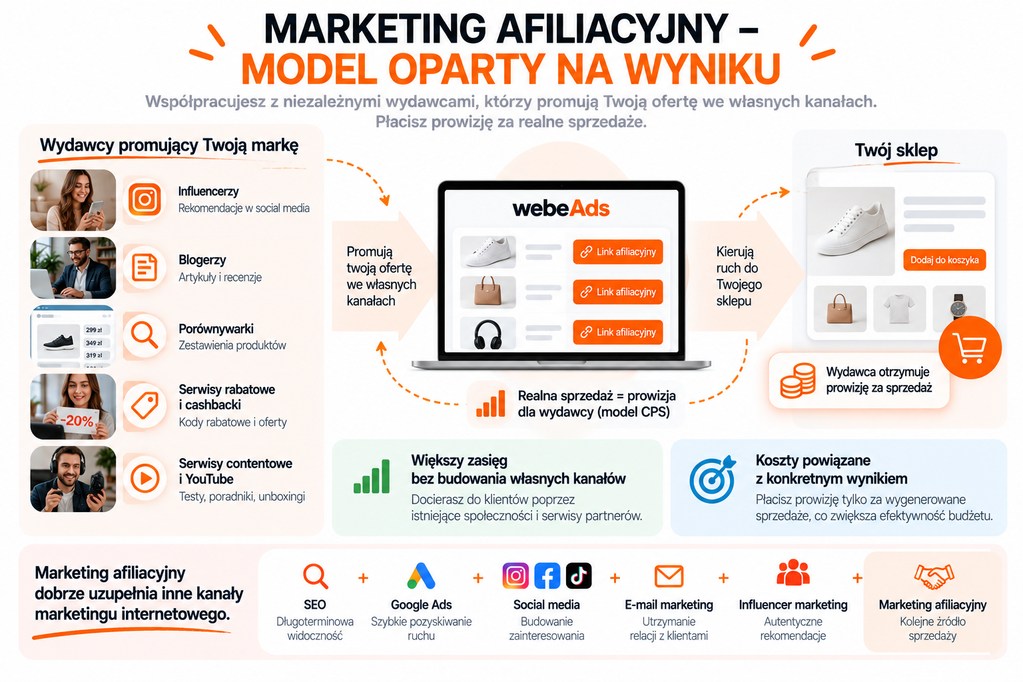
First, affiliate marketing makes it possible to reach customers through channels that the brand does not need to build on its own. Instead of creating a niche website, YouTube channel, or community from scratch, a company can work with partners who already have these assets in place. Second, the cost can be directly tied to a specific business result. This makes affiliate marketing a strong complement to SEO, Google Ads, social media, influencer marketing, and email marketing. It does not have to replace any of these channels. Instead, it can become an additional source of sales within a broader marketing strategy.
One of the most common mistakes in online marketing is making sales too dependent on a single traffic source. A company that acquires most of its customers exclusively through Google Ads can be highly vulnerable to rising click costs. A brand that relies mainly on a single marketplace for sales may feel the impact of every change to its terms or algorithm. Similarly, a business that builds reach only through social media depends on platforms it does not fully control. That is why a marketing mix, in which individual channels complement one another, is becoming increasingly important.
SEO can generate organic traffic, Google Ads can capture existing demand, social media can build interest, email marketing can maintain customer relationships, and affiliate marketing can create additional touchpoints through publishers. The goal is not to be everywhere. It is to avoid relying on a single mechanism for the entire sales process.
Your Strategy Doesn’t Have to End With Google and Social Media
Without data, it is difficult to distinguish a channel that simply looks good in a report from one that actually supports the business. That is why the foundation should be an analysis of several groups of metrics.
At the traffic level, it is worth monitoring traffic sources, CTR, and cost per click. For sales campaigns, much more important metrics include conversion rate, customer acquisition cost, average order value, ROAS, and revenue generated by individual sources. It is also important to take a long-term perspective. A channel that acquires a more expensive customer may still be more valuable if that customer returns more often and places additional orders. Individual channels should not be analyzed in complete isolation either. A customer may first see an ad, then read an article, watch a creator’s content, and only later make a purchase through another source. That is why effective measurement should answer not only the question “where did the sale come from?”, but also “which activities helped the customer make the decision?”
At the beginning, there is no need to use every available tool. A much better approach is to build a simple system. First, define the target audience and the business objective. Next, choose channels that match the different stages of the customer journey. The next step is to implement measurement and regularly analyze the results.
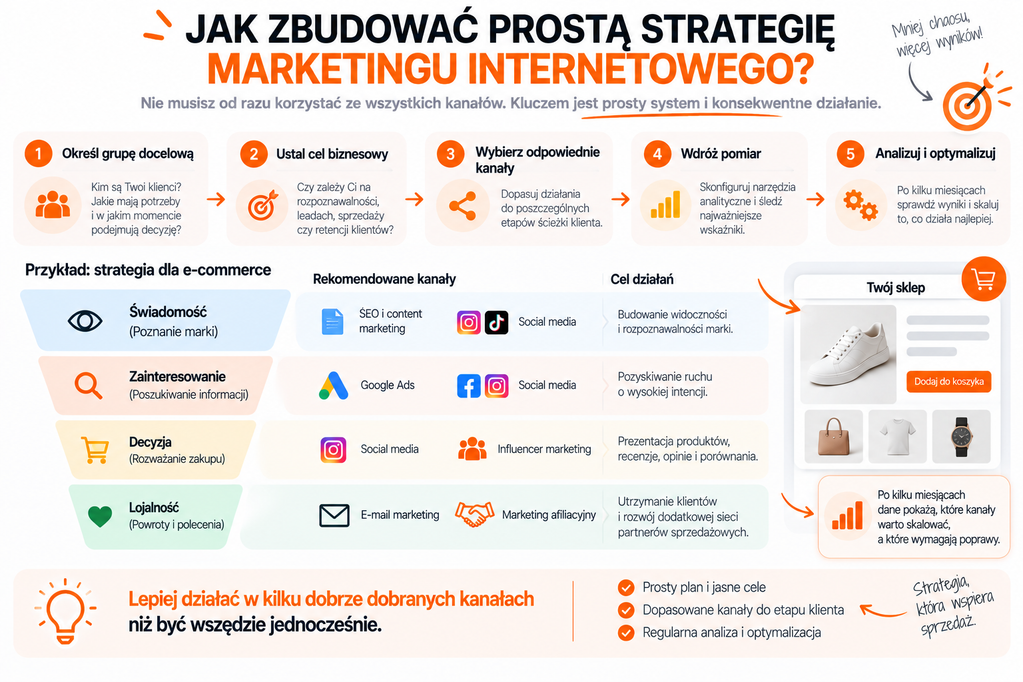
For example, an e-commerce business can use SEO and content to build visibility, Google Ads to attract high-intent traffic, social media to showcase products, email marketing to support retention, and an affiliate program to expand its network of sales partners. After a few months, the data will show which channels are worth scaling and which ones need improvement. This is far more effective than trying to be active everywhere at once without a clearly defined goal.
If a company already uses SEO, paid advertising, or social media, the next step may be to grow sales through affiliate partners. WebeAds allows advertisers to launch an affiliate program and work with different types of online publishers. Partners can promote the offer through their own websites, content, communities, and other channels, giving the brand additional ways to bring customers to its store.
Publisher activities can be analyzed based on the results they generate, while in the CPS model, compensation is directly linked to sales. This allows affiliate marketing to serve as an additional sales channel that can grow alongside the brand’s other marketing activities.
Build an Additional Sales Channel Through Publisher Partnerships
The fundamentals of online marketing are not simply about knowing the names of channels and tools. What matters most is understanding how all the elements work together and guide the customer from their first interaction with the brand to a purchase and future transactions. SEO builds visibility. Paid advertising accelerates traffic acquisition. Social media strengthens relationships with audiences. Email marketing helps retain customers, while affiliate marketing can expand sales through a network of independent partners.
Nie każda firma potrzebuje dokładnie takiego samego zestawu kanałów. Wspólna pozostaje jedna zasada: marketing powinien być mierzony przez pryzmat celów biznesowych, a nie samej liczby kliknięć czy wyświetleń. Jeżeli chcesz rozszerzyć swoją strategię o dodatkowy kanał sprzedaży, dołącz do WebeAds i sprawdź, jak program afiliacyjny może uzupełnić działania, które już prowadzisz online.
Not every company needs exactly the same mix of channels. One principle, however, remains the same: marketing should be measured against business goals, not just the number of clicks or impressions. If you want to expand your strategy with an additional sales channel, join WebeAds and see how an affiliate program can complement the online activities you already run.