

When a customer types “women’s running shoes”, “best automatic coffee machine”, or “160×200 mattress” into Google, they are not browsing the internet randomly. They are signaling a specific need. That is why Google advertising has remained one of the most important marketing tools for e-commerce for years – it allows a brand to appear exactly when a potential customer is actively searching for a product, service, or solution to a problem. The scale of this market continues to grow. According to IAB Polska/PwC AdEx, the value of online advertising in Poland reached PLN 10.9 billion in 2025, growing by 14.6% year over year. SEM alone accounted for approximately PLN 3.25 billion and 30% of online advertising budgets, remaining the largest segment of the market. What is more, in the first quarter of 2026, online advertising spending increased again – by 10.6% year over year.
However, popularity has another side. Simply being present on Google is no longer a competitive advantage in itself. Advertisers compete for the attention of the same users, and campaign performance depends not only on how many people click the ad, but above all on what happens next. You can generate 10,000 visits to your website and still fail to achieve a satisfactory return on investment. You can also attract significantly less traffic that results in more valuable orders. That is why effective Google advertising should not be evaluated solely based on the number of clicks or even the number of conversions. Google allows advertisers to assign different values to conversions precisely so they can analyze their actual impact on the business and optimize campaigns based on factors such as sales value or ROAS.
The question is therefore no longer: “how can I get more clicks from Google?”. A much more important one is: “how can I make Google advertising generate more profitable sales?” And that is where a good strategy begins.
Google’s biggest advantage is the ability to reach users at the moment when their purchase intent may already be very specific. Let’s compare two situations. A user browsing social media may see an ad for a new coffee machine even though they had not previously planned to buy one. Meanwhile, someone typing “automatic coffee machine under PLN 2,000” into a search engine is directly telling advertisers what they currently need. For an online store, this difference is extremely important.
Not every search phrase, however, indicates the same level of purchase readiness. A user typing “which coffee machine should I choose” is probably at a different stage than someone searching for a specific model together with its price. The first person is still gathering information, while the second may be only a few clicks away from making a purchase. That is why Google advertising should respond to user intent, rather than simply to the presence of a specific keyword. Someone learning about a product category needs a different message from a customer comparing models, and someone ready to place an order needs yet another one. At the same time, modern Google Ads goes far beyond traditional text ads displayed above search results. Advertisers can use different formats and campaign types to reach users at multiple stages of the purchasing journey, while automation, conversion data, and value-based strategies are playing an increasingly important role in optimization. This leads to one of the most important principles:
Google can find users interested in making a purchase, but the quality of the entire customer journey determines whether that interest turns into revenue.
Build an Additional Performance-Based Sales Channel
One of the most common mistakes in campaign evaluation is treating traffic as a goal in itself. Let’s assume an online store spends PLN 20,000 per month on Google Ads. The campaign generates thousands of clicks, so at first glance it looks successful. The problem only becomes apparent when we check how many of those visits result in a purchase, what value the orders generate, and how much margin remains after accounting for advertising costs. That is why advertisers should look beyond CPC. If a product costs PLN 500, but one customer buys a single item while another places an order worth PLN 1,500, those two conversions do not have the same value for the business. Similarly, acquiring a customer who returns to the store regularly may be worth more than a one-time transaction.
Google Ads allows campaigns to be optimized based on conversion value, and a target ROAS strategy can use this data to maximize value while aiming for a specific return on ad spend. For advertisers, this means changing the way they think. We no longer ask only: “How much does a click cost?” We ask: “How much does it cost to generate a sale, and how much value does that sale generate for the business?”
This difference may seem small, but it is exactly what separates a campaign that generates traffic from one that genuinely supports business growth.
A high budget does not guarantee high sales. An ad may direct users with the right purchase intent to the store, but if they land on a slow website, an unclear product description, a complicated checkout process, or an offer that is less attractive than the competition, even a well-configured campaign will not solve the problem.
Imagine two stores advertising the same type of product. The first pays an average of PLN 1.50 per click, while the second pays PLN 2. At first glance, the first advertiser may seem more effective. However, if a significantly higher percentage of users make a purchase in the second store, the higher CPC may translate into a lower customer acquisition cost. That is why Google advertising should not be optimized in isolation from the store itself. Product price, delivery costs, availability, customer reviews, website speed, payment methods, return policy, and the quality of the product page can all directly affect whether acquired traffic turns into revenue. From the advertiser’s perspective, the goal should therefore not be the cheapest traffic. The goal should be traffic that makes business sense.
The phrase “Google advertising” is often associated with sponsored links that appear after entering a specific search query. In reality, Google’s advertising capabilities are much broader.
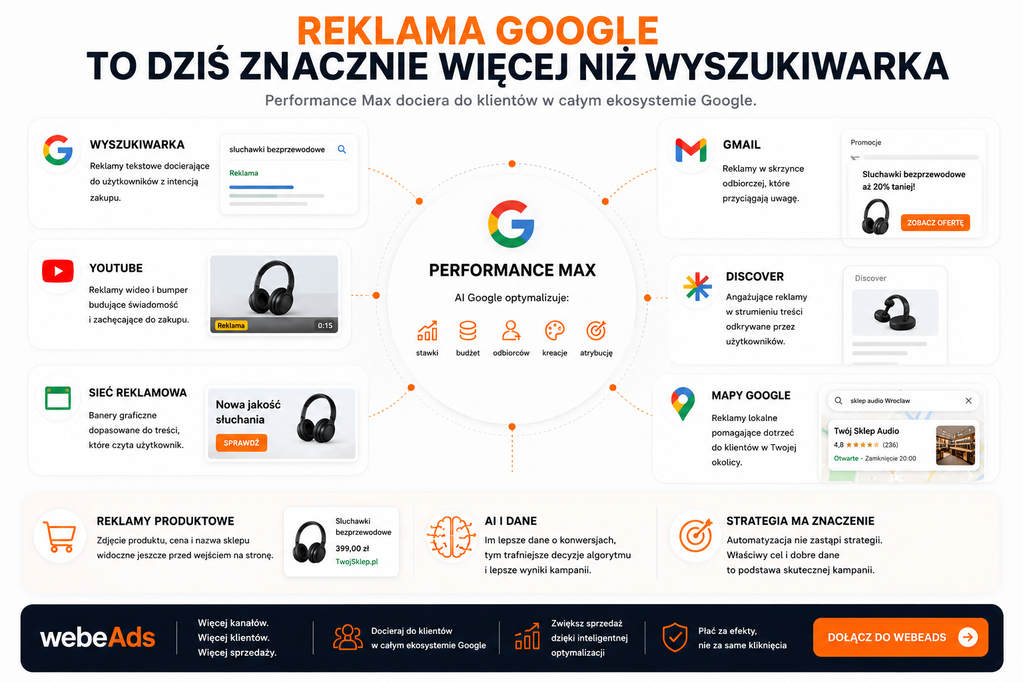
A good example is Performance Max. This campaign type can use Google’s entire advertising inventory and reach customers across Search, YouTube, the Display Network, Discover, Gmail, and Maps. Google also uses AI to optimize elements such as bids, budget, audiences, creatives, and attribution according to the advertiser’s specific goals. Product ads are also particularly important for e-commerce. Users can see a product image, name, price, or store name before they even visit the website. This means that Google is not only a place where people search for information, but also a space where consumers can begin comparing specific offers. This gives advertisers more opportunities, but at the same time makes campaign management increasingly dependent on the quality of the data provided to algorithms. If the system receives incorrect or incomplete conversion data, it may optimize the campaign toward actions that are not actually the most valuable for the business.
Automation therefore does not eliminate the need for strategy. On the contrary – the more decisions the algorithm makes, the more important it becomes to provide it with the right objective and the right data.
A problem with campaign effectiveness does not always mean that Google Ads “doesn’t work”. Sometimes the source of the problem lies far beyond the advertising platform itself.
The first mistake is focusing on clicks instead of business results. A campaign may have an attractive CTR and generate a large amount of traffic, but if sales do not cover customer acquisition costs, strong advertising metrics mean very little.
The second problem is directing all users to the same destination. Someone searching for a specific product model should be able to find that exact product as quickly as possible, rather than being redirected to the homepage and having to start their search from the beginning.
Another mistake is treating all conversions as equally valuable. A PLN 100 purchase and a PLN 1,000 purchase are both conversions, but their importance to the store is completely different. The difference can be even greater when individual product categories have different profit margins.
We should also not forget about mobile devices. If an ad successfully attracts a user browsing on a smartphone, but completing the purchase requires going through an inconvenient form, the brand is paying for traffic while making conversion more difficult for the user.
In practice, improving the effectiveness of Google Ads therefore very often does not begin with increasing the budget. It begins with removing the obstacles between the click and the purchase.
This is one of the most important pitfalls when scaling campaigns. If Google advertising delivers good results with a budget of PLN 10,000, the natural reaction may be to increase it to PLN 20,000 and expect twice as many sales. In practice, the relationship is rarely that simple. At first, the ads may reach users with the highest purchase intent. As the campaign scales, however, the system has to look for additional opportunities to generate traffic and conversions. As a result, the marginal cost of acquiring each additional customer may increase, and the additional budget may not produce a proportional increase in revenue.
That is why scaling should be based on profitability, not simply on the ability to spend more. It is worth monitoring not only revenue and ROAS, but also margin, customer acquisition cost, and whether each increase in budget actually generates additional valuable sales. This leads to a broader strategic question. Should the entire additional marketing budget be allocated to a single channel? Not necessarily.
For many advertisers, the next stage of growth may involve not only further increasing spending on Google advertising, but also diversifying customer acquisition sources. And this is exactly where Google Ads can complement affiliate marketing very effectively.
Turn Affiliate Marketing Into Another Sales Engine for Your E-Commerce Business
Google Ads and affiliate marketing do not have to compete with each other for a place in the advertising strategy. In reality, both channels can be responsible for different customer touchpoints and work together to guide the user toward a purchase. Imagine a customer who wants to buy a sports watch. First, they enter a general query into Google and discover several brands through ads. Later, they watch a review of a specific model on YouTube, come across a ranking prepared by a technology website, check a price comparison, and before making the purchase, look for a current promotion. Several days have passed between the first search and the transaction, and many touchpoints have appeared along the way. Some of them may be created by affiliate marketing.
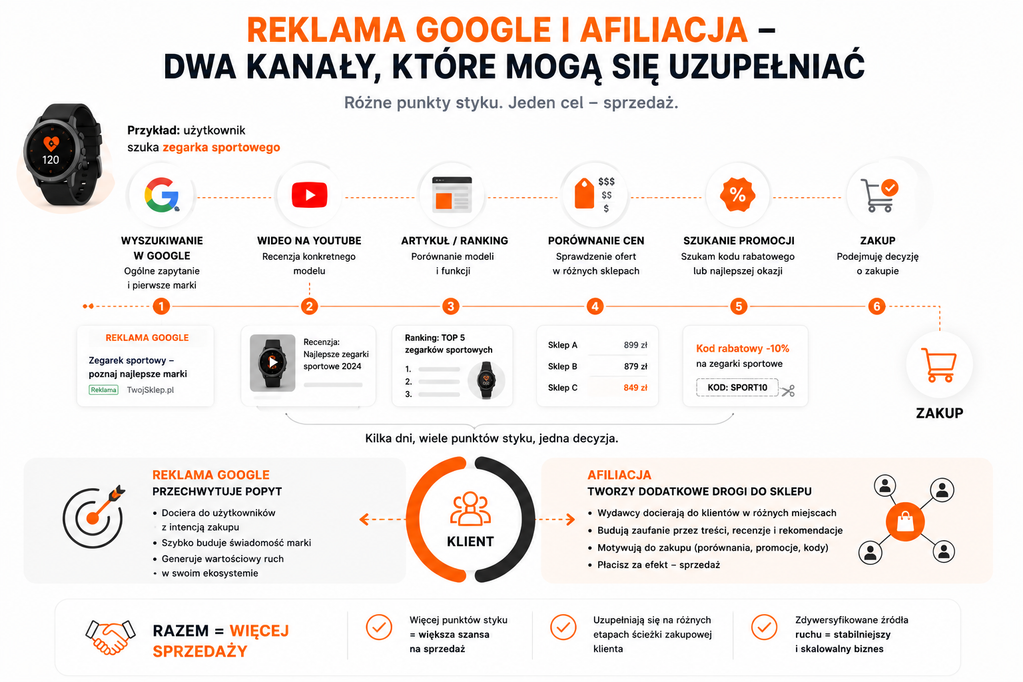
Publishers in an affiliate program may include online creators, content websites, comparison platforms, coupon sites, cashback services, or other partners with access to specific audience groups. Instead of trying to appear independently in every one of these places, the advertiser can build a network of partners promoting its offer. Google can therefore help capture existing demand and reach users within its ecosystem, while affiliate marketing can create additional paths that lead customers to the store.
If the vast majority of new orders come from a single paid channel, the company becomes highly dependent on its costs, rules, and level of competition. This does not mean that effective Google advertising should be reduced. If campaigns generate profitable sales, they are worth developing. At the same time, it is sensible to build additional revenue sources that can operate in parallel.
Affiliate marketing allows brands to approach this challenge from a different perspective. Instead of buying all traffic directly, a brand can work with publishers that have their own communities, websites, and distribution channels. In the CPS model, publisher compensation is tied to the sales they generate. This is particularly attractive when scaling e-commerce. A brand does not have to choose between “Google or affiliate marketing”. It can use Google advertising where it delivers the best results while developing an affiliate program in parallel and testing which additional sales sources publishers can provide. As a result, the strategy becomes less dependent on a single customer acquisition channel.
One of the biggest differences between traditional Google advertising and affiliate marketing is the moment when the cost is incurred.
In Google Ads, advertisers may pay for clicks and incur traffic costs before knowing whether the user will make a purchase. In the affiliate CPS (Cost Per Sale) model, the publisher earns a commission for generating a sale. Let’s assume that an online store generates PLN 100,000 in monthly sales through affiliate partners, and the agreed commission is a specific percentage of the value of approved transactions. In this case, the cost of the collaboration grows together with the results. If the publisher increases sales, they earn more, but at the same time the advertiser generates more revenue. This creates a mechanism in which both sides share the same interest.
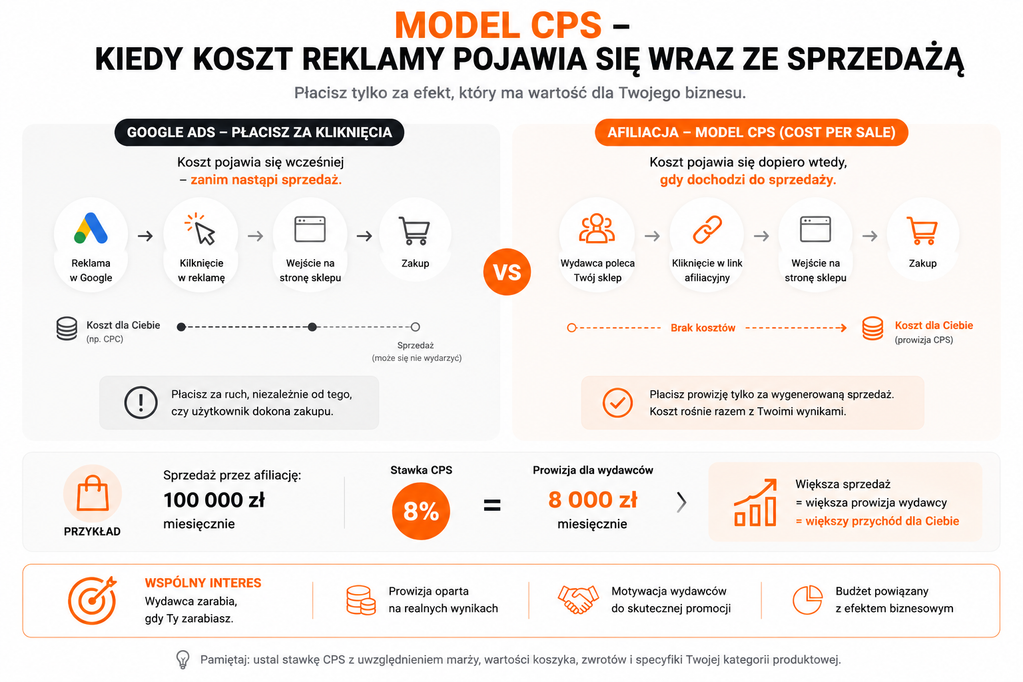
Of course, this does not mean that affiliate marketing is free of costs or that every sale will automatically be profitable. Advertisers should still set the CPS rate with factors such as margin, average order value, returns, and the economics of a specific product category in mind. The key difference lies elsewhere: the budget can be directly linked to an outcome that has real business value for the store.
The more channels a brand uses, the more important accurate measurement becomes. A customer may click a Google ad, return a few days later through influencer content, read a product ranking, and only then make a purchase. Attributing the entire value of the transaction to the final touchpoint can lead to the wrong conclusion that earlier activities did not matter.
For several years, Google has been developing data-driven attribution, a model that analyzes the contribution of different interactions throughout the path to conversion. Google states that this model uses account data to determine the actual contribution of individual advertising interactions. A similar principle is worth applying to the entire marketing strategy. It is not enough to know where the last click came from. You need to understand how individual channels influence purchasing decisions and whether they generate incremental sales. That is why, when comparing Google Ads and affiliate marketing, it is worth analyzing more than just the number of orders. Customer acquisition cost, average order value, share of new customers, margin, conversion rate, and repeat purchase behavior are also important.
A channel generating fewer transactions may prove more valuable if it brings in new customers or sales that would probably not have occurred without its involvement.
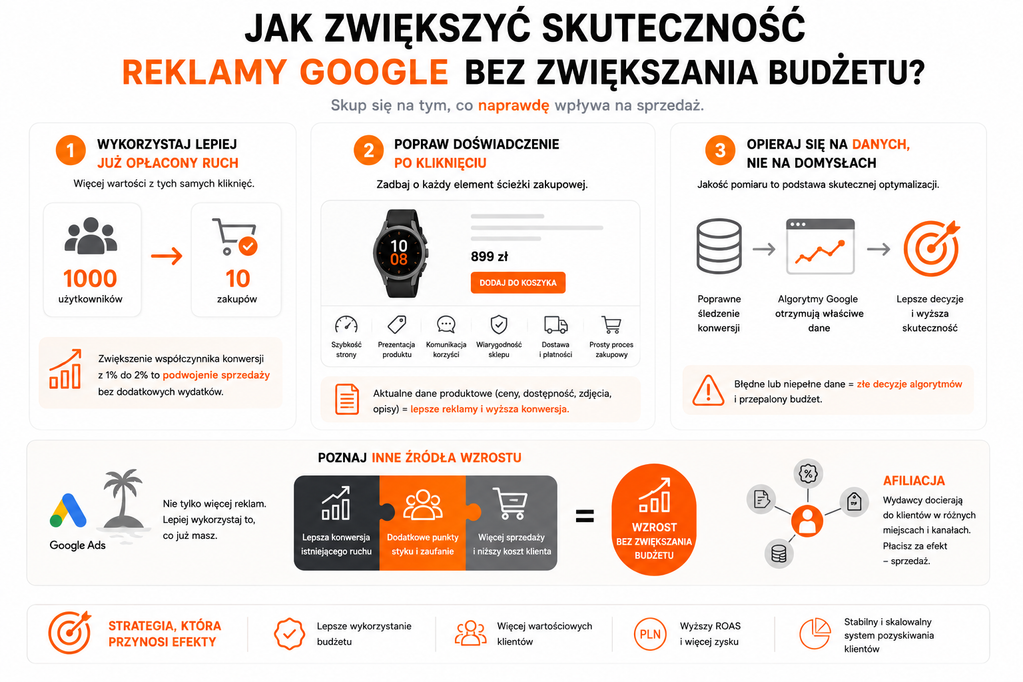
The first instinct when trying to increase sales is often to raise the budget. However, a much better starting point may be to check how much value the company is getting from the traffic it is already paying for. If 1,000 users visit the store and 10 make a purchase, increasing the conversion rate may be just as important as attracting another 1,000 visitors.
It is therefore worth improving the entire post-click experience: website speed, product presentation, communication of benefits, store credibility, delivery options, payment methods, and the simplicity of the purchasing process. In e-commerce, up-to-date product data is also particularly important – accurate prices, availability, images, and information provided to advertising systems.
The second area is measurement quality. Google’s algorithms can optimize a campaign only based on the data they receive. If sales tracking is incomplete or conversion values are incorrect, automation may make decisions based on the wrong information.
The third way is to look beyond the Google Ads panel itself. More sales do not necessarily mean more ads on Google. It may mean better conversion of existing traffic and creating additional touchpoints through other channels, including affiliate publishers. In this way, Google advertising does not operate as an isolated channel. It becomes one element of a broader customer acquisition system.
The best results do not always come from allowing one channel to take over the entire budget. A much more effective strategy may be one in which Google advertising and affiliate marketing perform different roles, but lead to the same goal – sales. Google Ads can capture users who are actively searching for a product. At the same time, affiliate publishers can create additional brand touchpoints through reviews, rankings, guides, social media, comparison platforms, or promotional websites. For example, a user may first discover a store through a Google ad but not make a purchase. A few days later, they come across a product review created by a publisher, then compare available models, and only then return to the store. In another case, the sequence may be completely reversed – an influencer or article may spark interest in the product, while Google helps capture the user when they begin actively searching for a specific offer. That is why, instead of asking “Google Ads or affiliate marketing?”, it is worth asking a different question: “How can we use both channels to give customers more valuable paths leading to our brand?”
If Google advertising is already one of your store’s main sources of sales, the next step may be to develop an additional channel based on collaboration with publishers.
With WebeAds, advertisers can launch an affiliate program and develop a network of partners promoting their offer. Depending on the program, these may include content publishers, influencers, comparison platforms, coupon sites, cashback services, or other partners reaching potential customers online. This means the brand does not have to rely solely on its own campaigns for customer acquisition. It gains additional partners who use their own channels, content, and communities to direct users to the offer. Most importantly, these activities can be linked to specific results. In the CPS model, the publisher receives a commission for generated sales. The advertiser can therefore expand cooperation with partners who genuinely deliver value and gradually build an additional, scalable sales channel. The goal is not to replace Google Ads with affiliate marketing. It is to reduce dependence on a single traffic source and create a broader customer acquisition ecosystem.
Join WebeAds and Let Publishers Drive Sales for Your Brand
Google advertising remains one of the most important tools for reaching consumers who are actively searching for products and services. However, simply appearing in sponsored search results does not guarantee profitable sales. The final outcome depends on many more factors: user intent, campaign quality, conversion data, the landing page, the offer, conversion rate, customer acquisition cost, and the way Google works together with other marketing channels. That is why growth should not always mean simply “let’s spend more on Google Ads”. Sometimes greater potential lies in improving conversion, making better use of data, and diversifying sales sources. Affiliate marketing can be one of those sources. It allows brands to build a network of partners who reach customers across different parts of the internet and can be rewarded for the results they generate.
If you want to complement Google advertising with an additional sales channel, launch an affiliate program with WebeAds. Reach customers not only when they search for your products on Google, but also where they discover, compare, and choose offers.