
Just a few years ago, generating additional traffic for an online store was associated primarily with Google Ads, social media advertising, or collaborations with large online portals. Today, the customer journey is much more fragmented. A customer may first see a product on Instagram, then read a review on a blog, compare prices on a comparison website, and look for a discount code before making a purchase. At each of these stages, the brand may encounter a virtual publisher. Publishers are one of the foundations of affiliate marketing. They may run a niche website, a social media account, a YouTube channel, a comparison platform, a coupon site, or another online space where they reach potential customers. Their role is to connect audiences with the advertiser’s offer, and in the affiliate model, their compensation may depend on the result they generate, such as a sale.
For advertisers, this represents an important shift in perspective. Instead of purchasing every advertising placement independently, a brand can build a network of independent partners around itself, with each partner reaching customers through their own channels, content, and communities. One publisher may generate sales through product guides, another through social media, while another may reach users who are already very close to making a purchasing decision. The importance of such activities continues to grow along with the entire digital market. According to IAB Polska, digital advertising spending in Poland reached nearly PLN 11 billion in 2025, while online channels accounted for more than 60% of the entire advertising market. At the same time, around 90% of the growth in the advertising market came from digital channels.
However, this does not mean that the solution is simply to spend more and more on advertising. For e-commerce businesses, one question is becoming increasingly important: which activities actually lead to sales? And this is exactly where a well-built collaboration with virtual publishers offers its greatest advantage.
Simply put, a virtual publisher is a person or company operating online that promotes an advertiser’s products or services and can earn money based on the results generated by their recommendations. In affiliate marketing, they use dedicated tools for this purpose, primarily affiliate links that make it possible to attribute specific user actions to a particular publisher. However, a virtual publisher should not be understood only as a blogger placing banners on a website. Today’s ecosystem is much broader. A publisher can be an influencer creating content on TikTok, the owner of a specialist website, a YouTube creator, a price comparison platform, a coupon site, a cashback service, or a company running email marketing activities.
Imagine an online store selling cosmetics. An influencer can create content showing how the product works and spark initial interest. A beauty blog can publish a detailed review that answers users’ questions. Another publisher can help the customer compare offers, while a coupon site may appear when the user is already ready to make a purchase. Each of these partners operates differently, but they all guide the customer toward the same brand.
Build a Publisher Network That Drives Your Sales.
From an advertiser’s perspective, the most important question should therefore not be “which type of publisher is the best?”, but rather “which publishers do I need at each stage of my customer’s journey?”. It is this diversity of partners that can transform affiliate marketing from a single traffic source into an additional, scalable sales channel.
An effective affiliate program should not rely solely on one type of partner. Different virtual publishers reach consumers at different stages of the purchasing process and respond to different needs. In the affiliate industry, these may include content publishers, influencers, cashback and coupon sites, comparison platforms, email marketing partners, or entities running advertising activities. Let’s assume a customer is planning to buy a coffee machine. Their first contact with the product may happen while watching a video created by a culinary creator. A few days later, the user finds a ranking of the best coffee machines through Google, then checks prices on a comparison website, and before completing the purchase, looks for a current promotion. Along this single journey, the customer may therefore encounter several different publishers.
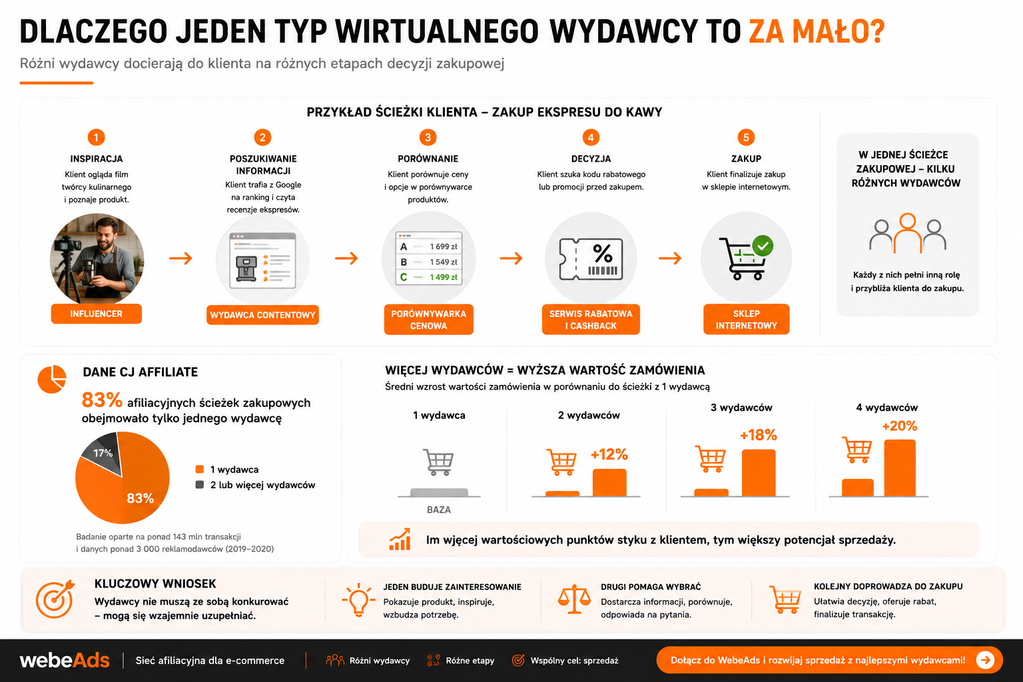
Interestingly, data from CJ Affiliate shows that 83% of the affiliate customer journeys analyzed involved only one publisher. At the same time, in journeys involving more partners, the average order value was higher – by 12% with two publishers, 18% with three, and 20% with four compared with a journey involving just one publisher. The study was based on more than 143 million transactions and data from over 3,000 advertisers, although it should be noted that the analyzed data came from 2019-2020. For advertisers, this leads to an important conclusion: publishers do not have to compete with one another – they can complement each other. One builds interest, another helps compare options, and another guides the user toward completing the purchase.
The greatest value of a virtual publisher, however, is not simply generating another click. A good partner has something that a brand often cannot build quickly on its own – their own community, reach, search engine visibility, or access to a specific group of users.
This allows an online store to appear in places it previously could not reach. A manufacturer of outdoor equipment can start working with a trekking-focused website, a pet store with a creator running a dog-related profile, and a cosmetics brand with a website publishing product rankings and reviews. Instead of building each of these media channels from scratch, the advertiser can use the potential of partners who have already gathered the right audiences. This is why an affiliate program should be treated as a portfolio of different sales sources, not as a collection of random websites publishing links. Industry analyses indicate that overreliance on a single publisher category can limit further program growth.
The better a virtual publisher is matched to the product, the greater the chance that their traffic will be valuable. For advertisers, what matters more than the sheer number of publishers is therefore their sales potential and fit with the target audience.
It is the payment model that distinguishes affiliate marketing from many traditional forms of online advertising. In the CPS (Cost Per Sale) model, the publisher receives a commission when their activities lead to a sale. This allows the advertiser to determine in advance what portion of the transaction value they are willing to allocate to acquiring an order.
For example, an online store sets a commission for sales generated by publishers. A partner publishes a guide, product ranking, or social media content and includes an affiliate link. If users only read the content but do not make a purchase, no sales commission is generated under the standard CPS model. However, when the recommendation leads to a transaction, the system can attribute it to the appropriate partner.
This does not mean that every virtual publisher has to work exclusively within a single model. Depending on the nature of the activities, other forms of collaboration and hybrid models are also possible. The WebeAds platform itself supports, among others, CPS, flat fee, flat fee + CPS, barter and barter + CPS. This gives advertisers the flexibility to tailor the terms to a specific partner. An influencer may need a product to create content, a large portal may expect an additional fee for special exposure, while a publisher focused strictly on sales may be primarily interested in an attractive commission on generated transactions. The most important shift is therefore that a virtual publisher is no longer just a place where a brand buys advertising. They become a partner whose interests can be directly tied to the advertiser’s results.
The number of transactions alone does not always show how valuable a particular virtual publisher really is. Two partners may each generate 50 orders, but the first may attract mainly existing customers looking for a discount, while the second reaches new audiences who were previously unfamiliar with the brand. From a business perspective, their impact on the store’s growth can therefore be completely different.
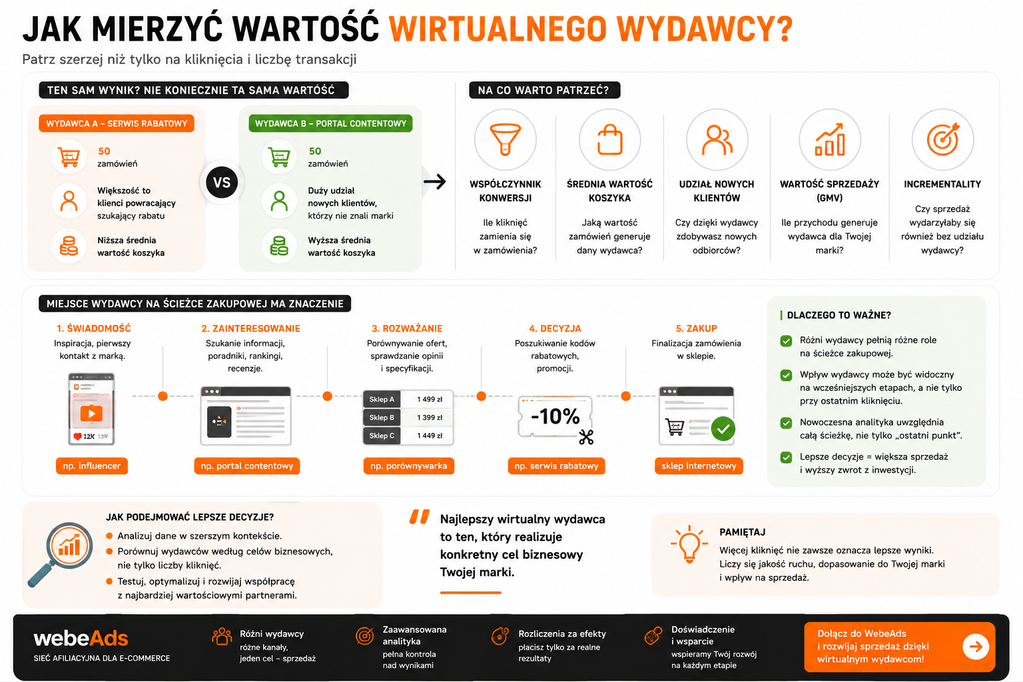
That is why advertisers should look beyond clicks and the number of sales alone. Depending on the program’s objective, it is worth analyzing conversion rate, average order value, the share of new customers, and the sales value generated by individual partners. Incrementality is also becoming increasingly important, meaning an attempt to answer the question: would a given sale have happened even without the publisher’s involvement? This is currently one of the more important directions in affiliate analytics. A good example is a content publisher that creates an in-depth product ranking. Their audience may need several days or weeks to make a decision, so the publisher’s impact may not always be visible when looking only at the last click. Another partner, in turn, may appear much closer to the final purchase. Modern affiliate analytics increasingly takes into account the partner’s role across the entire customer journey, not just the moment directly preceding the transaction.
The best virtual publisher is therefore not always the one generating the most clicks. The most valuable one is the partner who helps achieve a specific business goal for the brand.
In traditional advertising, the relationship is often simple: a brand launches a campaign, buys a certain amount of reach or traffic, and once the budget is turned off, the exposure ends. With some virtual publishers, the effect can look completely different.
Imagine a technology website that publishes an article titled “Which Smartwatch Should You Choose for Running?”. The content may continue appearing in search results and generating traffic long after publication. The same applies to a blog guide, a YouTube video, or a well-prepared product comparison. Once published, such content can repeatedly direct new users to an online store. This is one of the reasons why content publishers should be viewed as long-term partners, not merely as advertising space purchased for a few days. In the affiliate industry, it is increasingly recognized that traditional attribution models may not fully capture the value of content that influences customer decisions at earlier stages of the purchasing journey.
Of course, not every type of publisher works in this way. A coupon site, influencer, comparison platform, or content publisher all play different roles. That is why a well-developed affiliate program should make it possible to test different partners and observe which of them best match the needs of a particular brand.
Simply launching an affiliate program does not mean that the best publishers will immediately start actively promoting your offer. A virtual publisher is also running a business. If they can choose between several similar stores, they will pay attention to where their efforts are most likely to deliver results.
Launch an Affiliate Program and Let Publishers Sell Alongside You
Commission rates obviously matter, but the attractiveness and competitiveness of the offer, brand recognition, store quality, and conversion rate are equally important. Even a high CPS rate will not be especially appealing if users frequently abandon their purchases after visiting the store. Advertisers should also provide partners with tools that make promotion easier. These may include affiliate links, up-to-date banners, video materials, information about promotions, or product feeds. WebeAds provides publishers with, among other things, affiliate links, product widgets, banners and rotators, video creatives, and XML files. It is also worth regularly informing publishers about new products, discount codes, seasonal campaigns, or events such as Black Friday. A good affiliate program should not be a static offer left to run on its own. The more reasons a brand gives publishers to create new content and promote products again, the greater the sales potential of the entire collaboration can be.
The greatest potential of affiliate marketing emerges when a brand stops thinking in terms of individual collaborations and starts building an entire ecosystem of partners. At first, there may be only a few. One may prepare a review, another promote the product on social media, while another places the offer on a comparison platform. Over time, the data will show which activities generate sales, where new customers come from, and which partners are worth developing further. The advertiser can then increase the activity of the best-performing publishers, test new partner groups, and optimize program terms. The ability to monitor results is crucial here. The WebeAds system allows advertisers to track traffic and sales statistics and analyze publisher performance. And this is where a single virtual publisher becomes part of something bigger. Instead of running another one-off campaign, the brand begins developing a channel in which different partners reach customers in their own ways, while their results can be compared and optimized.
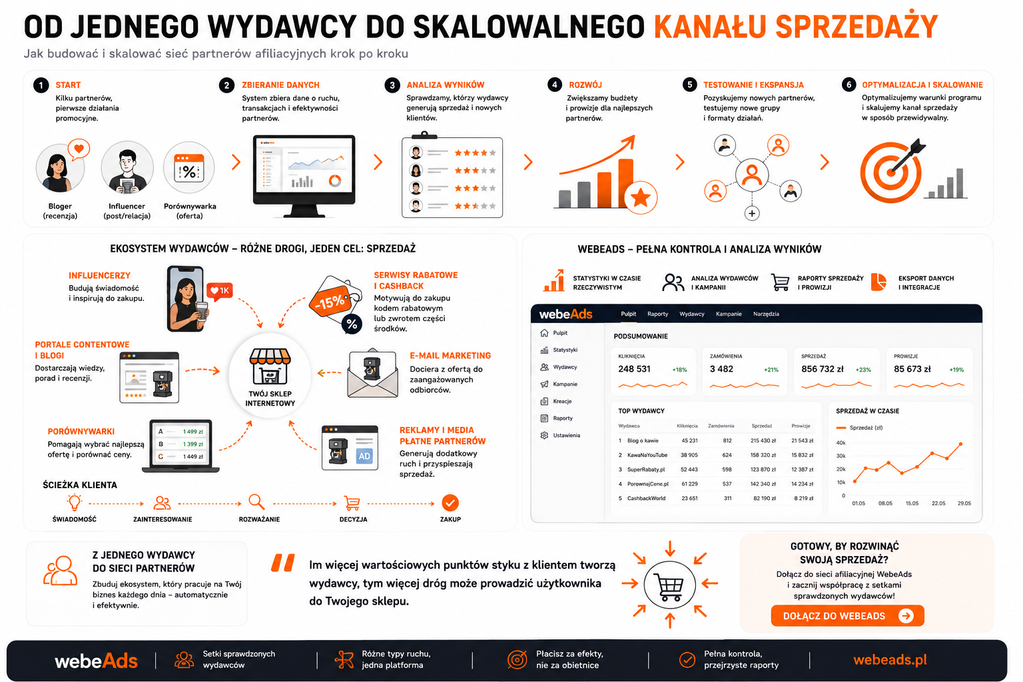
The More Valuable Customer Touchpoints Publishers Create, the More Paths Can Lead Users to Your Store.
There is no single publisher profile that will be the best fit for every advertiser. An electronics store may achieve strong results through comparison platforms and technology websites, a cosmetics brand through beauty creators and content publishers, and a home furnishings store through interior design blogs, social media, or inspiration websites. That is why, instead of focusing solely on the number of partners, it is worth building a diversified program structure. An influencer can create demand, a content publisher can answer a potential customer’s questions, a comparison platform can make it easier to choose a specific product, and a coupon partner can help close the sale.
Traffic quality is also important. A large portal generating thousands of clicks will not always be more valuable than a small specialist website reaching a highly specific audience. Similarly, an influencer with a relatively small community may deliver better results than a creator with a much larger reach if their followers genuinely match the brand’s customer profile.
In practice, the best answer comes from the data. It is worth testing different virtual publishers, comparing their results, and gradually scaling cooperation with those that deliver the most valuable outcomes.
Affiliate marketing does not have to be treated as an alternative to Google Ads, Meta Ads, SEO, or influencer marketing. Much more interesting results can come from a situation where all of these channels complement one another.
Social media advertising may be the first place where a user sees a product. A few days later, they come across a review created by a virtual publisher. They then look for opinions, compare available options, and eventually visit the store from another source. Today’s purchasing journey is rarely limited to a single interaction with a brand. For advertisers, this means that affiliate marketing can extend the brand’s presence into places not covered by its own campaigns. Instead of trying to create content for every niche, build new communities, or gain visibility for hundreds of search queries on its own, the brand can work with partners who already have those resources.
Reach Customers Where They Make Purchasing Decisions
A virtual publisher therefore becomes another touchpoint between the brand and a potential customer. The better the partners are aligned with the advertiser’s strategy, the greater the chance that affiliate marketing will complement other channels rather than simply compete with them.
Searching for publishers independently, negotiating terms, creating links, monitoring transactions, and settling accounts with dozens of partners can quickly become time-consuming. That is why one of the main roles of an affiliate network is to create an environment in which advertisers and publishers can collaborate in an organized and efficient way.
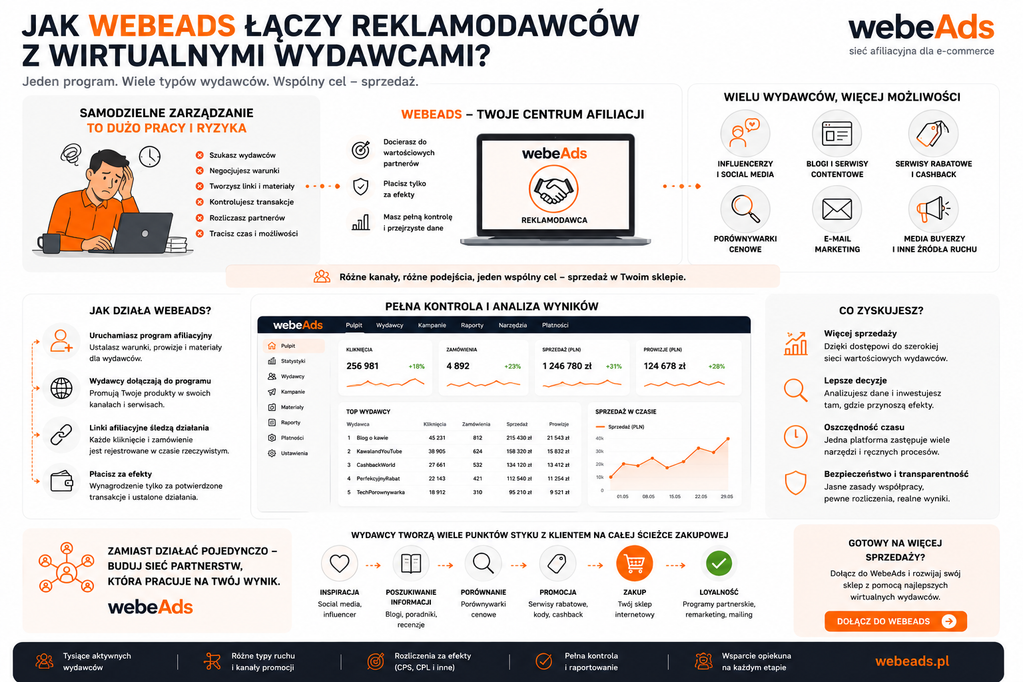
After launching an affiliate program with WebeAds, the advertiser can develop cooperation with different types of virtual publishers. They do not have to limit themselves only to influencers or traditional content websites. This allows the program to grow across many places where potential customers look for inspiration, search for information, compare products, or make purchasing decisions. At the same time, affiliate marketing makes it possible to connect partner activities with specific results. The advertiser can analyze traffic and transactions, monitor publisher activity, and assess which sources genuinely support sales. Over time, this makes it possible to shift attention away from the question “where did our advertisement appear?” toward a much more important one: “which partnerships are bringing us customers?”
As a result, WebeAds can become a place where individual promotional activities develop into a network of partnerships working toward a shared goal – growing the advertiser’s sales.
A virtual publisher is no longer just a website owner who provides space for a banner. They can be a creator, expert, owner of a niche website, comparison platform, or another partner with access to audiences interested in specific products. For advertisers, the greatest value lies in the ability to leverage the potential of many such partners at the same time. Each one can reach the customer in a different place and at a different stage of the purchasing decision. One inspires, another educates, a third helps choose an offer, while another directly generates sales. The goal is therefore not to find a single publisher with the largest reach. It is to create a network of valuable touchpoints with potential customers and use data to determine which of them best support the business.
If you want your products to be promoted by virtual publishers while also being able to measure the results of their activities, launch an affiliate program with WebeAds. Instead of investing exclusively in additional advertising campaigns, you can develop a network of partners who earn alongside your brand when they help it achieve results.