
Working with an influencer does not always have to start with a large advertising budget. For many brands, the first step into influencer marketing is a barter collaboration, a model in which a creator receives a product or service in exchange for specific promotional activities. Cosmetics sent for testing, a weekend hotel stay in exchange for coverage, clothes used in a styling post, or access to a premium app in return for a review are just a few examples. Barter works particularly well for brands in the beauty, fashion, food, travel, parenting, fitness, and broader e-commerce sectors.
However, a simple mechanism does not mean that it is enough to send a package to a popular creator and wait for sales. A barter collaboration should be treated as a fully fledged marketing campaign. It requires choosing the right partner, defining the goal, setting the terms of the collaboration, and establishing how results will be measured. This approach is becoming increasingly important as brands move away from random, one-off publications and focus more on long-term relationships with creators. IAB Polska also points to the growing importance of nano- and micro-influencers, whose smaller but more engaged communities can have a real impact on purchasing decisions. So how can barter be used effectively without turning into nothing more than giving away products?
In the simplest terms, barter involves an exchange of benefits. The brand does not pay the creator a traditional monetary fee, but instead provides a product or access to a service. In return, the influencer carries out previously agreed promotional activities. This could include a product review, reel, Stories, post, YouTube video, blog article, unboxing, or showing the product during everyday use.
For example, a cosmetics brand provides an influencer with a set of products worth PLN 500. In return, the creator prepares a reel showing how to use them, along with several Stories presenting the results. A hotel, on the other hand, may offer a weekend stay in exchange for travel content and coverage of the visit. From the advertiser’s perspective, this type of arrangement can seem very attractive. There is no need to allocate a large cash budget for fees, while the product goes directly to someone who already has their own community.
However, one thing should be kept in mind: barter is not free advertising. The product has a specific value, its preparation and shipping generate costs, and running the campaign requires time. If a brand sends 100 packages worth PLN 300 each, the scale of the investment quickly becomes significant. That is why barter activities should also be evaluated in terms of their business effectiveness.
Turn Barter Into Real Sales Results
One of the biggest advantages of barter is the ability to test collaborations with new creators relatively easily. Instead of immediately investing a large budget in a paid campaign, a brand can see how the influencer presents the product, how their community responds, and whether the publication generates interest in the offer. This is particularly appealing to young brands and online stores that are just beginning to develop their influencer marketing activities.
Barter can also be a way to obtain authentic content that shows the product in real-life use. A well-prepared reel or video often presents the product far more convincingly than a traditional advertising shoot. The audience sees not only the packaging, but also how the product is used, its features, and how it fits into everyday life. Another advantage is the opportunity to reach niche communities. A brand does not have to start by working with the biggest names. A few well-matched micro- or nano-influencers can provide access to audiences interested in a specific product category. The goal is therefore not to find the biggest influencer, but one whose community is genuinely likely to be interested in the offer.
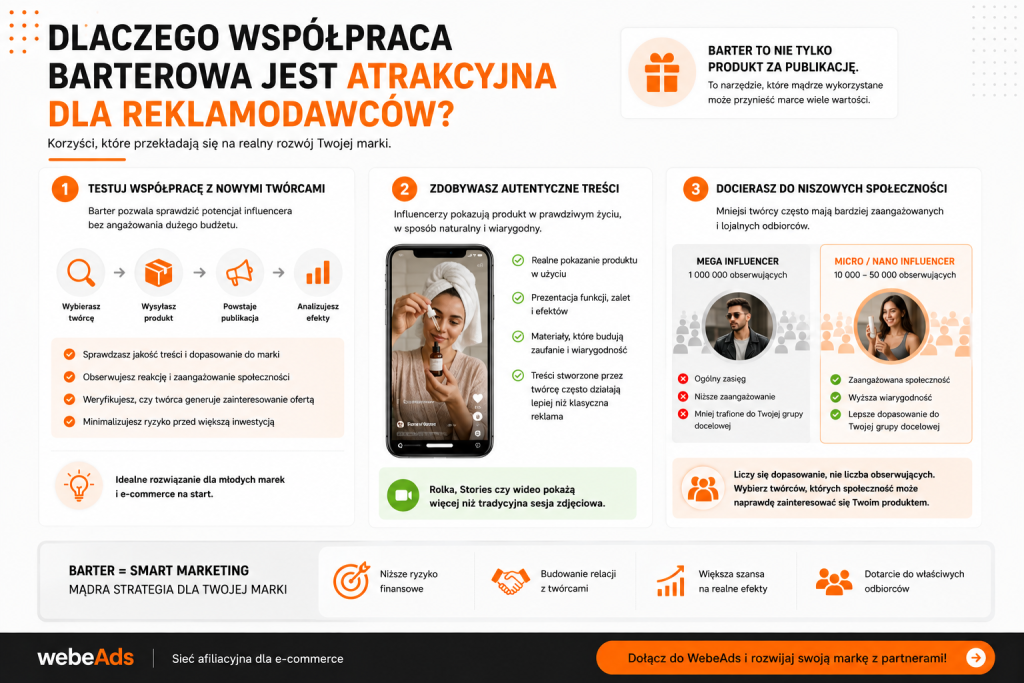
Imagine an online store selling professional accessories for runners. The brand could send a product to a lifestyle influencer with several hundred thousand followers or to a smaller creator specializing in long-distance running. The first will probably generate greater reach. The second, however, may reach people who are genuinely considering buying a similar product. This is why matching the influencer to the target audience should be one of the key criteria when choosing a barter partner.
Before sending a product, it is worth analyzing the profile’s main topics, the quality of its content, audience comments, previous advertising collaborations, and the way the creator recommends products. Profiles are particularly valuable when followers not only leave likes, but also ask about price, availability, features, or experiences related to the products being presented. Barter collaboration works best when the recommendation feels like a natural part of the influencer’s existing content. If the audience can immediately see that the product does not fit the profile at all, even a large reach may have little business value.
This distinction is particularly important for advertisers. If a brand provides an influencer with a product or service in exchange for agreed promotional activities, it is considered a commercial collaboration. According to UOKiK, a product or service received by an influencer as part of such a barter arrangement constitutes a material benefit, so the publication must be properly labeled as advertising content. Therefore, the absence of a direct payment does not mean that the collaboration is not advertising.
A different situation may involve the first no-obligation PR package, where a brand sends a product without agreeing on any publication and without influencing the content. UOKiK points out that the nature of the relationship between the brand and the creator matters here, and situations involving subsequent, regular product shipments should be assessed individually. For advertisers, the best solution is therefore to clearly define the rules before any activities begin. The creator should know what the brand expects, what materials should be created, when they should be published, and how the collaboration should be disclosed. This way, barter stops being a spontaneous product shipment and becomes a planned marketing activity whose results can later be analyzed.
Combine Barter With Affiliate Marketing and Start Measuring Results
A successful barter collaboration begins before the product is even sent. First and foremost, the advertiser should define what they want to achieve through the collaboration. The goal may be to increase product awareness, obtain new content, generate traffic to the online store, reach a specific target audience, or drive direct sales.
Only then should the brand select influencers and define the scope of activities. If the goal is to demonstrate how a product works, a reel or video may be the right format. If the brand wants to generate traffic to the store, Stories with a link can be effective. For sales-focused campaigns, an individual affiliate link or discount code can be particularly useful. The brief is also important. However, it should not turn the influencer into an actor simply reading a script prepared by the brand. The creator knows their community best and understands what type of communication feels natural to them. The advertiser should define the key product information, campaign objective, and requirements, while still leaving room for creativity. A barter collaboration should be a balance between brand control and creator authenticity.
This is one of the most frequently overlooked elements of barter collaborations. A brand sends out products, influencers publish content, views and comments appear, but after a few weeks it can be difficult to answer a basic question: was the campaign actually profitable? That is why it is worth defining specific KPIs before the campaign begins.
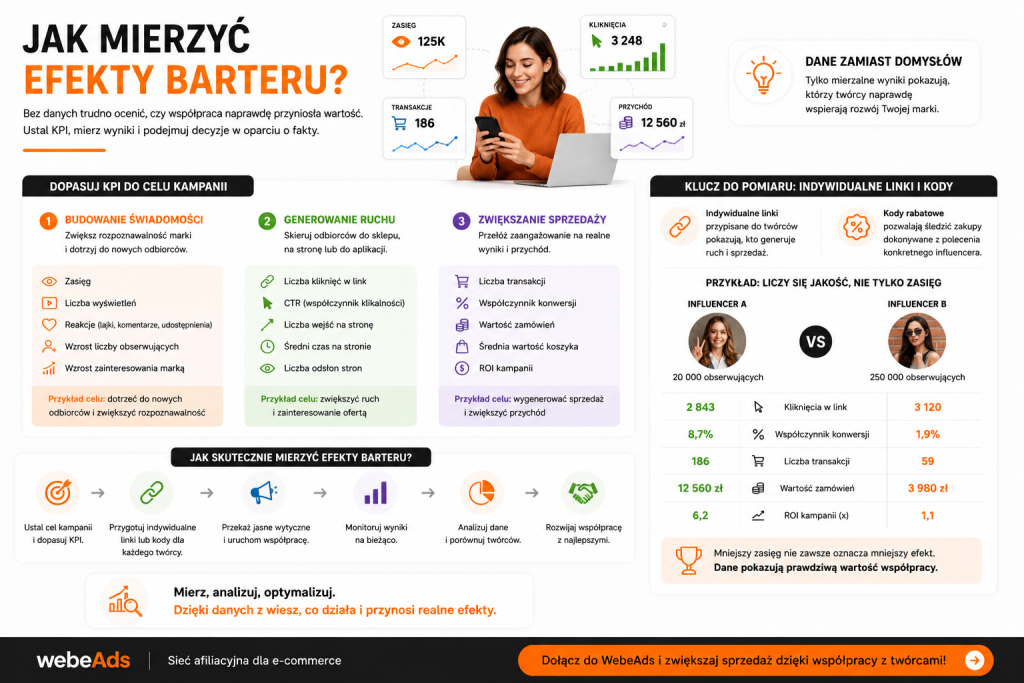
If the goal is to build awareness, you can analyze reach, the number of content views, audience reactions, or increased interest in the brand’s profile. In traffic-focused campaigns, clicks and website visits are more important. For sales-oriented activities, it is worth monitoring the number of transactions, conversion rate, and the value of generated orders. Individual links and codes assigned to specific creators are particularly important here. They can show, for example, that an influencer with 20,000 followers generated more valuable actions than a profile several times larger. Only this kind of data makes it possible to assess the real value of the collaboration.
Barter is often seen as a low-cost way to promote a brand. The problem arises when the advertiser forgets to calculate its real cost. If a product sells for PLN 300, sending it to one influencer may seem like a small investment. However, if the brand works with 100 creators at the same time, the costs of products, logistics, package preparation, and managing the entire campaign quickly add up.
An even bigger problem is the lack of proper selection. Mass-sending products to random profiles may generate a large number of publications, but little sales value. Barter also starts to lose its appeal when a brand expects a very extensive package of promotional activities in exchange for a product of relatively low value. Professional creators treat their channels like a business, so the value of the product provided should be proportionate to the expected scope of the collaboration. In some cases, a paid collaboration or a hybrid model may therefore be more profitable, where the influencer receives both the product and additional compensation based on the results achieved.
Launch an Affiliate Program and Grow Collaborations With Top Influencers
Barter can be a great starting point for a relationship with an influencer, but it does not have to be the end of it. Imagine a brand that sends products to ten creators. After the campaign ends, it turns out that three of them generated particularly strong interest. Their audiences asked about the product, visited the store, and used discount codes.
Instead of organizing another random product shipment, the advertiser can invite those particular creators to join the affiliate program. The influencer receives an individual affiliate link and can continue recommending products to their community. If their activities lead to sales, they receive an agreed commission. The brand, in turn, can monitor results more accurately and develop collaborations with partners who actually generate measurable outcomes. This creates a simple model:
barter → collaboration test → performance analysis → affiliate marketing → long-term partnership
This way, barter collaboration is not just a one-off promotional activity. It can become the first stage in building a network of valuable sales partners.
Combining both models allows brands to take advantage of their greatest strengths. Barter lowers the entry barrier to collaboration and gives the influencer a chance to get to know the product. The creator can test it, create authentic content, and see how their community responds. Affiliate marketing adds measurability and long-term motivation. From the advertiser’s perspective, this is particularly valuable. The brand does not have to make a large investment in every creator from the start. It can first test the potential of the collaboration and then develop relationships with influencers whose audiences genuinely respond to the offer.
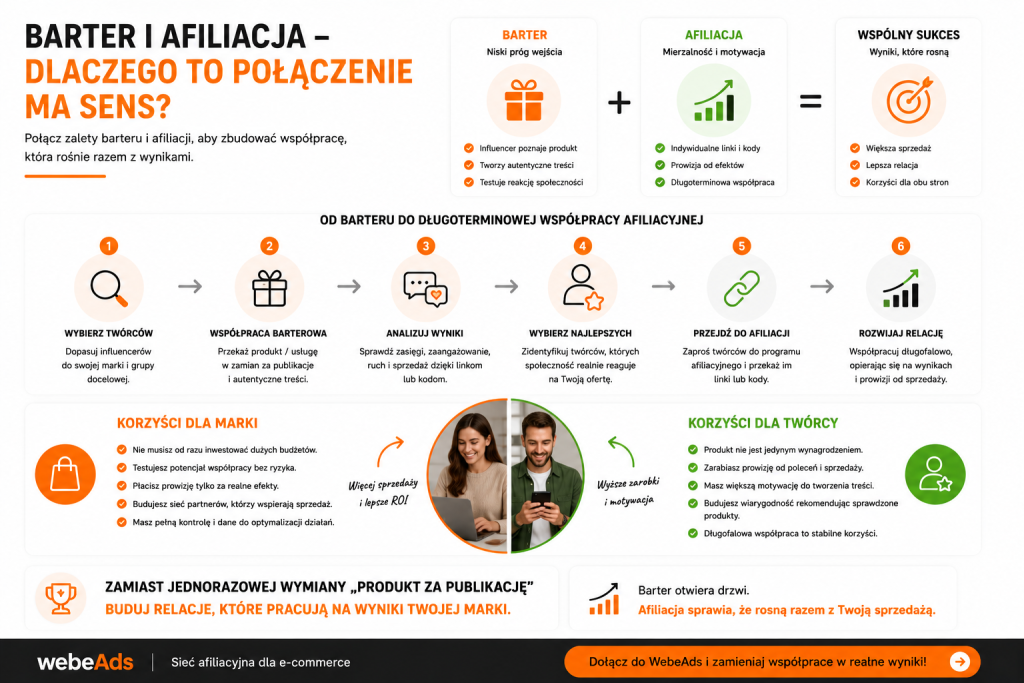
The creator also gains an additional benefit. The product is no longer their only form of compensation. If the recommendation generates sales, the influencer can earn commission based on the results of their work. This changes the nature of the entire relationship. Instead of a one-off “product in exchange for a publication” arrangement, the collaboration becomes one in which both the brand and the creator are focused on long-term results.
For a brand that wants to move from individual collaborations to more scalable activities, the natural next step may be to launch an affiliate program.
WebeAds allows advertisers to develop collaborations with different types of publishers and build an additional sales channel based on measurable results. Influencers can be part of such an ecosystem alongside content publishers, niche websites, comparison platforms, coupon sites, and other affiliate partners. This means that activities do not have to end with the final barter publication. The most valuable partners can continue promoting the offer and earn commission for the results they generate, while the advertiser can analyze the effectiveness of individual sources. This makes it possible to move from random promotional activities to a more predictable and measurable collaboration model.
Barter collaboration can be an effective way to promote a brand, but only when it is well planned. Simply sending a product to an influencer does not guarantee reach, interest, or sales. What matters most is matching the creator to the target audience, defining a clear goal, setting appropriate collaboration terms, and measuring the results. Advertisers should also remember that barter has a real cost and should not be treated as free advertising.
The most interesting opportunities arise when barter becomes the beginning of a longer-term relationship. A brand can test a collaboration with a creator, analyze how their community responds, and then invite the best-performing partners to join the affiliate program. This way, the influencer is no longer simply someone who received a product in exchange for a publication. They can become a long-term partner supporting the brand’s sales. If you want to develop activities based on measurable results, join WebeAds and see how affiliate marketing can complement creator collaborations and help scale sales.