
“Let’s send the product to an influencer and have them feature it on Instagram or TikTok.”
At first glance, barter seems like one of the simplest ways to promote a brand. The advertiser provides a product or service, the influencer creates content, and the brand gains visibility among potential customers. Without large media budgets, complex ad production, or the risk of an expensive campaign.
The problem begins when barter is treated as “free advertising.” Because in reality, it is not free. The product has value, the marketing team’s time costs money, logistics require resources, and a poorly matched influencer may not only fail to generate sales but also dilute the brand image. That is why more and more advertisers are asking a more important question today: not “how many products can we send to influencers?”, but which barter collaborations actually deliver results?
This is where barter begins to connect with modern performance marketing. When an affiliate link, discount code, sales tracking, and a clear payment model are added to an influencer collaboration, barter stops being a random PR activity. It becomes part of a measurable strategy.
When does barter with influencers work, when does it become a waste of budget, and how does WebeAds help advertisers turn product-based collaborations into real business results?
Barter is a form of collaboration in which a brand provides an influencer with a product, service, or access to an offer in exchange for specific promotional activities. These most commonly include social media posts, reviews, stories, reels, unboxings, blog posts, or video content.
In practice, barter can take different forms:
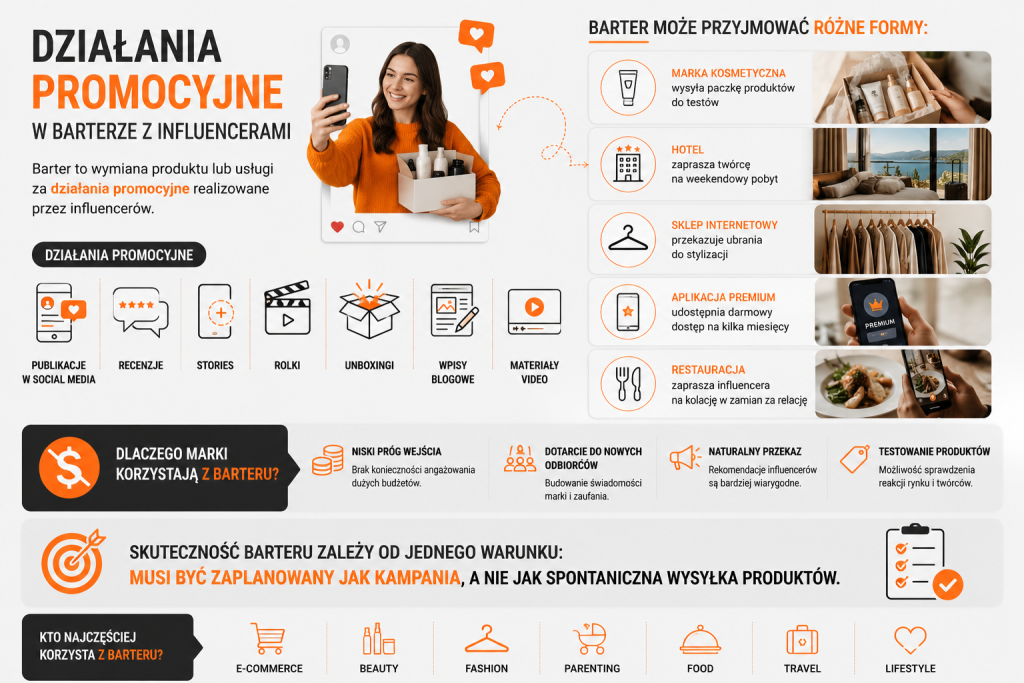
For advertisers, barter can be attractive because it allows them to start working with influencers without a large cash budget. It is particularly popular among young brands, e-commerce businesses, and companies in the beauty, fashion, parenting, food, travel, and lifestyle sectors.
However, the effectiveness of barter depends on one condition: it must be planned like a campaign, not treated as a spontaneous product giveaway.
For many advertisers, the biggest advantage of barter is that it does not require a large advertising budget. Instead of paying an influencer several or even tens of thousands of zlotys for a publication, the brand provides a product it already has in stock.
This is particularly appealing to companies that are just starting to test influencer marketing. Barter allows them to see how a particular audience responds to the product, which content formats work best, and which creators are able to generate engagement.
Not every influencer with a large reach will be effective at driving sales. Barter makes it possible to test a collaboration on a smaller scale before the brand decides to invest in a larger paid campaign.
This is important because in influencer marketing, the quality of the community matters more and more than the numbers alone. A creator with 15,000 engaged followers may generate better results than a profile with 200,000 random followers.
A well-executed barter collaboration feels natural. The influencer shows the product in everyday use, tests it, talks about their experience, and answers questions from their community.
This is a completely different type of interaction than traditional display advertising. The audience does not see a banner. They see a person they follow and often trust.
This is exactly why influencer marketing is growing globally. According to Influencer Marketing Hub, the influencer marketing market is expected to exceed $32 billion in 2025, and more than 80% of marketers consider this channel an effective part of their strategy.
Want to See Which Influencers Actually Generate Sales?
Barter works when it is part of a broader marketing strategy. Simply sending a product to a creator does not guarantee results. Effectiveness comes only when the brand knows why it is running the collaboration, who it is choosing, what it wants to measure, and how it will use the attention generated.
The basic condition for effective barter is simple: the product must be relevant to the creator’s audience.
If a beauty brand sends cosmetics to an influencer who specializes in skincare, the collaboration has a natural context. If an electronics store works with a tech creator, the audience is already open to product recommendations.
The problem arises when an advertiser chooses an influencer solely based on the number of followers. Barter with a random creator may generate reach, but not necessarily sales.
Barter works particularly well with micro- and nano-influencers. They have smaller communities, but often higher engagement rates and closer relationships with their audiences.
For advertisers, this means a greater chance of receiving a genuine recommendation. Users are more likely to respond to a creator they see as a trusted expert than to a major celebrity who publishes many sponsored posts each week.
This represents an important shift in the approach to influencer marketing. Brands are increasingly moving away from the idea that “a bigger profile = better results” and are starting to analyze relevance, credibility, and the quality of interactions instead.
Barter designed to build brand awareness will look different from barter aimed at generating website traffic, and different again from barter focused on sales.
Examples of goals for a barter campaign:
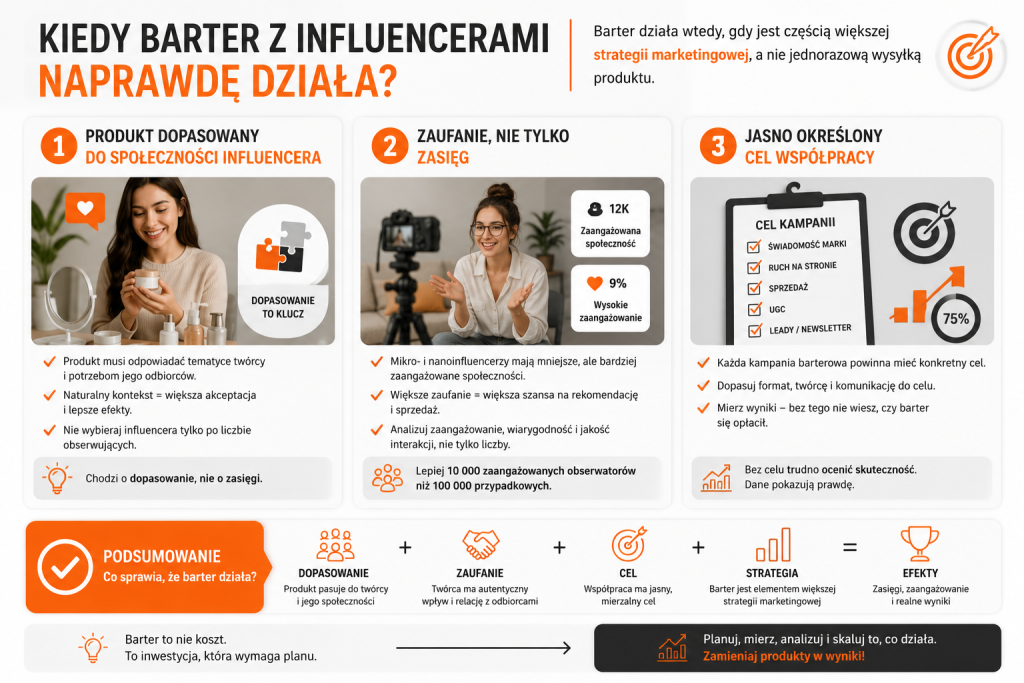
Without a clear goal, it is difficult to determine whether the barter collaboration was worthwhile. Ten thousand story views may look impressive, but if the goal was sales, the number of views alone says very little.
Barter becomes a waste of budget when a brand does not measure results, chooses creators randomly, and has no control over how the offer is presented.
The biggest mistake advertisers make is treating barter as an “incidental” activity. We send out packages, wait for mentions, collect screenshots of published content, and consider the matter closed.
Meanwhile, the real questions should be:
If the brand does not know the answers, barter remains a cost rather than an investment.
Follower count is the easiest metric to check, but one of the least sufficient. A large account may have low engagement, an inactive community, or an audience that is completely mismatched with the product.
Much more important are:
A good influencer for barter is not always the one with the largest profile. It is the one whose audience may genuinely be interested in the offer.
Barter should not mean chaos. Even if the collaboration is not paid in cash, the advertiser should prepare clear guidelines.
The brief should define:
Without a brief, disappointment is almost inevitable. The influencer publishes content that fails to highlight the product’s key benefits, the brand does not have the right to reuse the material, and the campaign results become unpredictable.
This is the most serious mistake, especially from an advertiser’s perspective.
If an influencer showcases a product but does not have an individual link, discount code, or tracking, the brand does not know whether the collaboration delivered results. It can evaluate likes and comments, but not sales.
That is why more and more companies are combining barter with affiliate marketing. The influencer receives the product, but also gets an affiliate link or code that makes it possible to attribute sales to a specific creator.
This changes the entire logic of the collaboration: barter stops being a “blind product send-out” and becomes a measurable performance channel.
Join WebeAds and Turn Barter Collaborations Into a Measurable Performance Channel.
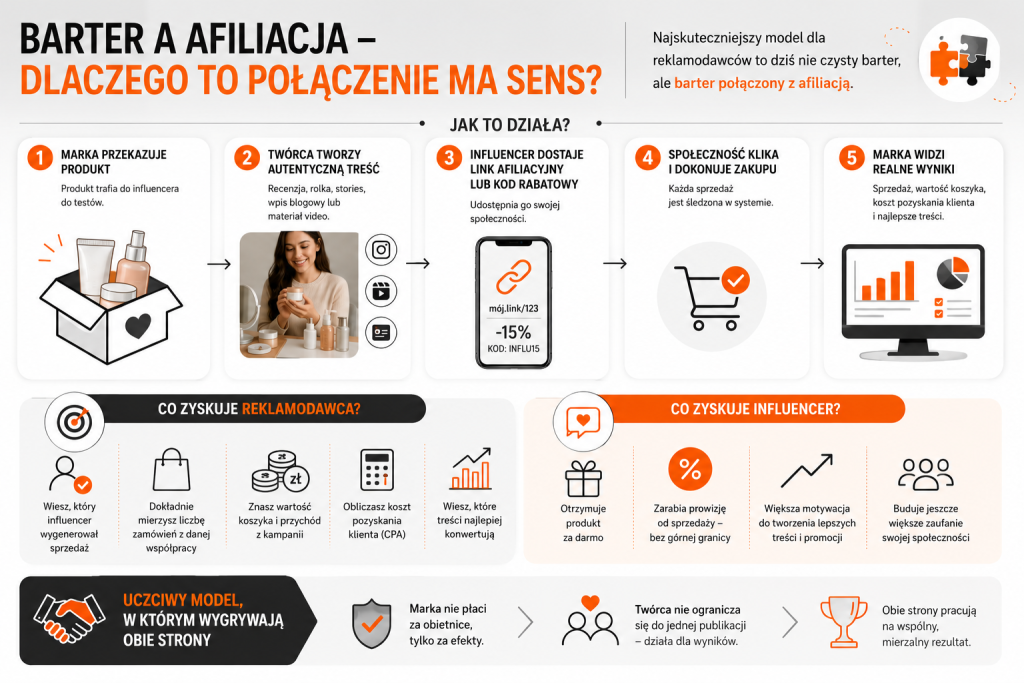
The most effective model for advertisers today is not pure barter, but barter combined with affiliate marketing.
How does it work?
The brand provides the influencer with a product to test. The creator prepares authentic content: a review, reel, stories, blog post, or video. In addition, they receive an individual affiliate link or discount code. Every sale generated through that link is visible in the system.
This allows the advertiser to know:
The influencer also benefits because, in addition to the product, they can receive a commission based on results. This increases their motivation to create better content and promote the offer for longer.
This model is fairer for both sides. The brand does not pay for promises, and the creator is not limited to a single publication “because that was the agreement.” Both sides work toward a shared result.
WebeAds allows advertisers to approach barter collaborations as a fully-fledged marketing channel: with measurement, control, and the ability to scale.
Instead of sending products to random creators and hoping for results, the brand can use an affiliate network to structure and organize the collaboration.
WebeAds helps in areas such as:
This is particularly important for advertisers who want to know not only who showcased the product, but who actually contributed to sales.
Modern barter should not end with sending out a PR package. The influencer marketing market is maturing, and advertisers increasingly expect data, transparency, and results.
According to trends identified by IAB Polska, influencer marketing is currently being driven by social commerce, AI, changes in consumer behavior, and the growing popularity of content created on social media. This means that influencers will continue to be an important part of brand communication, but the way collaborations are measured and compensated will become increasingly professional.
Barter still makes sense, but only when it is part of a broader system. It works best when it combines:
With this approach, the advertiser does not have to guess whether the barter collaboration was worthwhile. The data shows it clearly.
Barter with influencers can be an effective promotional tool. It can build brand awareness, generate authentic content, increase website traffic, and support sales.
But barter without a strategy, brief, and measurement can very easily become a waste of budget.
The key takeaway for advertisers is simple: do not evaluate barter based on the number of publications. Evaluate it based on results.
If you want to know which influencers actually drive sales, combine barter with affiliate marketing. With WebeAds, you can measure results, analyze the quality of collaborations, and scale only the activities that deliver a real return.
Gain Access to Publishers, Influencers, Affiliate Links, and Reports That Show Where Results Are Really Generated.