

Imagine an online store visited by thousands of users every day. Some browse products, others add items to their cart, subscribe to a newsletter, or make their first purchase. Each of these activities provides valuable information about customer interests and needs. The problem is that without the right tools, using all of this data effectively becomes almost impossible. Manually sending messages, preparing new campaigns, updating audience groups, or analyzing results takes time that could be spent on growing the business. What is more, even a large marketing team cannot react to every user action at exactly the right moment. That is why marketing automization, more commonly referred to as marketing automation, is becoming increasingly important. With properly designed processes, companies can run personalized communication, respond to customer behavior, and manage campaigns without having to perform every task manually.
However, it is not only about saving time. The greatest potential of automation lies in making better use of the marketing budget. Instead of sending the same messages to every audience, advertisers can tailor their activities to users’ needs, the stage of their customer journey, and their previous interactions with the brand.
Does this mean that automation always increases sales and reduces costs? Not necessarily. Poorly designed workflows can lead to unnecessary spending, frustrate audiences, and make it more difficult to evaluate campaign performance. That is why the key is not simply implementing technology, but understanding which processes are actually worth automating and how to measure their impact on business results.
Marketing automation is the use of software, data, and predefined rules to automatically carry out specific marketing activities. In practice, this means that a system can respond to particular user behaviors without requiring an employee to intervene each time.
For example, a customer visits an electronics store and browses several models of wireless headphones. They then add one product to the cart but do not complete the purchase. If they have provided the appropriate consent, the marketing automation system can send them a reminder about the unfinished purchase after a specified period of time. If the customer returns to the store and buys the headphones, they can automatically be moved into a different communication scenario, for example one that includes a product usage guide or suggestions for matching accessories. Everything happens based on predefined rules and data about the user’s activity. It is worth emphasizing, however, that marketing automation is much more than automated email messages. It also includes audience segmentation, content personalization, advertising campaign management, product recommendations, customer behavior analysis, and data synchronization between different systems.
Don’t Waste Time on Manual Tasks. Choose Automation and Grow Sales With WebeAds!
Well-implemented marketing automation does not replace a marketing strategy. It allows that strategy to be executed more efficiently, consistently, and at a larger scale.
As e-commerce continues to grow, so does not only the number of potential customers, but also the number of touchpoints between consumers and brands. A user may see a product on Instagram, read a review on a niche website, compare prices on Google, visit the store, subscribe to a newsletter, and only make a purchase several days later. Each of these interactions can influence the purchasing decision. At the same time, every interaction generates data that advertisers can use to better tailor their communication.
The problem appears when a company uses multiple tools, but customer information remains fragmented. The email marketing system stores one set of data, the advertising platform another, and the online store yet another. Without proper integration, it is difficult to build a consistent view of user behavior. Automation can help organize these processes. It makes it possible to transfer information between systems, update audience segments, and trigger specific actions based on defined events.
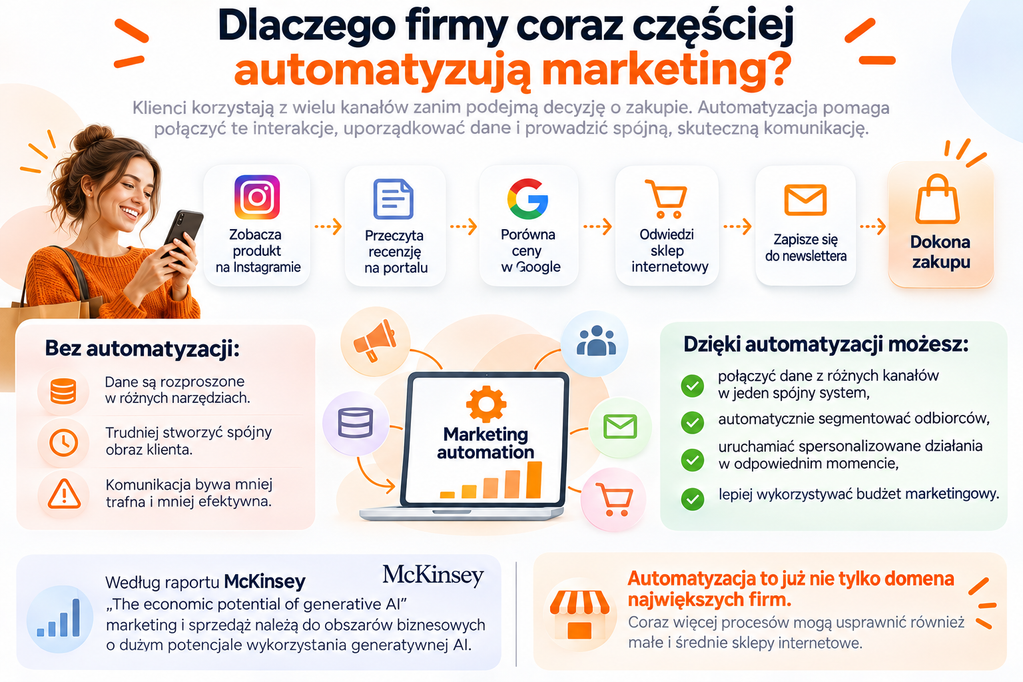
The importance of this technology is also growing alongside the development of artificial intelligence. According to McKinsey’s 2023 report The Economic Potential of Generative AI, marketing and sales are among the business functions with significant potential for the use of generative AI. The authors estimated that the technology could increase productivity in marketing and sales functions, although the actual results depend on how it is implemented and on the characteristics of the organization.
Source: McKinsey – The economic potential of generative AI.
For advertisers, the key takeaway is simple: automation is no longer a solution reserved only for the largest companies. More and more processes can also be improved in small and medium-sized online stores, provided that the implementation addresses real business needs.
One of the most common arguments in favor of marketing automation is its potential to reduce the cost of marketing activities. This does not mean, however, that simply implementing an automation system will automatically lower expenses. Savings appear when technology eliminates unnecessary tasks, improves the use of data, or increases the effectiveness of existing campaigns. Imagine an online store that acquires 5,000 new newsletter subscribers every month. In a traditional model, all of them receive similar promotional messages, regardless of which products they are interested in. After implementing automation, the store begins dividing recipients into groups based on their activity and preferences. People interested in sports equipment receive information about relevant products, while customers browsing home furnishings see different recommendations. As a result, the brand can reduce the number of irrelevant messages and make better use of its existing audience database.
Financial benefits can appear at several levels. The first is saving the marketing team’s time. Repetitive tasks such as sending welcome messages, reminders, or updating audience segments do not require constant manual handling. The second is better communication relevance. Instead of promoting every product to every user, advertisers can focus their activities on offers that match specific interests. The third is reducing unnecessary advertising spend. For example, a system can update audience lists and exclude people who have already purchased the promoted product from selected campaigns, provided that the available data and advertising platform settings allow it. The fourth is the potential to increase customer value over time. Automated post-purchase scenarios, replenishment reminders, or recommendations for complementary products can encourage repeat purchases.
It is also important to take into account the costs of implementation, subscription fees, integration, and system maintenance. Only by comparing these expenses with the benefits achieved can a company assess the actual profitability of marketing automation.
Cart abandonment is a natural part of e-commerce. Users add products to their carts for many different reasons: they may want to check the final price, compare offers, calculate delivery costs, or simply save an interesting product for later. According to a Baymard Institute compilation based on multiple studies, the average observed cart abandonment rate is around 70%. This does not mean that every abandoned cart can be recovered. Some users never intended to make an immediate purchase in the first place.
Source: Baymard Institute – Cart Abandonment Rate Statistics.
For advertisers, however, this is a signal that it is worth taking a closer look at the purchasing process and the ways of reconnecting with potential customers. An example automation scenario might look like this:
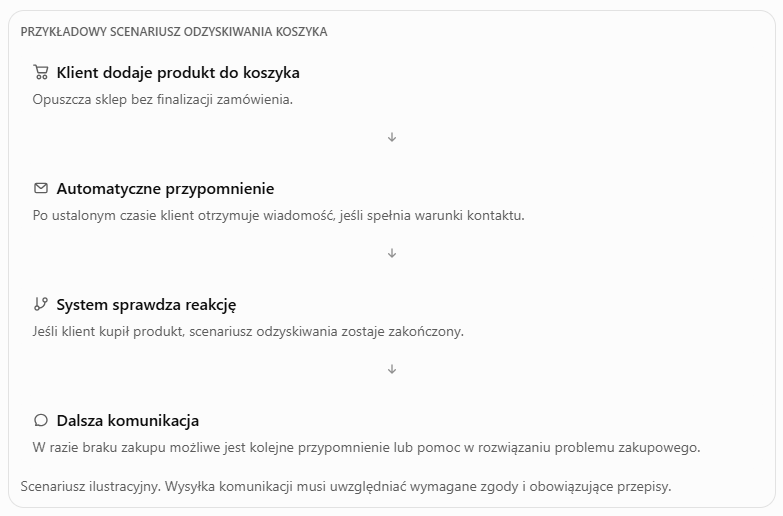
It is important that automation does not simply become a constant stream of discounts. If a customer regularly receives a discount after abandoning their cart, they may learn to deliberately postpone the purchase in anticipation of a promotion. In some cases, a simple product reminder, delivery information, or clarification of the return policy may be much more effective. A good marketing automation scenario should remove barriers to purchase rather than simply reduce the product price.
One of the biggest advantages of marketing automation is the ability to tailor communication to the behaviors and interests of different customer groups. Personalization does not have to mean creating a separate campaign for every individual. In many cases, effective audience segmentation is enough.
A sportswear store, for example, can distinguish between customers interested in running, strength training, and outdoor activities. Each of these groups can receive different product recommendations, guides, and information about promotions. Even more opportunities arise when the system also takes purchase history into account. Someone who has recently bought running shoes can be offered technical socks or training accessories. A customer who regularly orders consumable products can be reminded to purchase them again at the right time. These activities can improve the relevance of communication and reduce the number of messages that recipients consider irrelevant.
Less Operational Work, More Sales Opportunities
It is worth remembering, however, that personalization should be based on reliable data and on using that data in accordance with the law. Excessive user tracking or overly detailed messages can make customers feel uncomfortable and negatively affect trust in the brand. That is why the best personalization is the kind that helps the customer instead of making them feel that the brand knows too much about them.
Automation is increasingly being used in paid campaigns as well. Advertising platforms use algorithms to optimize bids, select placements, match ads, and identify users who are more likely to complete a specific action. Examples include automated bidding solutions in Google Ads and campaigns that use machine learning to optimize ad delivery. For advertisers, this means reducing some of the manual work involved in campaign management. The system can analyze a large number of signals and make decisions far more frequently than a human could. However, this does not mean that the algorithm will always choose the most profitable solution.
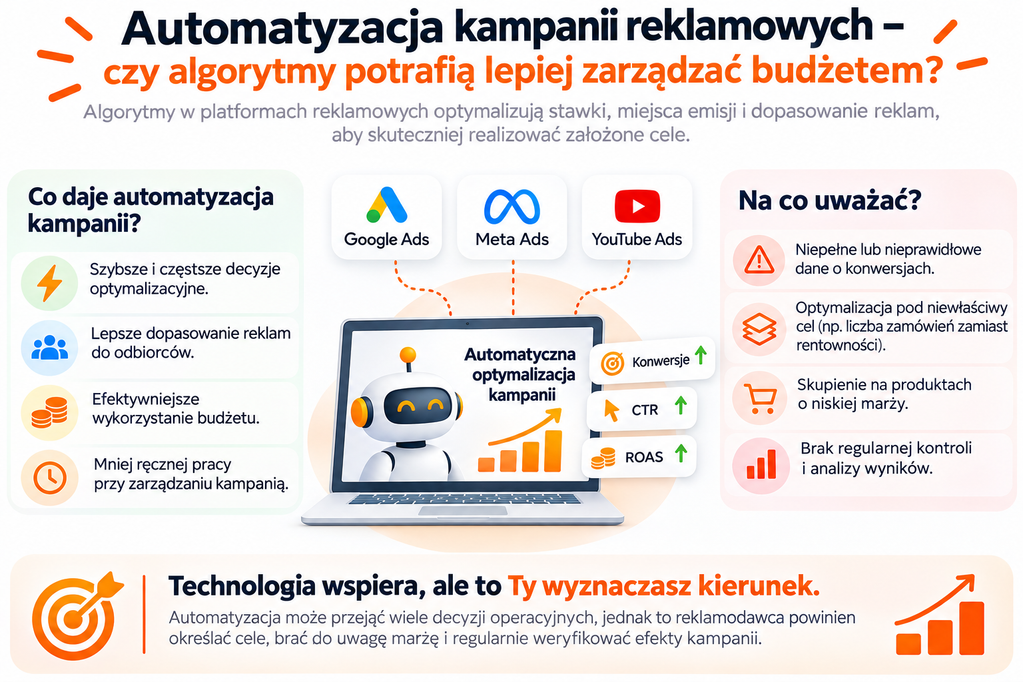
Automated systems optimize activities primarily based on the goals and data they receive. If an advertiser provides incorrect conversion data or fails to account for the actual value of orders, the campaign may appear to perform well in the advertising dashboard while still failing to generate the expected profit. For example, the system may successfully increase the number of orders while focusing on low-margin products. In such a case, higher sales do not necessarily mean better profitability. That is why even the most advanced automation requires proper oversight. Advertisers should regularly monitor data quality, analyze results in the context of margins, update campaign goals, and check whether automated decisions remain aligned with the broader business strategy. Automation can take over many operational decisions, but people should still define which outcomes are truly valuable for the business.
Just a few years ago, marketing automation was based primarily on simple rules: if a user performed a specific action, the system triggered a predefined scenario. Today, artificial intelligence is playing an increasingly important role, making it possible to analyze larger datasets, identify patterns, and adjust activities to changing customer behavior.
The difference is significant. Traditional automation performs tasks according to predefined rules. AI-powered systems can additionally help predict which actions are most likely to deliver the desired result. Imagine an online store selling cosmetics. A standard marketing automation system may send the same welcome message to every new subscriber. A more advanced solution can analyze the user’s previous interactions, interest in specific categories, and purchase history to select the right content, products, or timing of communication. Artificial intelligence is also used to create advertising messages, analyze campaign performance, recommend products, and segment audiences. This does not mean, however, that AI should manage the entire marketing process on its own. Generated content may contain errors, recommendations may be based on incomplete data, and algorithms do not always take the broader business context into account. The greatest value comes from combining the capabilities of technology with the knowledge of the marketing team. AI can speed up analysis and task execution, but the advertiser should still make decisions about strategy, budget, and goals.
Implementing marketing automation does not have to mean immediately rebuilding the entire marketing strategy. In many cases, a better approach is to start with a few repetitive processes that take up a lot of time or have a direct impact on sales.
For an online store, a good starting point may be automating communication with new customers. Welcome messages, information related to the first order, or recommendations for complementary products can be prepared as scenarios triggered by specific events. Another area is abandoned cart recovery. Well-designed reminders can help customers complete their purchases, especially when they address real concerns or barriers. It is also worth considering the automation of audience segmentation. Instead of manually updating lists of customers interested in particular categories, the system can assign users to the appropriate groups based on the available data. Automated product information management also has significant potential. Stores with thousands of products regularly change prices, stock levels, and assortments. Up-to-date product feeds make it possible to pass this information to external systems, reducing the need to update offers manually.
Let Technology Streamline Your Marketing While Publishers Help Grow Your Sales!
Not every activity needs to be automated. Creating a communication strategy, building relationships with key partners, or making decisions about brand positioning still requires knowledge, experience, and an understanding of the market. That is why, before implementing automation, it is worth asking: will automating this process actually save time, reduce costs, or improve the customer experience? If the answer is unclear, it may not be the best area to start with.
Marketing automation is most often associated with email marketing, CRM systems, and advertising campaigns. In reality, similar mechanisms also play an important role in affiliate marketing.
Working with online publishers involves managing many processes: providing promotional materials, generating affiliate links, tracking clicks, attributing transactions, verifying orders, and calculating commissions. Imagine an online store working with dozens of partners. Each of them promotes different products, uses different communication channels, and generates their own sales results. Manually assigning every transaction to a specific publisher would be time-consuming and, at a larger scale, difficult to manage. That is why affiliate systems use tracking mechanisms and automated data processing. When a user visits the store through the appropriate affiliate link, the system can record the interaction. If the user later completes a purchase that meets the program conditions, the transaction can be attributed to the appropriate publisher according to the applicable attribution rules.
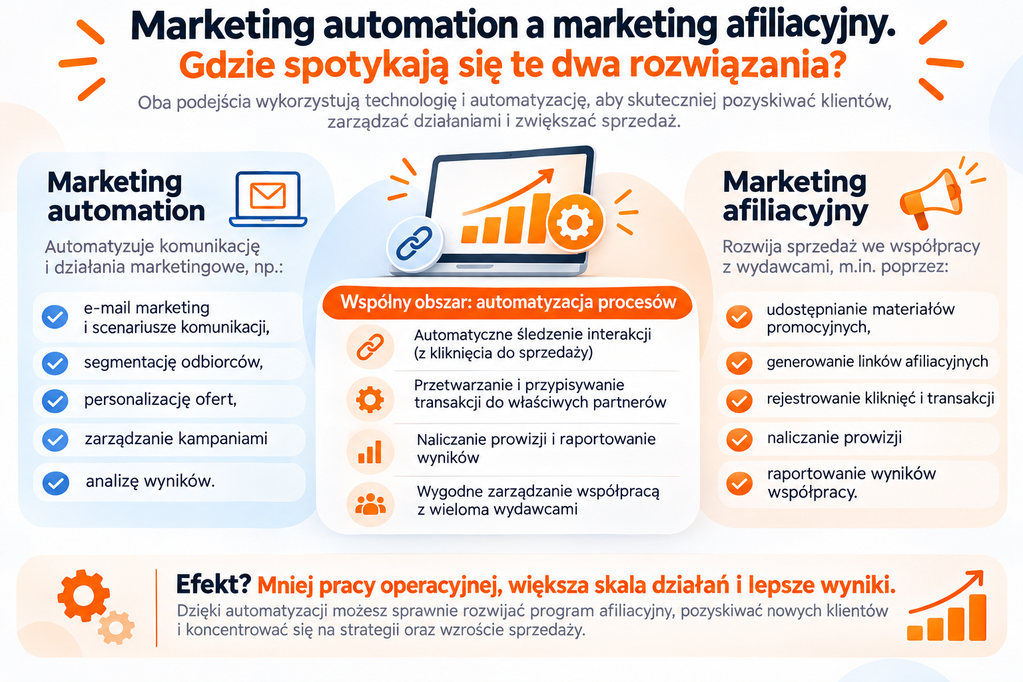
Automation also makes it easier to calculate commissions, prepare reports, and manage a larger number of partners. It is important, however, to distinguish between automatically recording transactions and giving them final approval. Orders may still require verification, for example because of returns, cancellations, or specific program conditions. For advertisers, the key benefit is that technology reduces part of the operational workload, allowing them to focus more on developing publisher partnerships and analyzing their results.
One practical example of automation in affiliate marketing is the use of XML product feeds. A store with a large product range can provide partners with structured product information, including product names, prices, images, availability, and product page URLs. This means that a publisher running a price comparison website or product-focused platform does not need to manually add every item to their own system.
Let’s assume a store sells 20,000 products and their prices and availability change regularly. Manually sending updates to partners would be inefficient. A properly prepared feed allows external systems to retrieve the data periodically and update the displayed offers. For the advertiser, this means an easier way to share the product range with multiple partners, while publishers gain the ability to build more advanced shopping tools. Automation alone, however, does not guarantee high-quality data. If the feed contains outdated prices, incorrect links, or incomplete descriptions, those issues can be automatically replicated across other systems. That is why regular data verification is just as important as making the data available in the first place. Automation speeds up the distribution of information, but it does not replace responsibility for its accuracy.
Automate Processes, Not Opportunities
Saving time is an important benefit, but it should not be the only reason for implementing automation. Advertisers should assess whether new solutions actually improve business performance and whether the benefits justify the costs involved.
In practice, it is worth analyzing several areas:
It is also worth considering costs that are not always visible in the software provider’s basic offer. Integrations with other systems, preparing automation scenarios, employee training, and ongoing maintenance can have a significant impact on the total cost of the project. Let’s look at a simplified example.
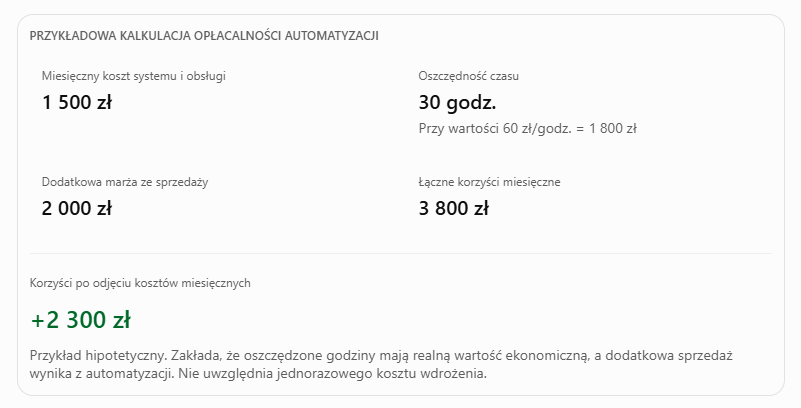
This type of calculation shows that the profitability of automation does not have to come solely from increased sales. Reducing operational workload can also be an important source of value. However, caution is needed when attributing results to specific activities. Not every transaction completed after a customer receives an automated message was necessarily caused by that message. That is why more advanced analyses should include control groups and testing methods that help determine whether automation is actually generating additional value.
Automation can improve marketing efficiency, but when implemented incorrectly, it can also increase costs and make communication more difficult to manage. One of the most common mistakes is automating processes that have not been properly organized beforehand. If a company lacks clear customer segmentation rules, a consistent communication strategy, or reliable data, a new tool will not solve these problems. It may actually accelerate their duplication. Another mistake is sending too many messages. A user who receives a welcome message, an abandoned cart reminder, a promotional newsletter, and another product recommendation within a short period of time may feel overwhelmed. That is why it is important to control contact frequency and set priorities for individual automation scenarios. Another common problem is failing to update automation workflows. A scenario created a year earlier may no longer reflect the store’s current offer, customer behavior, or pricing strategy.
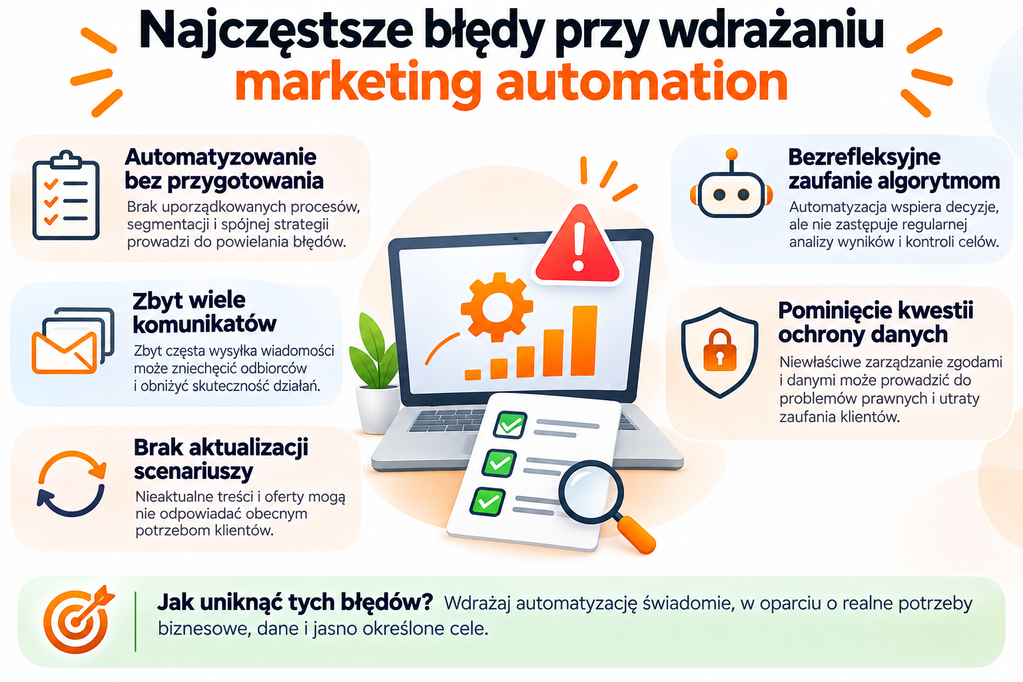
It is also risky to rely on algorithms without sufficient oversight. Even if a system automatically optimizes campaigns, advertisers should regularly review the results and verify whether the goals being pursued remain profitable. Another important mistake is overlooking data protection and marketing consent requirements. Automation does not exempt a company from complying with regulations governing the processing of personal data and electronic communications. The best results come not from automating everything, but from consciously choosing the processes that are genuinely worth improving.
Marketing automation can help advertisers make better use of their own data and communication channels. However, it does not solve every challenge related to customer acquisition. Even a well-optimized online store needs new traffic sources and ways to reach people who are not yet familiar with its offer. One solution may be to develop an affiliate program with WebeAds. The network enables advertisers to establish partnerships with online publishers who promote products and services through their own channels. These may include blogs, niche websites, price comparison platforms, coupon websites, online creators, and other partners interested in promoting the offer.
Turn Time Spent Managing Campaigns Into New Sales Opportunities
Affiliate collaboration uses a tracking system that makes it possible to record specific user interactions and attribute transactions to publishers according to the program rules. As a result, advertisers can manage cooperation with multiple partners without having to manually analyze every click and assign each order themselves. In the CPS model, the publisher’s commission is linked to generated sales, making it possible to combine the development of an additional promotional channel with measurable results. It is worth remembering, however, that affiliate marketing and marketing automation serve different purposes. Automation helps streamline marketing processes, while an affiliate program makes it possible to develop partnerships with external publishers who can bring new customers to the store.
Combining these two solutions can be particularly valuable: automation helps manage users and processes more efficiently, while affiliate marketing expands the brand’s ability to reach audiences beyond its own advertising channels.
Marketing automation is not an end in itself. Its purpose is to streamline processes, improve the quality of communication, and help companies use their available resources more effectively. Well-designed workflows can reduce the number of repetitive tasks, support personalization, help recover abandoned carts, and improve the effectiveness of post-purchase activities. At the same time, even the best tools cannot replace a well-thought-out strategy, a strong understanding of customers, and regular performance analysis. Advertisers should therefore treat marketing automation as one element of a broader sales growth system. Their own campaigns, customer communication, analytics tools, and cooperation with publishers can all complement one another.
There is no single universal set of automations that will work for every company. The best approach is to implement processes gradually, measure their effectiveness, and develop the activities that deliver real business value. Effective marketing automization is not about doing more things automatically. It is about using technology to achieve better results while making sensible use of time and budget. Want to grow sales beyond automating your own campaigns? Join WebeAds, launch an affiliate program, and start working with publishers who can help your brand reach new customers and generate sales through a performance-based model.