
The growing importance of affiliate marketing is undeniable. In the United States, over 80% of brands already use affiliate marketing. In the face of the coronavirus pandemic, almost all sectors moved their sales activities online. Newly established companies had to expand their marketing activities into the digital world. Existing online stores also had to respond to the increasing competition emerging online. That is why many companies began investing in building brand awareness and increasing online visibility, and affiliate marketing helped them achieve this.
Affiliate marketing appeared in Poland only around 2010. Its huge potential is still not being fully used, as only about 5% of advertisers in the e-commerce industry have chosen this form of promotion. The sooner an advertiser decides to start affiliate activities, the greater the chance of acquiring the best publishers for cooperation. A strong and effective publisher network is the foundation for all promotional activities that are billed only for results in the form of sales.
By definition, affiliate marketing is behavior involving the establishment and maintenance of positive contacts and cooperation by an individual, group, or organization with other groups and organizations. Affiliate marketing in e-commerce involves cooperation between an advertiser and a publisher. This cooperation consists of the publisher recommending the advertiser’s products and promoting selected products on their channels in exchange for a commission on each generated sale.
The idea of affiliate marketing was born at a party attended by the CEO and founder of Amazon – Jeff Bezos. There, he met a woman who wanted to sell books on her website. Bezos proposed redirecting visitors of her site who were interested in buying a book to the Amazon store website. For each book sold through her referral, he offered a commission. This is how the first Amazon affiliate program was created, which still operates to this day.
Thanks to affiliate marketing, advertisers strengthen brand awareness and increase sales. Publishers, in turn, receive a commission for effective referrals. Both sides benefit and are satisfied with the cooperation – a classic win-win situation.
An advertiser in affiliate marketing is the owner of an online store who wants to promote their products on publishers’ websites. If a sale occurs, the advertiser shares a previously agreed percentage of the profit from the sale with the publisher.
A publisher in affiliate marketing can be a person or company that recommends the advertiser’s products or services on their online channels or spaces and receives commissions from the transactions generated in the advertiser’s store.
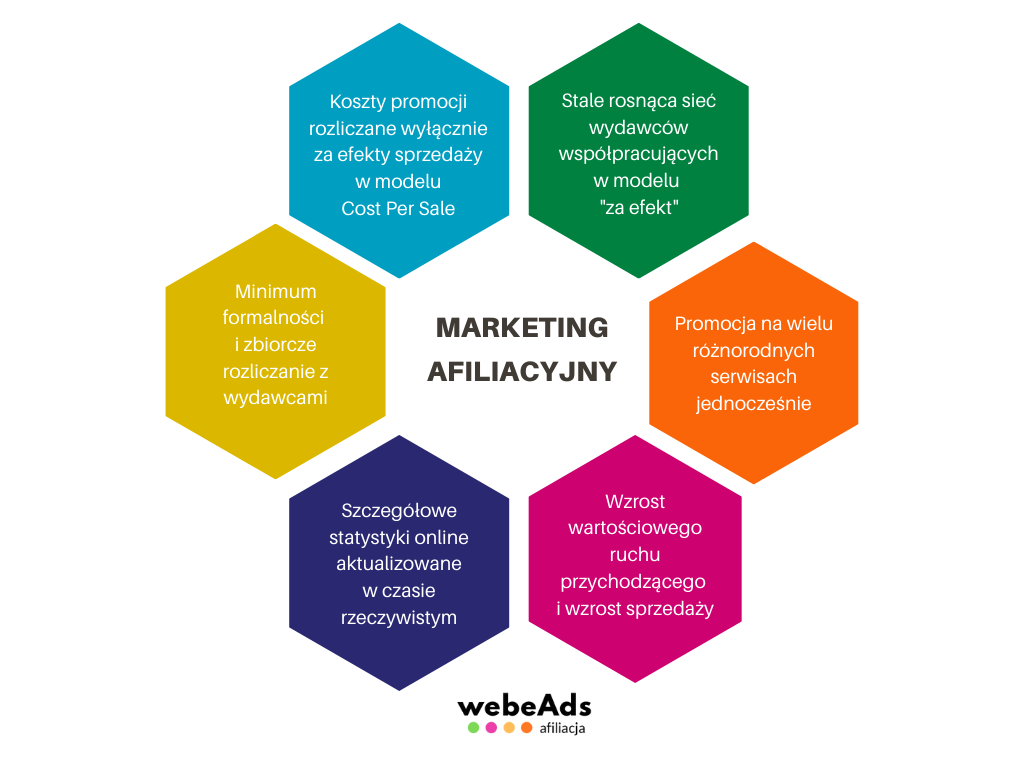
The most popular settlement model in affiliate marketing for e-commerce is the Cost Per Sale (CPS) model. The rules of this model are simple – the advertiser rewards the publisher’s efforts only when their referral leads to the purchase of the advertiser’s product. This allows advertisers to control their advertising campaign expenses, as they pay only for sales.
What does it look like in practice? Here is an example:
The owner of an online furniture store launched an affiliate program in which they set a 10% commission. An influencer who joined this program decided to promote this advertiser’s products in their inspiring blog posts about interior design. As a result, within a month they generated sales worth 12,000 PLN, so the furniture store owner will pay them a commission of 1,200 PLN.

A much less popular settlement model in affiliate marketing for e-commerce is Cost Per Lead (CPL). In this model, the advertiser does not pay a percentage commission as in CPS, but a fixed amount for delivering a sales lead. Acquired leads include, for example, filling out a form on a website, registering an account, subscribing to a newsletter, or downloading an e-book. The CPL model is mainly used to build a base of potential customers for a product or service.
It is also possible to use so-called hybrid models:
CPL + CPS – the publisher receives a fixed rate for delivering a lead, and if they generate transactions, the advertiser also pays a commission on sales.
CPC + CPS – the publisher receives a fixed rate for each click on an advertising creative and a commission on sales. This hybrid model is usually used in affiliate mailing campaigns or supporting brand-awareness campaigns.
CPC + CPL – the publisher receives payment for each click on an advertising creative and for each delivered lead.
To start affiliate activities, an advertiser must first launch an affiliate program. It is this program that makes it possible to build a network of publishers and cooperate with them in the Cost Per Sale model. A well-managed affiliate program can increase sales by as much as 20-30%. This is not the only advantage of using affiliate marketing in an online store.

There is no denying that affiliate activities are most effective when publishers run websites or accounts with topics aligned with the advertiser’s store assortment. In this case, advertisers can expect a high conversion rate, because publishers will direct people to the store who are strongly focused on products from that specific sector and advertiser.
However, there is nothing to prevent an advertiser from accepting publishers into their affiliate program who run websites not necessarily related to the program’s main category. Online creators operate across many websites and social media platforms, and the tools provided by the affiliate network allow them to easily integrate recommended products into the content they publish. Thanks to such publishers, advertising can reach a very wide audience that is sometimes difficult to reach through conventional marketing methods.
The advertiser independently sets the commission rate in the affiliate program. They can first analyze what commission percentage to set so that its value does not exceed the profit from the sale.
What’s more, if transactions have not been paid for, the buyer has not collected the shipment, or the product has been returned, the advertiser does not have to pay the commission. As mentioned earlier – the advertiser pays a commission only when they earn money from the sale. Incorrect transactions are rejected by the advertiser in the user panel of the affiliate system.
In affiliate marketing, the potential risk of unsuccessful activities is borne by the publishers. Why? It is the publisher who invests time in promoting the product and leading it to a sale. If their efforts do not prove effective, they do not receive their commission. The commission-based system in the Cost Per Sale model guarantees online stores no costs when there are no sales.
Building and developing an effective publisher network is the foundation of the benefits mentioned above. Recruiting publishers for an affiliate program can be time-consuming. For this purpose, it is worth partnering with an affiliate network such as ours – webeAds. We have over 12,000 publishers in our database and are constantly acquiring new partners interested in cooperation.

Publishers in our affiliate network have access to a list of affiliate programs. This allows them to choose an advertiser whose products best match the theme of the publisher’s channel. To join a program, the publisher must submit a request to join. Once the advertiser approves the request, the publisher gains access to advertising creatives and can start promoting products on their channel.
The advertiser can also invite publishers to their affiliate program independently. This is highly encouraged and recommended. The store owner knows their industry best and knows exactly which publishers’ websites they would like to be promoted on.
A strong publisher network helps strengthen brand image and increase sales.
Cooperation within an affiliate program delivers optimal results when both the advertiser and the publisher maintain good relations. The publisher is responsible for the highest quality of content intended to lead to sales. In return, the advertiser does not postpone transaction approvals and regularly pays remuneration. Meeting payment deadlines and the advertiser’s honesty strengthen trust and are an attractive incentive for publishers to become more engaged.
These are the key elements leading to affiliate success in the e-commerce industry. Advertisers who actively expand their publisher network and maintain good relationships with them can count on effective store promotion and, at the same time, increased sales. Even if a publisher does not generate sales, a side effect of the cooperation will be increased user awareness of the advertiser’s store and, consequently, a stronger brand image.