

How can you reduce the risk of an advertising campaign failing and wasting your advertising budget? The answer is: use performance-based online advertising. One of the most popular billing models in performance marketing is, above all, the commission-based payment model – Cost Per Sale, i.e. a model focused on payment for results.
Cost Per Sale (CPS) in affiliate marketing is a model for rewarding publishers in exchange for promoting the advertiser’s products on their website. In this way, the advertiser pays only for advertising that has delivered a result in the form of a sale.
The advertiser independently determines what percentage of the sale they can share with the publisher. Information about the Cost Per Sale rate is included in the terms of the affiliate program. Therefore, before the publisher starts recommending the advertiser’s products, they can check what commission they can expect after effective promotion.
How does the advertiser know who to pay commission to? This is where the affiliate system comes in, tracking traffic and transactions in the advertiser’s store that result from the affiliate activities of a specific publisher. Only referrals that led to a sale count, meaning when the customer has paid for the order and has not returned it.
An advertiser registered in an affiliate network has access to a panel where they can accept or reject sales generated by publishers’ referrals. The advertiser settles accounts with publishers collectively once a month. The affiliate system sums up all transactions and independently pays remuneration to individual publishers immediately after receiving the transfer from the advertiser.
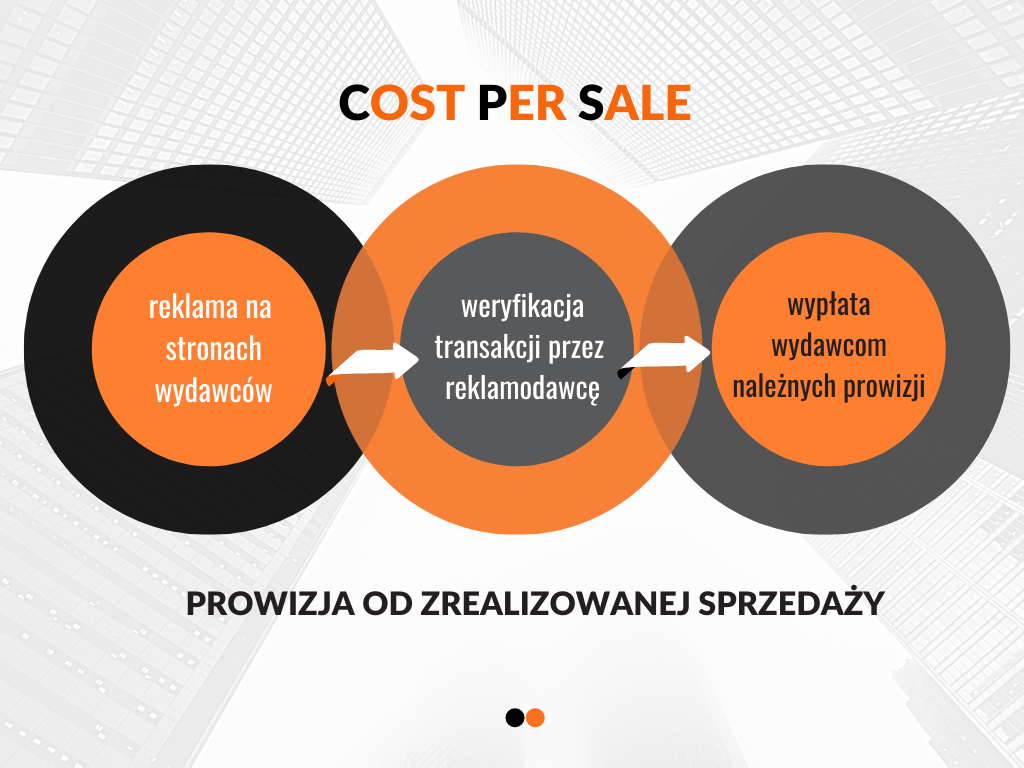
An advertiser cooperating with publishers in the Cost Per Sale model does not pay for the number of impressions or clicks on an ad. They pay only for achieved results in the form of product sales. If a user visits the advertiser’s website after being redirected from the publisher’s site but does not make a purchase, the advertiser incurs no costs.
A fashion influencer joined the affiliate program of a suit store with a CPS rate of 10%. It was prom season, so he decided to download affiliate links to suits that were perfect for the occasion. The influencer created InstaStories in which he placed stickers with affiliate links to the recommended suits. During that day, 20 transactions totaling PLN 16,000 were made through the influencer’s referrals.
Unfortunately, several orders were not paid for, and some suits were returned after being tried on. Ultimately, the advertiser accepted transactions worth PLN 13,000. As a result, the influencer earned PLN 1,300.
Minimizing the risk of overpaying for advertising is the greatest advantage of cooperation in the Cost Per Sale model. The advertiser does not incur advertising costs if no sale occurs. When using other forms of advertising, the advertiser must pay for promotion upfront, regardless of whether the campaign succeeds or turns out to be a complete failure. In the Cost Per Sale model, the cost of a failed campaign is borne by the publisher, who has invested time and resources in promoting the advertiser’s products.
Let’s compare the Cost Per Sale model to Cost Per Click, in which the advertiser pays for every click on their ad. The average rate for one click is usually at least several dozen groszy. This amount may seem small, but the cost of clicks from people who click the ad but do not make a purchase can significantly exceed the planned advertising spend.

The advertiser is planning a campaign aimed at generating product sales worth PLN 20,000. In an online women’s fashion store, we assume an average conversion rate of 1.5% and an average basket value of PLN 200. Let’s compare advertising costs in the CPS and CPC models, assuming a CPC rate of PLN 0.60 and a CPS rate of 10%.
CPC model
To achieve sales worth PLN 20,000, customers must place 100 orders with an average basket value of PLN 200. Taking into account a conversion rate of 1.5%, the store’s website must be visited by 6,666 customers. The cost of the campaign in the CPC model will then amount to nearly PLN 4,000 (6,666 x PLN 0.60 = PLN 3,999.6).
CPS model
Let’s assume that the average rejection rate of transactions due to non-payment or product returns is 15%. Therefore, the advertiser will pay commissions on the remaining orders that were completed, i.e. PLN 17,000 (85% x PLN 20,000 = PLN 17,000). The advertiser will pay publishers PLN 1,700 (10% x PLN 17,000).
In the Cost Per Sale model, the advertiser gives up part of their profit from the sale. Although their revenue is reduced, it is important to remember that the advertiser sets the commission rate themselves and can do so in a way that ensures advertising costs do not exceed the profit from the sale.
After joining an affiliate network, the advertiser creates a network of publishers who agree to cooperate in the Cost Per Sale model. The results will not be immediate; you need to be prepared for long-term cooperation. The more extensive the publisher network, the better the results of affiliate cooperation the advertiser will achieve. It can be a long and work-intensive process, but the acquired publishers are an asset that enables measurable benefits for many years to come.
In the Cost Per Sale model, the publisher can conduct promotional activities for the advertiser immediately after joining their affiliate program. In this way, the publisher has the opportunity to cooperate with both well-known brands and niche stores. There is no need to sign complicated cooperation agreements. The publisher can just as easily end the cooperation without giving a reason. They simply stop promoting the advertiser’s products – without completing unnecessary formalities.
No one imposes on the publisher which affiliate tools they should use or which products they should recommend and to whom. Of course, advertisers provide publishers with appropriate advertising creatives as part of the affiliate program, but the publisher has complete freedom in how they use them. They decide whether to use an affiliate link or banner, and whether to recommend the advertiser’s products on a blog, website, or any social media platform.
The Cost Per Sale model is profitable for publishers with both small and large audiences. The publisher does not need to have high website traffic, as sales success depends largely on their persuasion skills. One TikToker may have 100,000 followers, but only 2% of them will be convinced to make a purchase based on their recommendation. Another influencer has a much smaller number of followers, e.g. 10,000 people, but advertises products very effectively and convinces them to buy. As a result, every fifth, or perhaps even every sixth follower, may buy a product based on their recommendation. In that case, the earnings of both influencers may actually be the same despite differences in reach.
Billing in the Cost Per Sale model is an opportunity for publishers to create a steady passive income through affiliate marketing. Affiliate links are the simplest way to earn money from recommendations. Once a publisher generates and places a link in their content, they can receive profits from it for months or even years. How is this possible?! Affiliate links do not have a specific expiration date, so there is no concern about them becoming outdated or expiring.

Every publisher who cooperates in the Cost Per Sale model has a unique identifier. Thanks to it, it is possible to record traffic and transactions generated as a result of the publisher’s referral. Data on traffic and transactions is collected and compiled in detailed statistics. The advertiser can review the statistics at any time, analyze publishers’ activities, and possibly provide some guidance.
It may happen that publishers achieve poor results. Their sales are too low, and the conversion rate is unsatisfactory. In such cases, the advertiser can lend a helping hand and provide the publisher with discount codes or suggest which products from their offer are the most popular. The publisher’s results will improve, and if they do not, it still does not pose any problem or risk for the advertiser. In the Cost Per Sale model, commission is paid only for sales. It should still be remembered that active cooperation with publishers and the advertiser’s involvement in the development of the affiliate program are an opportunity for systematic sales growth.
Afiliacja, jako kanał performance marketingu, stale się rozwija. Model Cost Per Sale jest obecnie najkorzystniejszym modelem rozliczania. To model, który gwarantuje długofalową, dobrowolną współpracę, efektywność kampanii i brak zbędnych formalności. Sieci afiliacyjne dla e-commerce często oferują ten model, ponieważ posiada wszystkie argumenty ku temu, by zdominować marketing w e-commerce.
Affiliate marketing, as a performance marketing channel, is constantly developing. The Cost Per Sale model is currently the most advantageous billing model. It is a model that guarantees long-term, voluntary cooperation, campaign effectiveness, and no unnecessary formalities. Affiliate networks for e-commerce often offer this model because it has all the arguments needed to dominate marketing in e-commerce.