
Despite the turmoil in the financial market and the growing popularity of TikTok, Meta Platforms still records huge revenues. Almost 100% of Mark Zuckerberg’s platform’s profit comes from advertising. No wonder. Facebook is visited by nearly 2 billion people every month. This is a huge group of potential customers that advertisers cannot ignore. That is why it is worth finding out what Facebook advertising for an online store looks like and how to launch it.
The first version of Mark Zuckerberg’s platform was launched on February 4, 2004, and was called TheFacebook at the time. His university colleagues also took part in the project: Dustin Moskovitz, Chris Hughes, and Eduardo Saverin. The platform itself was intended exclusively for Harvard students. Within TheFacebook, registered students could find and maintain school connections. In addition, they could also exchange messages and even photos.
The Facebook gained enormous interest in the blink of an eye. In just the first two weeks of operation, more than 2/3 of students registered on it. The platform’s impressive growth prompted its founders to move to Silicon Valley. It was in the city of Palo Alto that they established their first company headquarters, which now occupies as many as four buildings.
In 2005, the platform changed its name to Facebook and expanded into international markets. The following year, the mobile version of Facebook appeared, which significantly improved access to the popular application. Shortly afterward, companies could also create their own pages there and use Facebook advertising.
The year 2012 was full of memorable events for Mark Zuckerberg. First, Facebook bought Instagram for a whopping one billion dollars. In addition, the popular application made its debut on the Nasdaq stock exchange and had already gathered over one billion users!
From a student project to a place where we share our photos and thoughts. Facebook has also become a place where we promote, earn money, and learn business. You have to admit that despite Facebook’s ups and downs, the development of this platform is truly impressive. It is one of the largest advertising platforms, allowing not only companies but also private users to earn money. Publishing affiliate links and recommending an advertiser’s products within an affiliate program is widely available on Facebook. Thanks to this, every user of this app can earn money through affiliate marketing.

As soon as Facebook moved beyond university circles, the creators of the app enabled companies to create their own pages. Thanks to them, brands can connect with their audiences and acquire new potential customers. Paid Facebook advertising undoubtedly helps with this as well.
Facebook Ads is a tool for large-scale promotion. It enables precise targeting of audience groups divided into many categories. It also allows you to create advertising creatives promoted on Facebook, Instagram, Messenger, and Audience Network. Audience Network is Facebook’s advertising network. It makes it possible to reach not only users of Meta platforms, but also people who do not use Facebook.
You have probably come across Facebook advertising more than once. The type of ad that appears in your feed strongly depends on how you react to specific content. If you often read posts about marketing, you signal to the algorithm that you are interested in such content. You are classified into a certain audience group, which is why you see ads promoting marketing training courses.
The Facebook algorithm constantly collects data and learns user behavior. Thanks to this, Facebook advertising is an effective way to reach the audience you are interested in.
The settlement model you choose is closely related to your planned budget. The basic models for settling Facebook campaigns are CPM and CPC.
With a CPM of 100 PLN, every thousand impressions of your ad creative will cost 100 PLN. But be careful—this does not mean that the ad reached 1,000 unique users. An ad creative can be shown to the same person multiple times.
A CPC (Cost Per Click) of 3 PLN means that you pay 3 PLN for each click on your ad creative. This model is somewhat safer than CPM because it ensures engagement and higher-quality traffic.
If you run an e-commerce business and want to use the CPS settlement model, i.e. commission on sales, be sure to read the article about affiliate programs.
In Ads Manager, you create and manage ads. You can view your campaigns there, make changes to them, and check their effectiveness.
The Facebook Ads advertising system works on an auction basis, which means that all ads compete with one another. The system displays the ads that have the highest probability of success. The Facebook algorithm is responsible for determining this. Based on the collected data, the algorithm can direct ads to people who are most likely to complete the advertising campaign goal. If the campaign goal is page likes, the algorithm will direct ads to people who like many pages. This gives the promoted page the highest chance of being liked by them.
The Facebook Ads advertising system is very complex. It is worth learning how to use and optimize it to make sure that your advertising budget is not wasted.
To launch your first Facebook Ads campaign, you need to have a Facebook business page. You can conveniently manage it from Meta Business Manager. This page will be linked to your private account, but it will be a separate place for promoting your business. Facebook business pages have many features that are not available on private profiles. These include, for example, the ability to promote posts, create advertising campaigns, or analyze statistical data.
There are no restrictions when it comes to the type of business you want to create a Facebook business page for. It can be a page for an e-commerce business, beauty salon, restaurant, school, or cinema. Business pages are also often created by influencers and other social media users who want to build large communities.
Creating an ad account is described very clearly in Meta’s business help center. In short, you simply need to create an ad account in Business Manager and choose a payment method. Until recently, the only option was to connect a credit or debit card from which the system automatically charged payments. Now it is possible to add funds to a prepaid balance and start advertising activities.
Facebook advertising is usually an image or video with ad copy and a CTA button. However, before we create the ad creative, there is a whole process of setting up the advertising campaign ahead of us. You should start by defining the following parameters:
It is worth noting at this point that you can also promote your posts using Ads Manager. Choose especially those that gained a lot of popularity after publication and whose content is still up to date.
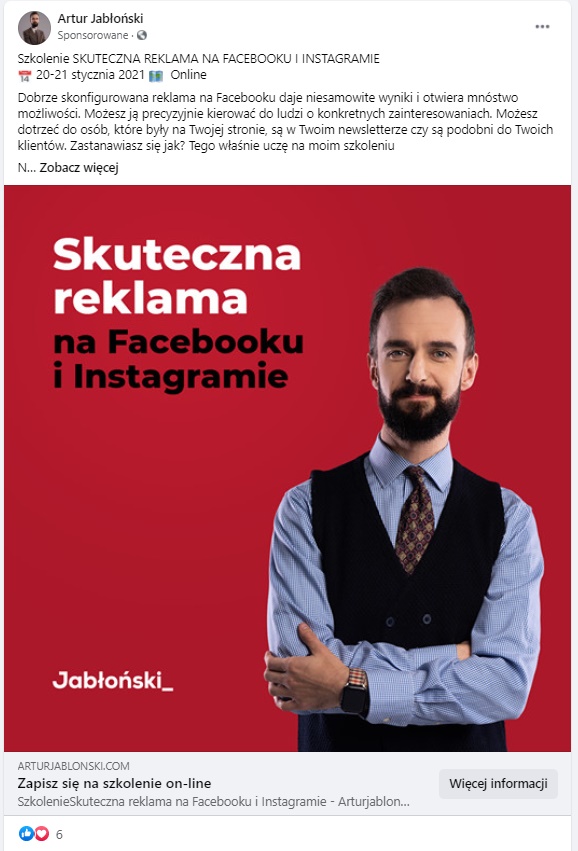
Artur Jabłoński is a specialist in running effective campaigns on Facebook and Instagram. In addition to running his own marketing agency, digitalk, he also conducts training sessions and sells his own courses on this topic. Naturally, he uses Facebook Ads to promote his products. The above ad creative was designed to acquire customers for training. The “Learn more” CTA button redirects the user to arturjablonski.com, where anyone interested in the training can find more details about the courses.
In this case, a static creative was used, featuring Artur Jabłoński and a short, clear advertising slogan that is also the topic of the training. It is worth knowing that the amount of text on ad images is no longer limited by the Facebook Ads system. However, for effectiveness, it is recommended that images contain no more than 20% text.

Above is an example of a carousel ad by RoseBelle. The carousel works great for showcasing products from an online store. The “Buy now” CTA button directs the user straight to the product in the online store.
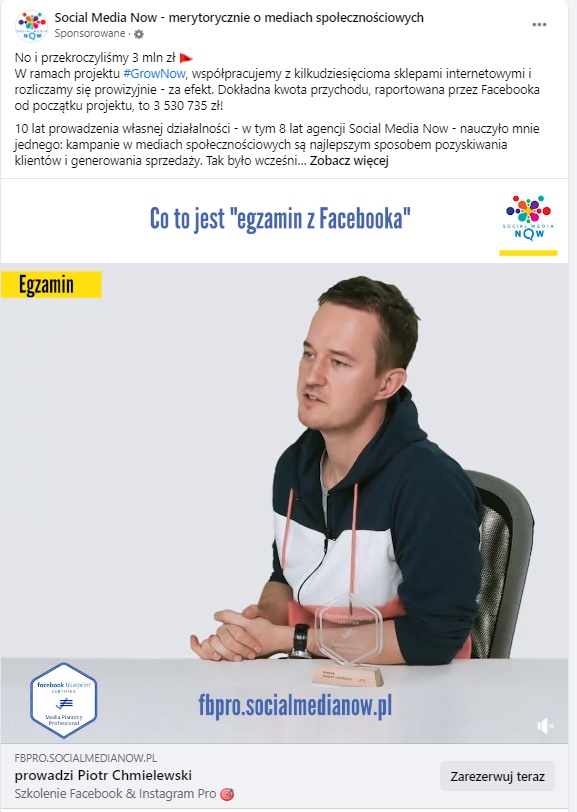
Above is an example of a video ad. Piotr Chmielewski from the Social Media Now agency talks about a Facebook exam. The “Book now” CTA button takes the user to the registration page for the PRO training on Facebook and Instagram. The video ad format is a great magnet for customers who prefer consuming this type of content.
As mentioned at the very beginning, Instagram was acquired by Mark Zuckerberg in 2012. That is why, by default, ads will be displayed on both Facebook and Instagram.
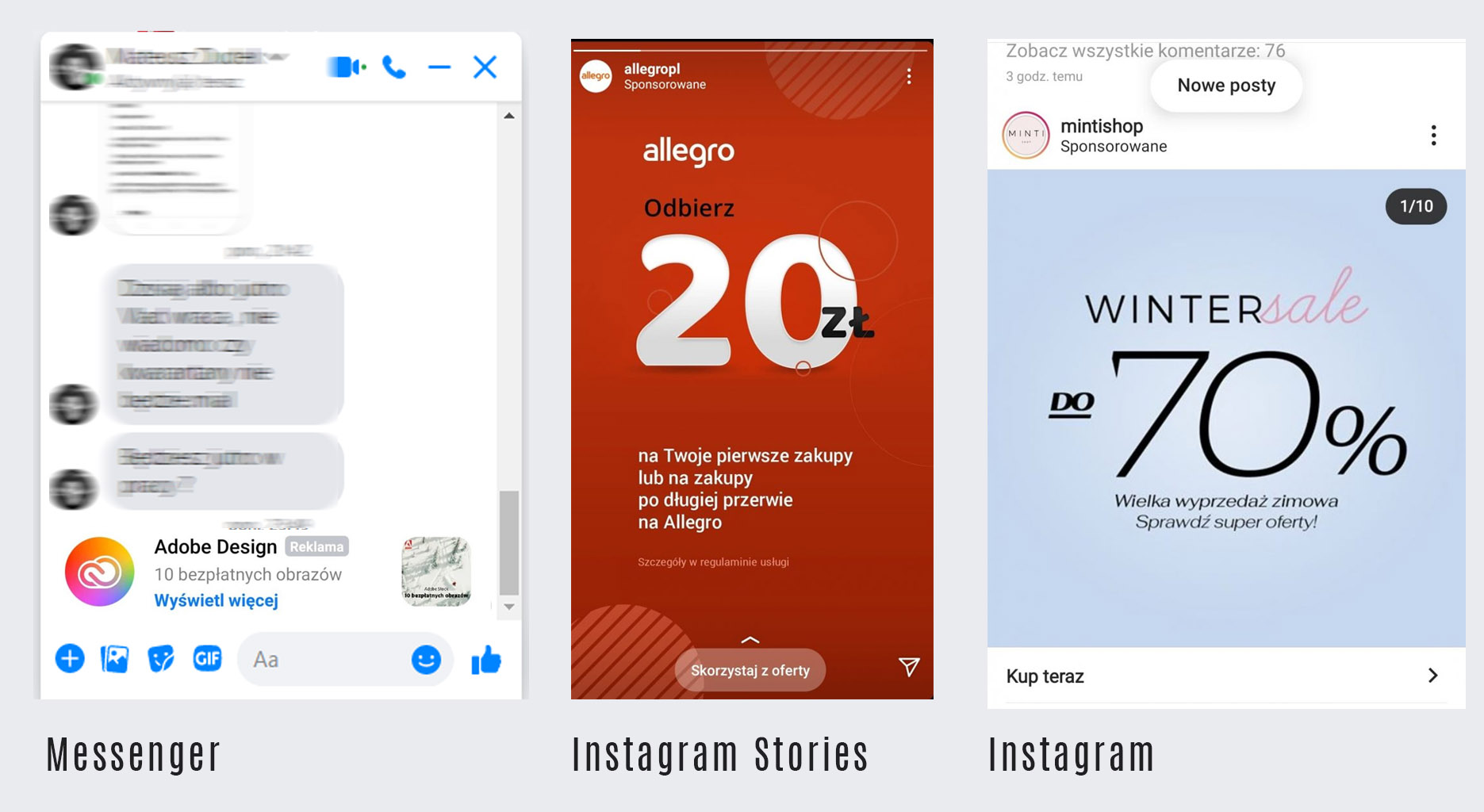
An ad creative in the Messenger app blends into the conversation window. It is small in size and essentially looks like one of the started conversations. An ad displayed in Instagram Stories can take the form of an image or video. An ad in the Instagram feed, on the other hand, looks like a regular post. It differs from it by the word Sponsored appearing under the username.
Launching a campaign in Ads Manager starts with choosing an advertising objective. The advertising objective should be matched to the business goal. That is why it is worth determining at the beginning who we want to reach with the ad and what results we intend to achieve.
Currently, in the Facebook Ads system, you can choose from 6 simplified objectives:
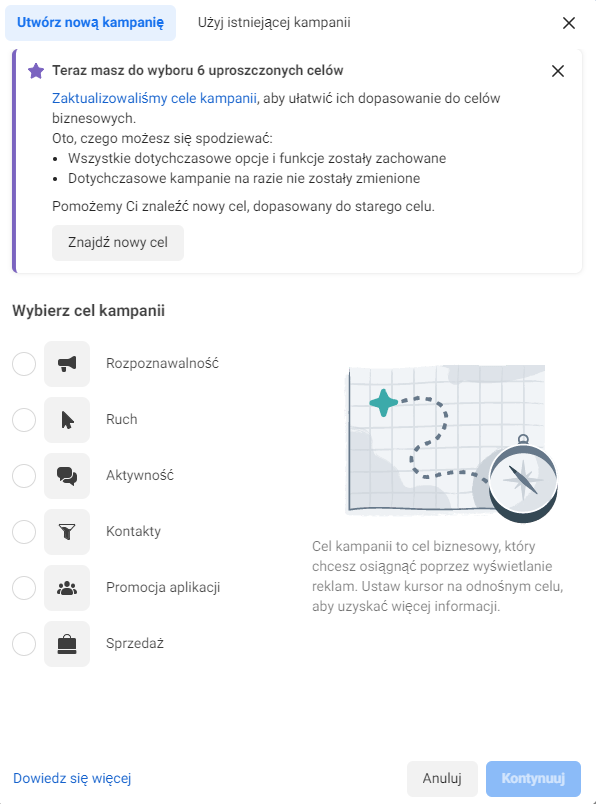
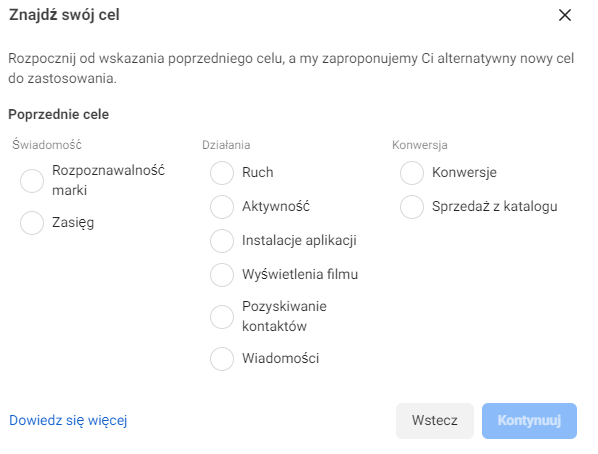
In the previous version of the system, you could choose 1 of 10 objectives divided into three main categories: awareness, consideration, and conversion. You can still switch back to it by clicking “Find new objective” in the new campaign setup window.
The goal of the Brand Awareness campaign is to build recognition by showing ads to audiences who are more likely to remember them. Choose this objective if you want as many people as possible to learn about your brand.
The main advantage of this objective is its low cost. Facebook will allow you to reach all users who may be interested in your offer.
In the statistics for this campaign, you will find the ad recall lift metric. It shows the estimated number of people who will remember your ad within two days of seeing it.
A Brand Awareness campaign is billed using the CPM model (cost per 1,000 impressions).
The Reach objective makes it possible to show your ad to as many users as possible, while also controlling how often they see it.
The Brand Awareness and Reach objectives help you reach a large audience. However, the Reach objective additionally allows you to define how often an ad is shown to a given person, along with the minimum number of days between individual impressions.
An ad with the Reach objective is billed using the Cost Per Mille model. This means you can set the maximum rate for 1,000 impressions yourself.
Neither objective in the Awareness category will generate a large number of website visits, comments, or likes. The purpose of these campaigns is simply to show that your company exists. It is therefore worth preparing a creative that does not require a specific action. It should be memorable and encourage people to get in touch or visit your website. To generate audience engagement, it is better to use other campaign objectives from the Actions section.
If you want to encourage users to take specific actions on your website or Facebook page, choose the Action objective. There you will find 6 different objectives that allow you to:
Review the advertising objectives below and match them to your expectations.
Traffic is one of the most commonly used advertising objectives. It is used to direct users to a destination outside Facebook (e.g. a website or app) or within it (such as a Messenger chat).
Choose this objective if your goal is, for example, to gain a higher number of:
The campaign can be optimized for more clicks, impressions, or daily reach (one person will see the same ad at most once per day). A campaign with the Traffic advertising objective is the simplest way to generate a large number of visits to your website.
A campaign with the Engagement advertising objective is one of the most effective strategies. It allows you to reach people who are likely to engage with your ad creative by liking pages, sharing posts, or commenting on them.
With an ad using this objective, you can direct users to the store or page where they can download your app. Optimizing the campaign for the number of app installs requires integration with Facebook’s advertising system using the Software Developer Kit (a set of tools for developers). If you do not do this, the ad will be automatically set to generate the maximum number of clicks.
The objective of Video Views is to achieve a high number of video views lasting more than 10 seconds at the lowest cost.
PRO TIP: If the shared video includes someone speaking, it is worth adding subtitles. Many users use Facebook without sound. Do not let this be the reason they fail to play your ad.
I probably will not surprise you. With a campaign focused on lead generation, you will collect contacts for your company (e.g. email addresses, phone numbers). Your ads will gather contact details from people interested in your product. Users will leave this information in a dedicated lead form. This will allow you to build a database of potential customers or an email mailing list.
The Messages advertising objective allows you to connect with potential customers through Messenger, Instagram, or WhatsApp. This way, you can communicate with both potential and existing customers to spark interest in your company. Personal messages often perform much better than even the most polished ad creative.
Conversion is a group of ads aimed at encouraging people interested in your company to make a purchase decision regarding your product or service. In this case, the Facebook ad is optimized to generate the highest possible number of conversions.
To use a conversion-focused advertising campaign, it is necessary to install the Facebook Pixel on your online store’s website. The Facebook Pixel is a piece of code added to your website’s source code that collects information about people visiting your store. This allows the Facebook Ads system to measure the effectiveness of your campaigns and run remarketing activities.
Using this objective is possible only after properly configuring the Facebook Pixel. Without it, Facebook is unable to collect the data needed to evaluate ad performance and optimize campaigns.
A conversion does not have to mean only a product purchase in your store. It can also be adding a product to the cart, submitting a form, or registering an account. You decide what counts as a conversion for your business.
Catalog Sales is one of the most effective ways to increase revenue and return on ad spend (ROAS). This objective is intended primarily for online stores with a wide product range. However, small businesses can also use it and achieve decent results.
To launch this ad, you need to connect a product catalog to your Facebook page. This is done through Catalog Manager, where you need to upload a list in CSV or XML format.
Catalog Sales allows you to display dynamic ads that you can easily tailor to potential customers. For example, an ad creative can remind a user that they added specific products to their cart but did not complete the transaction. You can also show your customers an ad with products similar to those they recently viewed or purchased in your online store.
The second stage after selecting the campaign objective is defining the target audience. Reaching the right audience causes many problems. Facebook advertising offers huge targeting possibilities, but this seems to complicate activities rather than support them.
That is why it is important to make one thing clear at the very beginning – there are no perfect solutions. Choosing the optimal target audience requires testing.
Facebook advertising allows you to reach different groups of people classified by age, gender, place of residence, interests, or job titles.
But that is not all…
You can target your ad to newlyweds, people who have recently changed their place of residence, or people who have recently changed jobs.
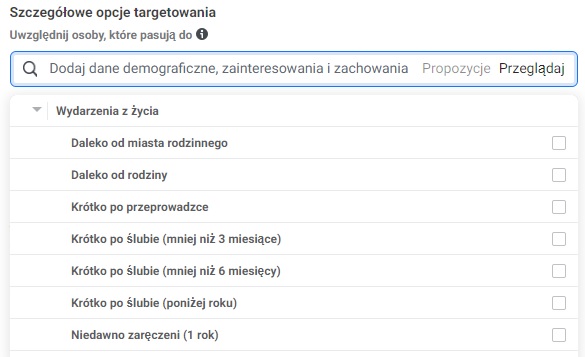
And that is still not the end of the possibilities…
Facebook advertising can also be targeted at audiences with specific interests.
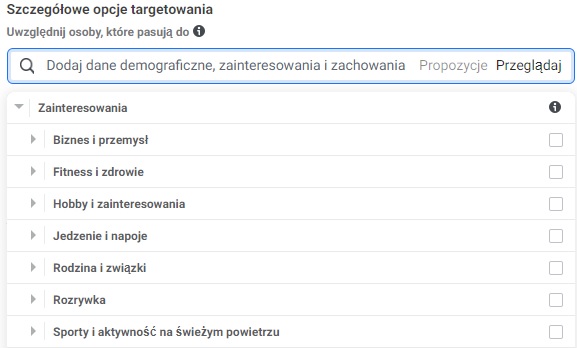
Detailed targeting options also include people who display specific behaviors. These may include, for example, groups using Facebook through the Chrome browser or people who travel frequently.

As you can see, there are plenty of options for defining target audiences. Before launching a Facebook ad, take some time to analyze the behavior, interests, and needs of your potential customer. Even though Facebook advertising is a very intuitive system, defining your audience yourself is crucial. You know best who your ad should reach.
The final stage of creating a campaign is adding the ad creative. This can be an image, a video, or a post that has already been created and published.
The ad creative is the first element the audience comes into contact with, so it should strongly attract attention. That is why it is worth paying attention to effective copy, graphics, and the amount of information included.
PRO TIP: An effective Facebook ad is only half the success. If your creative redirects users to your online store, make sure you take care of its UX/UI. An intuitive purchasing process and user-friendly website aesthetics will be just as responsible for the success of the ad.
High CTR, decent CPC, but low conversion. If you notice such CTR and CPC statistics, in many cases this means that the ad is effective. Low conversion may indicate a problem at the stage where the user interacts with the online store website. It is then worth tracing the path taken by a user visiting your store. It may turn out that there is an obstacle at some stage of the order process that causes cart abandonment.
Setting a campaign budget can be a headache. You have two options to choose from:
The cost of a click on your ad depends on many factors, including:
Refining these elements will help you lower your CPC/CPA and make optimal use of your budget.
Like the Google Ads system, Facebook uses an ad auction to display the best ad to a specific user at a given moment.
The auction is won by the ad whose combined value of three factors (bid, estimated action rate, and ad quality) is the highest.
The ad delivery period depends basically only on you and your budget.
Facebook advertising uses machine learning to optimize ads for results. With each day the ad is displayed, the system collects information about the best:
What does this mean for you?
The longer your campaign runs, the better its results become.
At the beginning of the campaign, results may be less stable due to the learning phase. During this stage, the system searches for the optimal ad delivery settings. Once an ad set achieves around 50 optimization events within 7 days, the campaign exits the learning phase.
IMPORTANT!
During this time (the learning phase), DO NOT make changes to:
You will then lose all the data collected by the algorithm, because the learning phase will be reset. The algorithm will again need time to collect new data before it optimizes ad delivery. And you still have to pay for the ad delivery time.
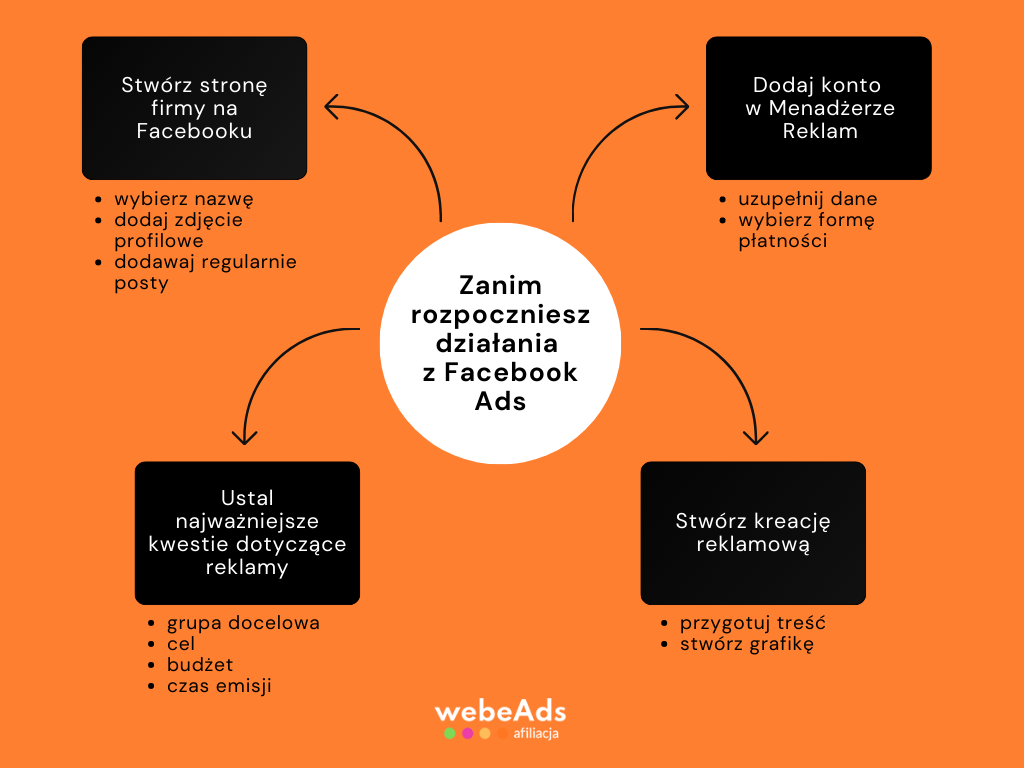
We have guided you through the most important stages of creating a campaign in the Facebook Ads advertising system. However, simply launching a campaign is not the end of the work. You can get even more out of it through a detailed analysis of the measured results. Draw conclusions based on them, and then make the appropriate changes.
The amount of data collected and shared by Facebook Ads is enormous. In the campaign statistics, you will find parameters such as results, reach, impressions, CTR, or CPC. Thanks to these, you can assess whether your campaign is delivering the intended results or whether it needs to be optimized.
Considering Facebook’s reach, it is difficult to point to any industry that cannot run advertising activities on the Meta platform. Online businesses are certainly in a privileged position. Facebook advertising gives them the opportunity to build brand awareness, generate conversions, build relationships with customers, and acquire new ones.
It is not enough to post an ad on Facebook once and profit from it indefinitely. Maintain Facebook users’ interest by changing creatives and testing different ad settings. Managing campaigns in the Facebook Ads system is ongoing work based on continuous testing, measuring, and then changing and improving ad creatives or target audiences. With this approach, you can achieve excellent campaign results without wasting your budget.

Advertising systems such as Facebook Ads, Google Ads, and LinkedIn Ads are not perfect and have certain limitations.
Many of these advertising materials must comply with all applicable local laws, regulations, industry standards, guidelines, licenses, permits, and other rules. Learn more at https://www.facebook.com/policies_center/ads.
Ads in the Facebook Ads system can be created independently, but you can also hire an agency to do it.
Launching a campaign on your own will require time and a willingness to learn the basics. Working with an agency or freelancer will certainly save you time, but it requires a larger financial investment. In return, experienced marketers will handle your campaign comprehensively – from choosing the ad objective to creating the creative and analyzing results.
The choice between an agency and working independently depends on your needs and capabilities – both time-related and financial.
Below are a few more people we recommend, from whom you can really learn a lot about Facebook advertising:
Artur Jabłoński – an expert in Facebook, Instagram, and Content Marketing. You can make use of his blog, which even includes a dedicated category about Facebook Ads. In addition, he organizes training sessions, online courses, and runs a YouTube channel from which you can gain knowledge. He also wrote a book titled “Effective Facebook Advertising”.
Social Media Now – a marketing agency that is now developing in various areas, but started with Facebook. They have cut their teeth on the Facebook Ads system! It is worth checking their Facebook page, where a lot is happening, such as themed live streams or posts about new Facebook solutions.
Daniel Bossy – a marketing specialist who most often focuses on Facebook Ads. He does not have a typical blog, but you can find many video materials on this topic on his website. It is also worth checking out his Facebook profile, as he runs it in a really interesting way.
Joanna Ceplin – a social media specialist who covers most social platforms, including, of course, Facebook. Her blog is definitely worth following.
Paweł Kępa – previously, his blog was called “Mała Wiejska Firma” (“Small Rural Business”). Recently, the website has been renamed to simply the creator’s first and last name, as his knowledge has started serving all businesses, not just small ones. It is worth checking out his blog and YouTube channel, where he shares his expertise.