

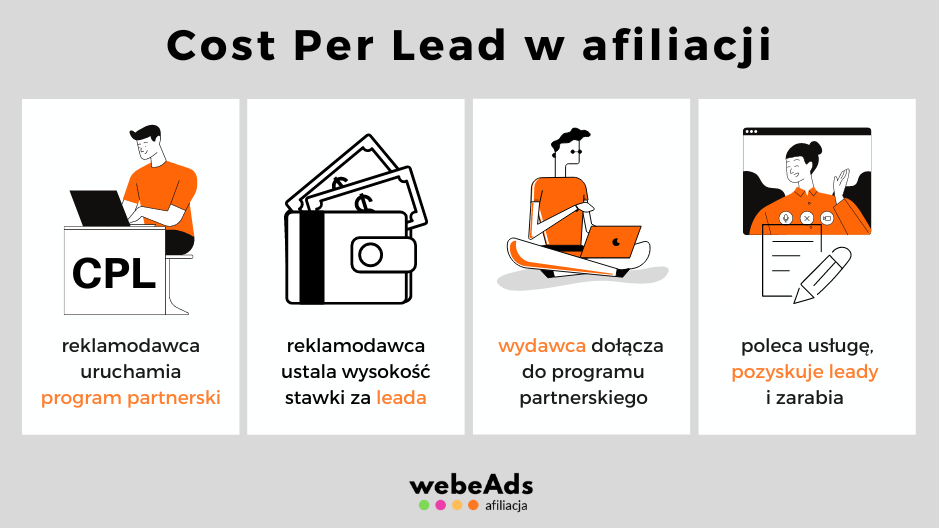
Cost Per Lead (CPL) is a popular billing model in affiliate marketing, where the advertiser pays for delivering a sales lead or for a potential customer completing a specific action. How does it work?
The basic concept in the Cost Per Lead (CPL) billing model that you need to understand is the sales lead itself. According to the definition used in online marketing, a lead is essentially a consumer who has left their details on a website. Therefore, acquiring a lead is most often associated with a user voluntarily filling out a form, through which they gain access to a specific service or product.
In short, a lead is contact information such as:
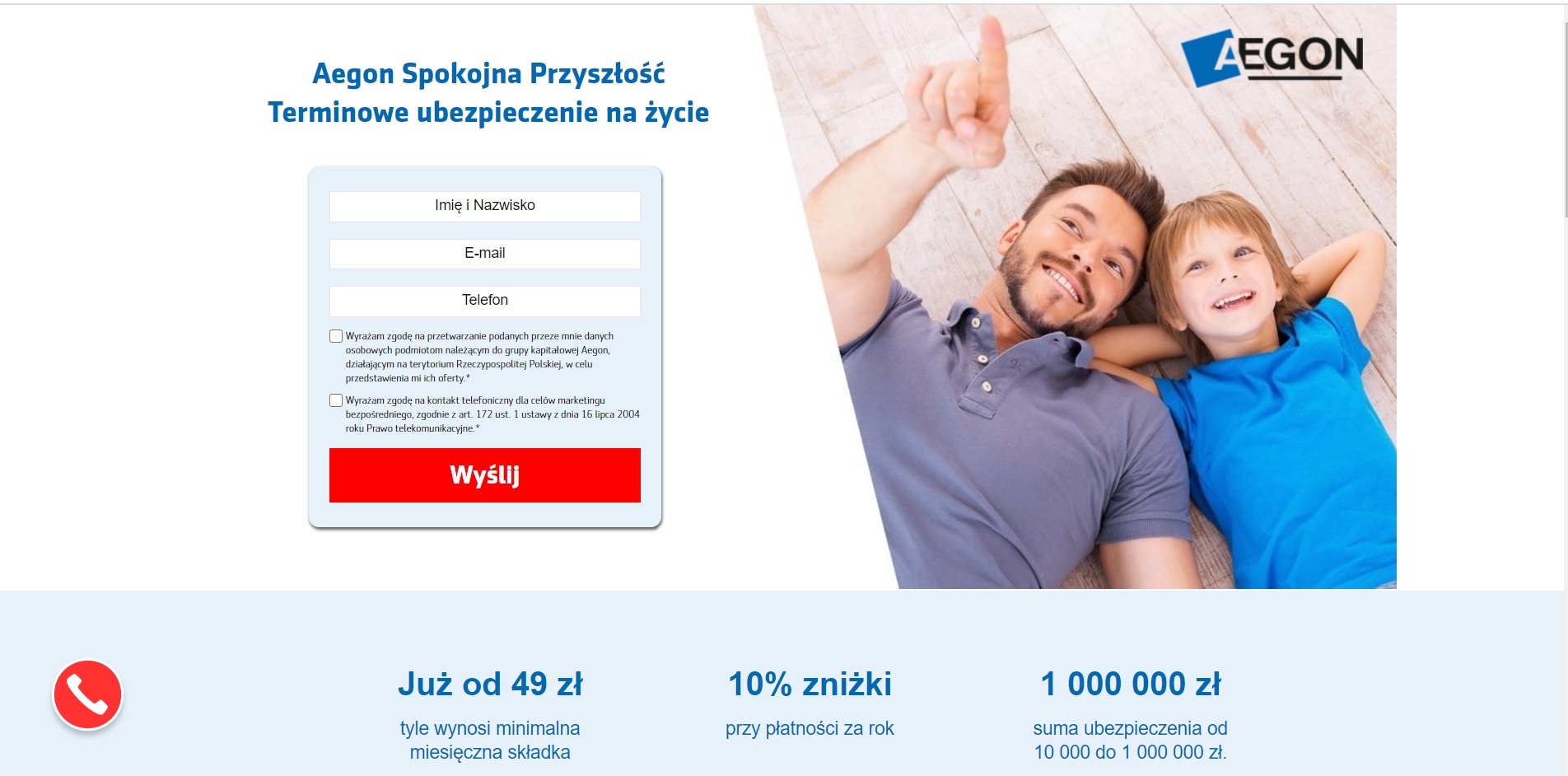
Landing page of an insurance company. As you can see, it is intuitive, simple, and visually appealing. The form is clearly highlighted and contains fields for entering the necessary information that enables further contact.
The type of information collected depends on the advertiser’s needs. That is why additional details are often gathered to help the advertiser better tailor the offer to the consumer they later contact. In such cases, the form may include additional questions about:
The Cost Per Lead (CPL) model is a method of billing online promotional campaigns in which the advertiser pays for delivering a lead or for completing a specific action:
The operation of the Cost Per Lead (CPL) model is best explained with an example. The owner of a company providing vocational training wants to acquire new customers. Due to the nature of the business, they should reach as many people as possible who are currently entering the job market, unemployed, or looking to retrain in order to change jobs. Therefore, the advertiser is interested in obtaining as many contacts to potential customers as possible. That is why the company owner creates a registration form for a free phone consultation during which available training courses will be presented. To acquire as many registrations as possible, the advertiser should support these efforts with cooperation based on the Cost Per Lead (CPL) model.
To launch an effective online ad using the Cost Per Lead model, it is worth preparing:
The CPL model belongs to performance-based billing models, which means that the advertiser pays only when the publisher delivers an action specified in the affiliate program terms and conditions. Therefore, delivering a lead itself is only one of the stages in acquiring a customer who will purchase the service or product offered by the advertiser.
Acquiring contact details of potential customers does not guarantee the sale of a service. Taking this into account, a situation may occur in which collecting a large number of valid leads does not translate into increased sales conversion. In such a case, it is very likely that a mistake is being made at some stage, and it may be related to poor target audience matching or the fact that the offer does not align with customer expectations because it is too expensive or simply unclear. That is why coordination and detailed analysis of all stages of the customer purchase journey, as well as eliminating any existing issues, are so important.
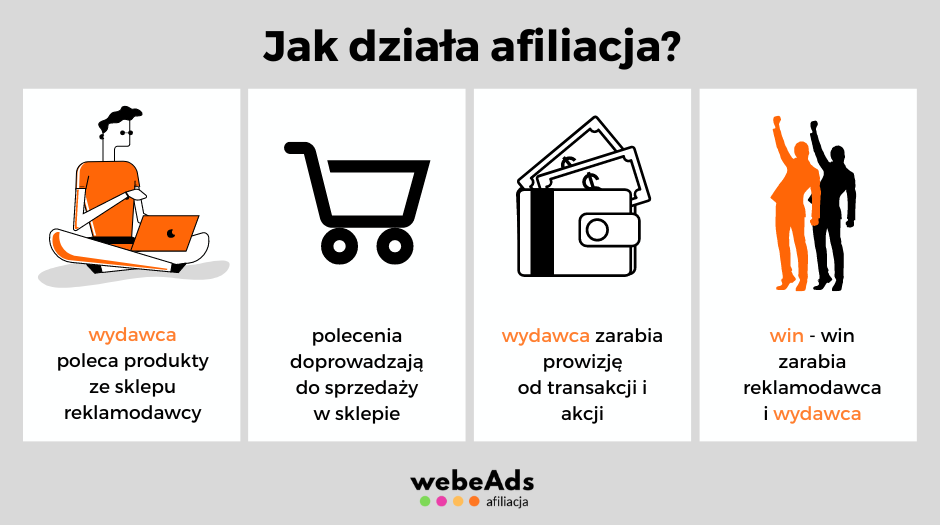
Cost Per Lead (CPL) does not deliver results in the form of sales, which means it is not as secure a model as Cost Per Sale. It is worth noting that in the CPS billing model, the advertiser pays for advertising only when a sale is generated in their store. The advertiser incurs costs only when they are earning money themselves. This is a more beneficial model, but it can only be implemented in services that enable the purchase of products or services.
Affiliate cooperation between advertisers and publishers in the Cost Per Lead (CPL) model is performance-based. The publisher receives a predetermined amount only for delivering a specific action described in the affiliate program terms and conditions. The main advantage of the CPL model is the ability to independently determine the rate paid for delivering a valid sales lead by the publisher.
The rate for delivering a specific action in the Cost Per Lead model largely depends on the amount of information a potential customer must provide in the form. A form requiring only a small amount of information usually costs from a few to several dozen PLN. More advanced forms can involve costs of up to several hundred PLN.
From a publisher’s perspective, cooperation based on the Cost Per Lead (CPL) model can prove to be an extremely profitable way of earning money. However, affiliate success depends on properly matching the affiliate program and promoted services to the theme and profile of the website, blog, or other publisher channel. A loyal community gathered around a publisher is much more likely to take a specific action based on the recommendation of the creator they follow and, for example, download a recommended ebook or sign up for a free phone consultation. As we have already mentioned, lead delivery rates vary. Simple forms generate profits of several dozen PLN, while questionnaires requiring a large amount of information can provide significant one-time earnings.
Źródło gadzetomania.pl
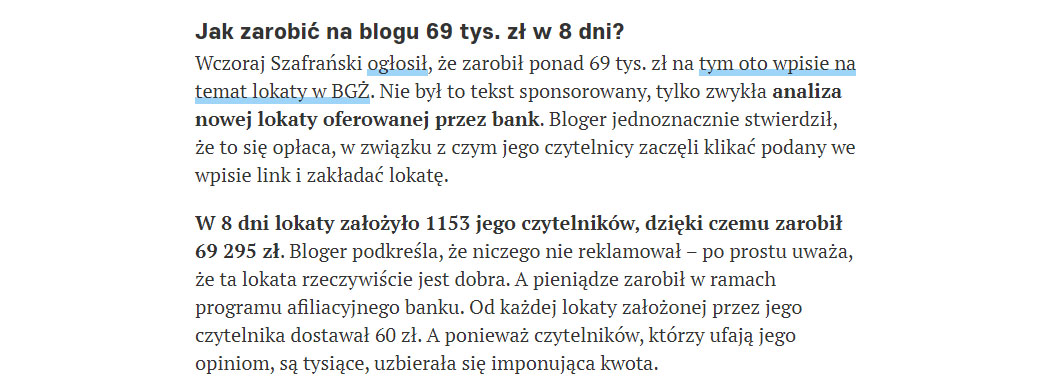
The best example of a publisher who benefited enormously from cooperation under the Cost Per Lead (CPL) model is Michał Szafrański. Several years ago, the well-known financial blogger published information about the amount he earned by recommending deposit accounts offered by the then BGŻ bank. A post about the deposit generated over PLN 69,000 in commission within 8 days.

Affiliate marketing is not the only way to acquire leads. They can also be generated on Facebook using the Facebook Ads advertising system. Facebook Ads allows you to set up a campaign aimed at acquiring contacts and create a form that does not redirect the user outside the Facebook platform. After clicking on the ad, the user is not redirected to another website but remains on Facebook, the form is automatically filled in with their data, and the only thing the user needs to do is click the Submit button.
The biggest advantages of generating leads on Facebook are:
If leads can be acquired using Facebook Ads, why not do the same through the Google Ads system? All you need to do is set the CPA model in the campaign, meaning Cost Per Action, where the action is precisely acquiring a lead. Cost Per Action is a very intelligent strategy in Google Ads that allows you to set the maximum cost an advertiser is willing to incur to acquire a lead.
Success in this lead acquisition strategy depends on properly configured conversions and conversion tracking, as well as the required minimum number of conversions. Google Ads operates on an auction system, so if the set bid for acquiring a lead is not attractive enough compared to the competition, the ad will not be displayed, and the advertiser will not manage to collect any leads.
Google Ads enables lead acquisition in three ways:
Cost Per Sale, meaning commission per sale, is the basic settlement model in affiliate marketing for e-commerce. Advertisers use it most often because it is safe and does not involve the risk of wasting the advertising budget. The advertiser pays a commission only when the user makes a purchase based on the publisher’s recommendation. Therefore, if the transaction is not completed — for example, if the user did not pay for the product, did not collect it, or returned the goods — the advertiser may reject such a commission.
Another settlement method alongside Cost Per Lead (CPL) is the payment model for each unique click, known as Cost Per Click. Unlike Cost Per Sale, this is the riskiest settlement model for the advertiser. After all, a click does not necessarily result in a sale or the completion of a form. The rate per click is significantly lower than the cost of acquiring a lead, but it is also associated with lower conversion and effectiveness. That is why the CPC model works best for brand awareness campaigns and campaigns focused on increasing website traffic.
The group of settlement models in which payment is made for an action desired by the advertiser is generally referred to as Cost Per Action (CPA). Therefore, this group includes the previously mentioned Cost Per Lead (CPL) and Cost Per Sale (CPS), as well as Cost Per Order (CPO) — payment for each generated order; Cost Per Download (CPD) — payment for each download, e.g. of a game, application, or ebook; and Cost Per View (CPV) — payment for each video view.
In the Cost Per Mille (CPM) settlement model, the advertiser pays a specific rate for 1,000 ad impressions. This model is most commonly used in brand awareness campaigns for various brands.
Flat Fee (FF) is a time-based model in which payment is made for displaying an ad on online advertising space for a specific period of time. Clicks or impressions do not matter in this model. The cost is a fixed fee for placing an ad for a specific time period.
Hybrid models
All of the settlement models mentioned above can be freely combined. This results in hybrid models, in which the most common combinations are:

Learn more about affiliate marketing in e-commerce from the articles below: