
Just over a decade ago, choosing promotional channels was relatively simple. A brand could invest in television advertising, print media, radio, outdoor advertising, or sales activities at retail locations. Today, advertisers have dozens of tools at their disposal: SEO, content marketing, social media, influencer marketing, email marketing, performance marketing, affiliate marketing, programmatic advertising, video campaigns, automation, AI, and many others. The problem is that having more options does not always make the decision easier.
Many advertisers today ask themselves: which types of marketing truly help increase sales, and which ones mainly build reach or brand awareness?
This is important because marketing budgets are being monitored more closely than ever. Companies want to know how much it costs to acquire a customer, which channel generates the best ROAS, and which activities actually contribute to revenue. According to IAB Polska data, the online advertising market in Poland grew by around 20% in 2024, with online video advertising being the fastest-growing category. Mobile is also playing an increasingly important role, already accounting for a significant share of digital spending. This article will help organize the most important types of marketing, understand their applications, and assess which strategies work best for driving sales. We will also show why affiliate marketing is becoming one of the safest models for advertisers who want to pay for results rather than promises.
Types of marketing are different strategies, channels, and methods used to reach customers. Each of them serves a different function in the sales process. Some build brand awareness, others educate audiences, some generate traffic, while others directly support conversion.
That is why there is no single best type of marketing for every company. An online fashion store will need a different mix of activities than a B2B software brand, a hotel chain, a financial company, or a cosmetics manufacturer.
For example:
The biggest mistake advertisers make is treating all channels the same way. A reach campaign should not be evaluated solely based on sales generated in the first week, while a performance campaign should not be assessed only by the number of impressions. Good marketing starts with understanding the objective.
See how affiliate marketing can improve your business results
Traditional marketing includes offline activities such as television, radio, print media, billboards, leaflets, events, and sponsorships. For decades, it was the primary way to build brand awareness.
Its biggest advantage is still its reach. Television or outdoor advertising can quickly reach a broad audience and build awareness of a new product. For large FMCG brands, banks, telecommunications operators, or retail chains, such activities can still make sense. The problem arises when it comes to measurement.
In traditional media, it is more difficult to clearly answer questions such as:
This is precisely why more and more budgets are shifting to digital channels. In digital marketing, advertisers can track clicks, conversions, traffic sources, average order value, and user behavior after they visit a website.
This does not mean that traditional marketing has stopped working. Rather, it means that in a modern strategy it increasingly plays a brand-support role, while online channels take over sales and performance measurement.
Online marketing is a broad category that includes all promotional activities carried out online. These include SEO, Google Ads, social media marketing, email marketing, influencer marketing, content marketing, programmatic advertising, video marketing, and affiliate marketing.
Its importance is growing because consumers are spending more and more time online. The DataReportal Digital 2025 report indicates that around 5.56 billion people worldwide now use the internet, while digital channels are playing an increasingly important role in discovering brands, comparing offers, and shopping online.
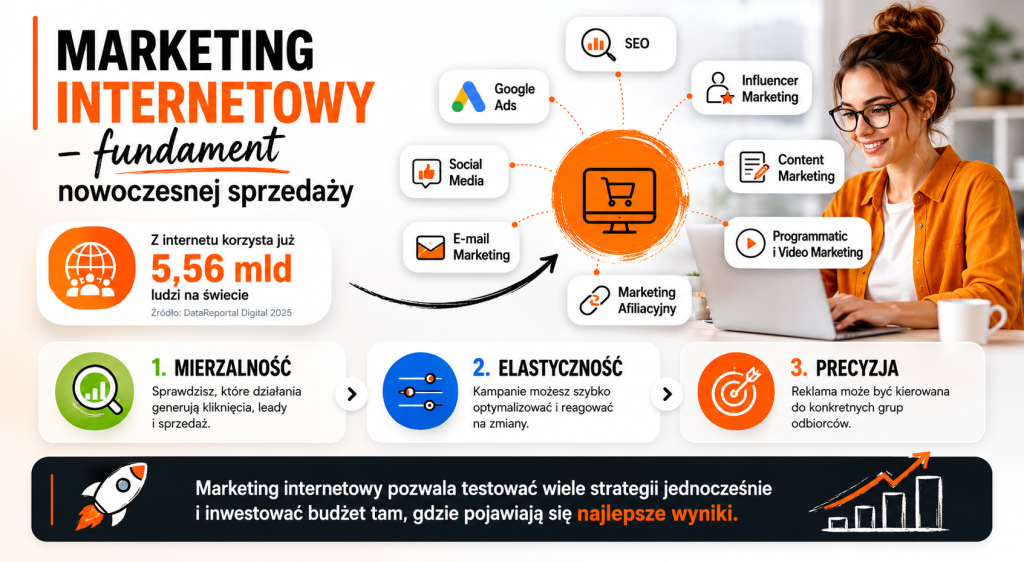
For advertisers, online marketing offers three key advantages:
In practice, online marketing allows companies to test multiple strategies at the same time and shift their budgets toward the activities that deliver the best results.
SEO, or search engine optimization, involves increasing a website’s visibility in Google’s organic search results. It is one of the most important types of marketing for companies that want to generate traffic without paying for every click.
SEO works particularly well when customers are actively searching for information, products, or services. For example, a user might type the following into Google:
If a brand appears high in search results, it gains valuable traffic from people who already have a specific need.
The biggest advantages of SEO:
SEO does have one drawback: it takes time. Results rarely appear after just a few days. That is why SEO works best as the foundation of a long-term strategy rather than a quick sales campaign.
Content marketing involves creating valuable content that helps audiences solve problems, make decisions, and better understand a brand’s offer. This can include blog articles, guides, reports, e-books, case studies, webinars, podcasts, infographics, or video content.
For advertisers, content marketing is particularly important because today’s customers rarely make a purchase immediately. First, they look for information, compare solutions, check reviews, analyze the benefits, and only then make a decision.
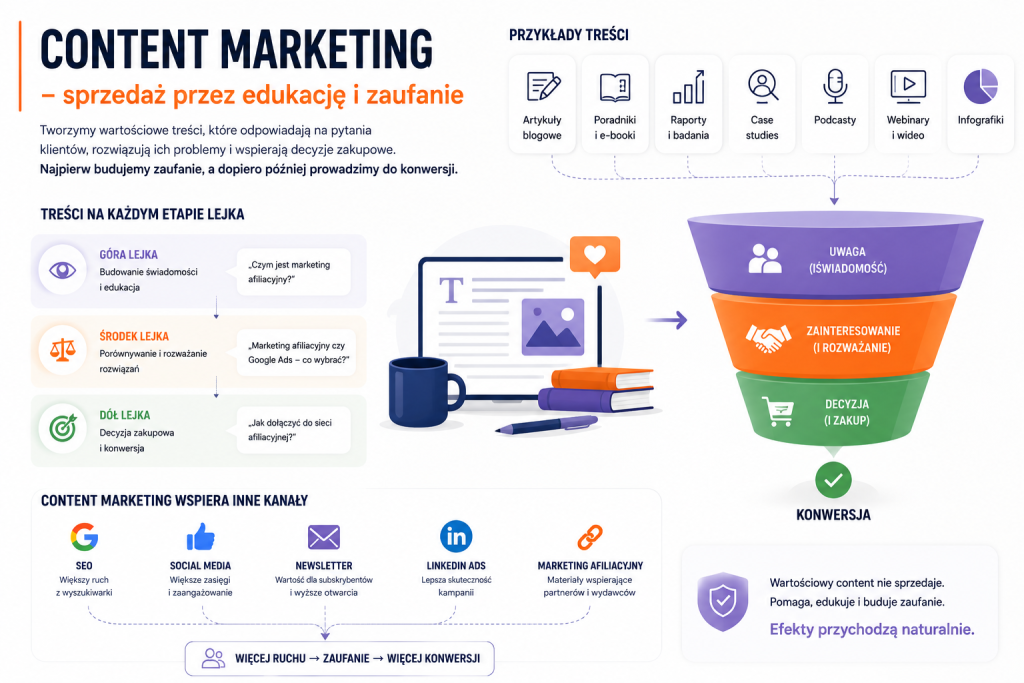
Good content answers customers’ questions at every stage of the funnel:
Content marketing works very well with SEO, social media, and affiliate campaigns. An expert article can attract traffic from Google, be used in a newsletter, support a LinkedIn Ads campaign, and also help affiliate publishers educate users.
The greatest strength of content marketing is that it does not sell aggressively. It builds trust first and only then leads to conversion.
Social media marketing includes activities carried out on platforms such as Facebook, Instagram, TikTok, LinkedIn, YouTube, Pinterest, and X. It is one of the most visible types of marketing, especially for B2C brands.
Social media allow brands to:
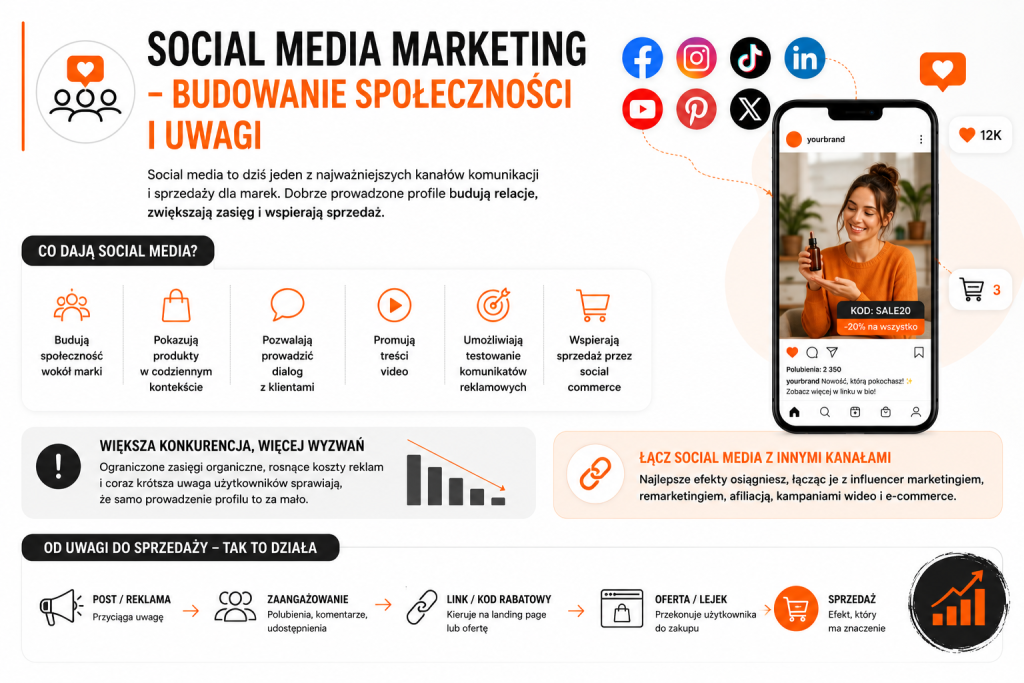
At the same time, social media are becoming increasingly competitive. Organic reach is limited, advertising costs are rising, and users have shorter attention spans. That is why simply running a company profile is no longer enough.
For advertisers, social media work best when combined with other channels: influencer marketing, remarketing, affiliate marketing, video campaigns, and e-commerce. A post can capture attention, but only a link, discount code, landing page, and well-planned funnel can turn that attention into sales.
Influencer marketing involves collaboration between brands and online creators who have their own communities and influence their audiences’ decisions. It is one of the types of marketing that relies particularly heavily on trust.
A customer may ignore a banner ad but stop at a recommendation from someone they have been following for months. That is why influencers are effective in industries where emotions, lifestyle, opinions, and product experience matter: beauty, fashion, parenting, fitness, travel, food, technology, or personal finance.
Influencer marketing can achieve different goals:
The biggest challenge? Measurement. That is why influencer marketing is increasingly being combined with affiliate marketing. The influencer receives an individual link or code, and the advertiser can see which creator generated clicks, leads, or sales. In this way, the influencer stops being solely a reach channel and becomes a performance partner.
Email marketing is one of the oldest, yet still highly effective types of online marketing. It involves communicating with audiences through newsletters, automation, transactional messages, promotional campaigns, and educational sequences.
Its advantage comes from the fact that the brand communicates with its own audience base. It is not entirely dependent on social media algorithms or rising click costs. According to Litmus data, some companies achieve a return of between $10 and $36 for every dollar spent on email marketing, while other industry benchmarks often indicate an average return of around $36 for every $1 invested.
Email marketing works particularly well for:
For advertisers, the key takeaway is simple: email marketing works best when it is based on segmentation, personalization, and automation. Sending the same newsletter to everyone is no longer enough.
Measure Results and Grow Your Campaigns with WebeAds
Performance marketing is an approach in which advertising activities are evaluated based on specific results. These can include clicks, leads, registrations, sales, app installs, or other measurable actions.
Performance marketing includes, among others:
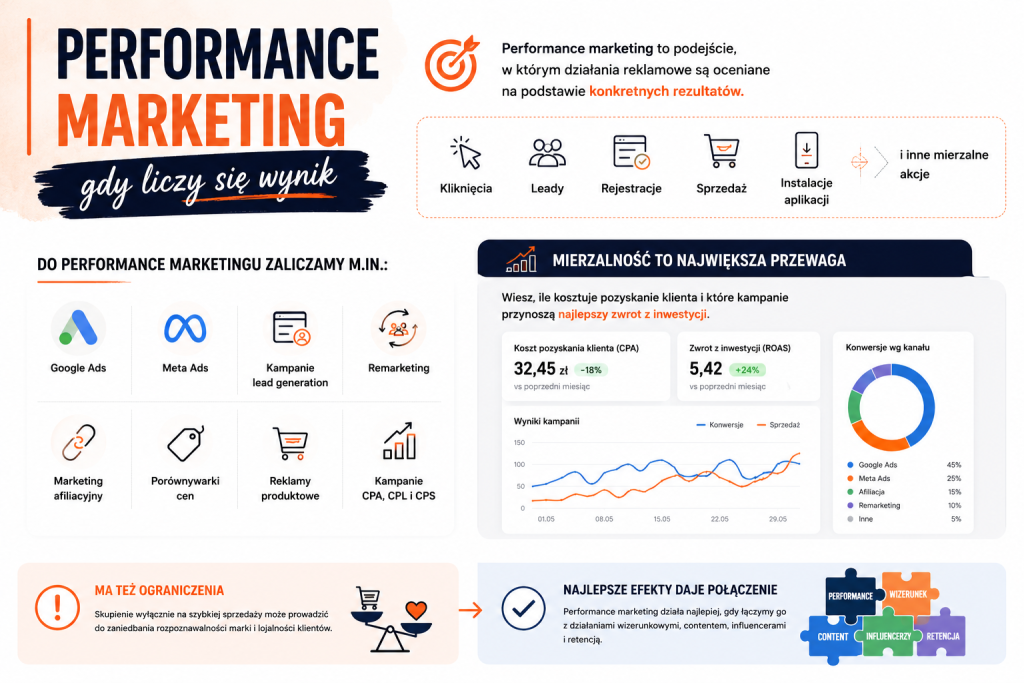
Its greatest advantage is measurability. Advertisers can determine how much it costs to acquire a customer and which campaigns deliver the best return on investment.
However, performance marketing also has its limitations. If a brand focuses solely on quick sales, it may neglect building brand awareness and loyalty. That is why the best strategies combine performance marketing with brand-building activities, content, influencers, and retention.
Affiliate marketing is one of the most effective types of marketing for companies that want to increase sales while keeping budget risk under control.
In this model, the advertiser works with publishers, influencers, bloggers, comparison websites, industry-specific platforms, or content partners. These partners promote the brand’s offer and receive compensation only when they generate a specific result.
This can be:
The biggest advantage of affiliate marketing is that the advertiser does not pay simply for the promise of reaching a customer. They pay for results. This is particularly important at a time when advertising costs are rising and pressure on ROI is increasing. In affiliate marketing, the budget is directly linked to the business outcome.
Affiliate marketing is growing because it addresses advertisers’ most important needs:
For an e-commerce company, affiliate marketing can mean an additional sales channel. For a financial brand – a source of leads. For an app – a way to acquire registrations. For an online store – collaboration with influencers and publishers who promote products in exchange for commission. Across Europe, the entire digital advertising market is growing dynamically. IAB Europe indicates that digital advertising spend exceeded EUR 100 billion in 2024, showing how important a role digital plays in companies’ advertising strategies.
Against this backdrop, affiliate marketing is particularly attractive because it combines the reach of multiple partners with a performance-based payment model.
Use Affiliate Marketing to Scale Sales Without Increasing Risk
Not every type of marketing works in the same way. Some channels are excellent for building a brand, others help educate customers, while others provide the strongest support for sales.
As a general guideline, it can be viewed like this:
| Type of Marketing | Brand Building | Sales | ROI Measurement |
|---|---|---|---|
| Traditional Marketing | high | medium | low |
| SEO | high | medium-high | medium-high |
| Content Marketing | high | medium | medium |
| Social Media Marketing | high | medium | medium |
| Influencer Marketing | high | medium-high | medium/high with affiliate marketing |
| Email Marketing | medium | high | high |
| Performance Marketing | medium | whigh | high |
| Affiliate Marketing | medium-high | very high | very high |
The key takeaway: if the goal is fast, measurable sales, the best results usually come from channels based on data and performance-based payment: performance marketing, email marketing, and affiliate marketing.
If the goal is to build the market, educate customers, or increase brand awareness, it is also worth investing in SEO, content, influencers, and social media. The strongest strategy is created when channels do not compete with one another but complement each other.
Effective marketing is not about choosing one channel and ignoring the rest. It is about building a system in which each type of marketing plays a specific role.
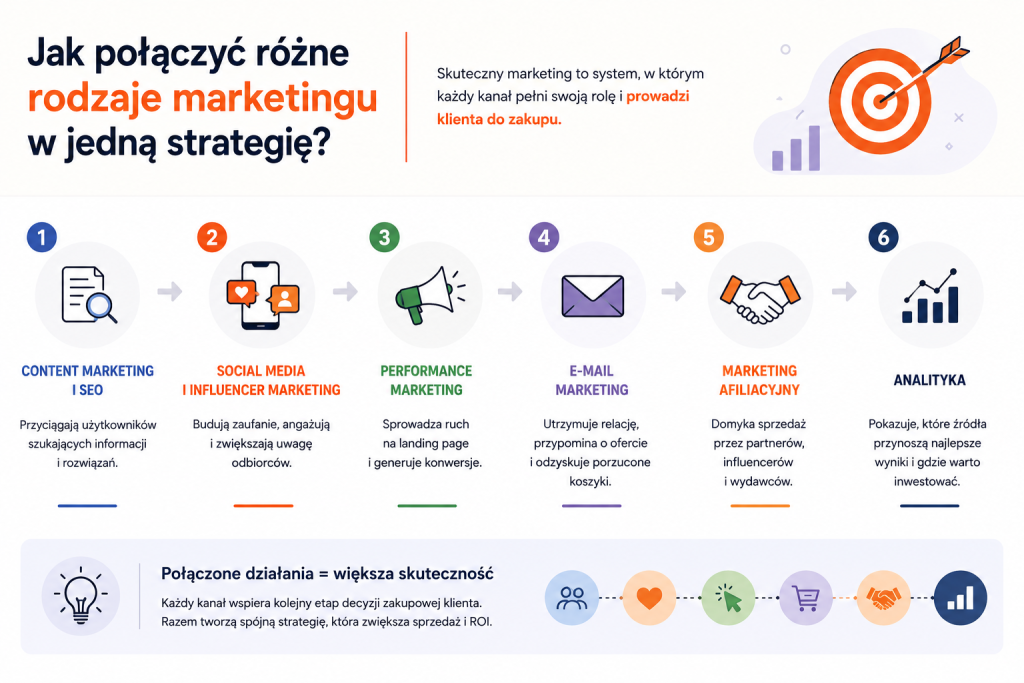
An example funnel might look like this:
In this model, the advertiser does not act chaotically. They know why each channel is being used and how to measure its effectiveness.
WebeAds helps brands leverage the potential of affiliate marketing and combine it with other types of marketing: influencer marketing, content marketing, social media, and performance marketing.
For advertisers, this means access to partners who can promote their offer across different channels, but within a performance-focused model. Instead of paying solely for reach or clicks, the brand can pay for a specific action.
WebeAds supports advertisers in areas such as:
This is particularly important for companies that want to grow sales without wasting budget on channels whose effectiveness cannot be clearly evaluated. WebeAds helps answer the question every advertiser is asking today: Which activities actually generate sales?
Launch an Affiliate Program and Reach New Audiences
There is no single universal type of marketing that works for every company. SEO builds visibility, content educates, social media capture attention, influencers build trust, email marketing supports retention, while performance and affiliate marketing help measure and scale sales.
The most important thing is to align the strategy with the business goal.
If you want to build brand awareness, invest in content, social media, influencers, and video. If you want to increase sales in a measurable way, focus on performance marketing, email marketing, and affiliate marketing.
For advertisers who expect budget control, data, and performance-based payment, affiliate marketing is one of the most practical solutions.
Join WebeAds and discover how affiliate marketing can complement your strategy, increase sales, and help you invest your budget where it truly delivers results.