

Just a few years ago, widgets were mainly associated with simple website add-ons such as weather forecasts, calendars, or contact forms. Today, their role is completely different. Widgets have become an integral part of modern online marketing, supporting sales, communication automation, and conversion growth.
Modern websites use widgets not only to extend the functionality of a website, but above all to engage users more effectively. Thanks to widgets, users can instantly contact a brand, receive a product recommendation, see a current promotion, or go directly to an advertiser’s offer without having to leave the website.
For advertisers and marketers, widgets are now one of the most practical tools for supporting performance marketing activities. When implemented properly, they can shorten the customer journey, improve the user experience, and help monetize traffic more effectively. They are also playing an increasingly important role in affiliate marketing, where they automate offer presentation and improve campaign performance.
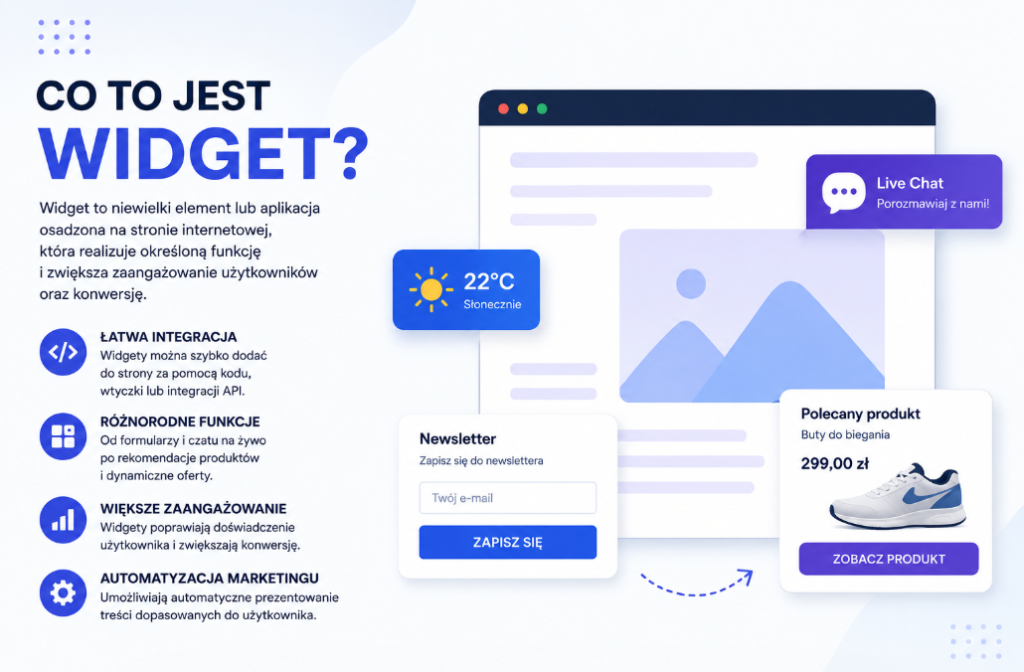
A widget is a small application or interface element embedded on a website that performs a specific function without the need to build an entire solution from scratch. It most often takes the form of an interactive module that can be implemented using a code snippet, API integration, or a dedicated plugin.
From the user’s perspective, a widget is simply a part of a website responsible for a specific action. It can allow users to submit a contact form, display product recommendations, show customer reviews, or handle communication with a consultant through live chat.
From a marketing perspective, however, a widget plays a much more important role. It is a tool that supports conversion and user engagement. A well-designed widget can effectively direct the user’s attention toward a specific action, increase CTR, and influence purchasing decisions.
That is why widgets are now widely used in:
Looking for Effective Ways to Increase Online Sales?
In the WordPress environment, the terms “widget” and “plugin” are often used interchangeably, even though they refer to different things.
A plugin is a system extension that adds new functionality to the entire website. A widget, on the other hand, is a specific element visible to the user. You could say that a plugin is responsible for the technological backend, while a widget is responsible for presenting a specific function within the website interface.
A good example is a newsletter system. The integration with the email marketing platform itself works through a plugin, while the sign-up form displayed to the user is a widget.
In practice, many modern WordPress plugins include their own widgets, which can be placed in sidebars, landing page sections, or within article content.
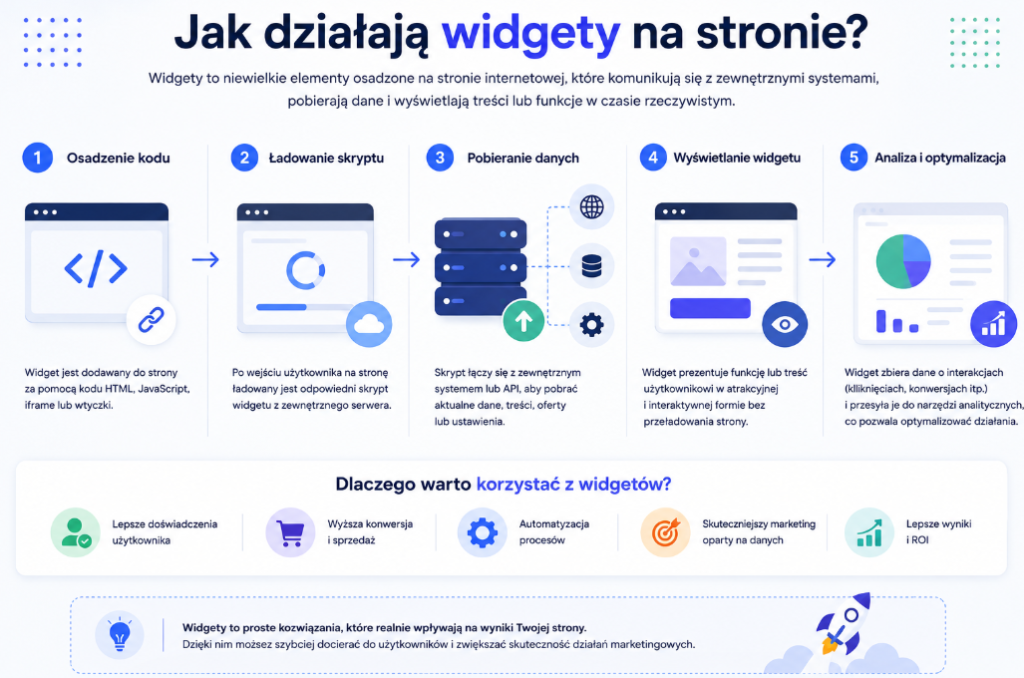
Most widgets work using embedded JavaScript code, an iframe, or an API integration. Once implemented on a website, the widget communicates with an external system, retrieves data, and presents it to the user in real time.
The way a widget works depends on the type of solution, but the process is usually similar. When a user visits the website, the relevant script is loaded, which is responsible for displaying the widget and enabling its functionality. At the same time, analytics data related to clicks, interactions, or conversions may be transmitted in the background.
For marketers, this is extremely important because widgets make it possible not only to display content, but also to collect data and automate advertising activities.
In practice, modern widgets often use:
This is particularly evident in affiliate marketing and e-commerce. Dynamic widgets can automatically display current promotions, best-selling products, or offers tailored to users’ interests. This allows advertisers to scale campaigns without having to manually update advertising creatives.
Behavioral data-driven widgets are also playing an increasingly important role. Based on a user’s previous interactions, the system can personalize the products or marketing messages displayed. Such solutions are widely used in modern performance marketing, where maximizing conversion rates and traffic efficiency is key.
Widgets can serve both practical and strictly sales-oriented functions. In modern online marketing, they are increasingly responsible for directly generating leads, increasing user engagement, and supporting sales processes.
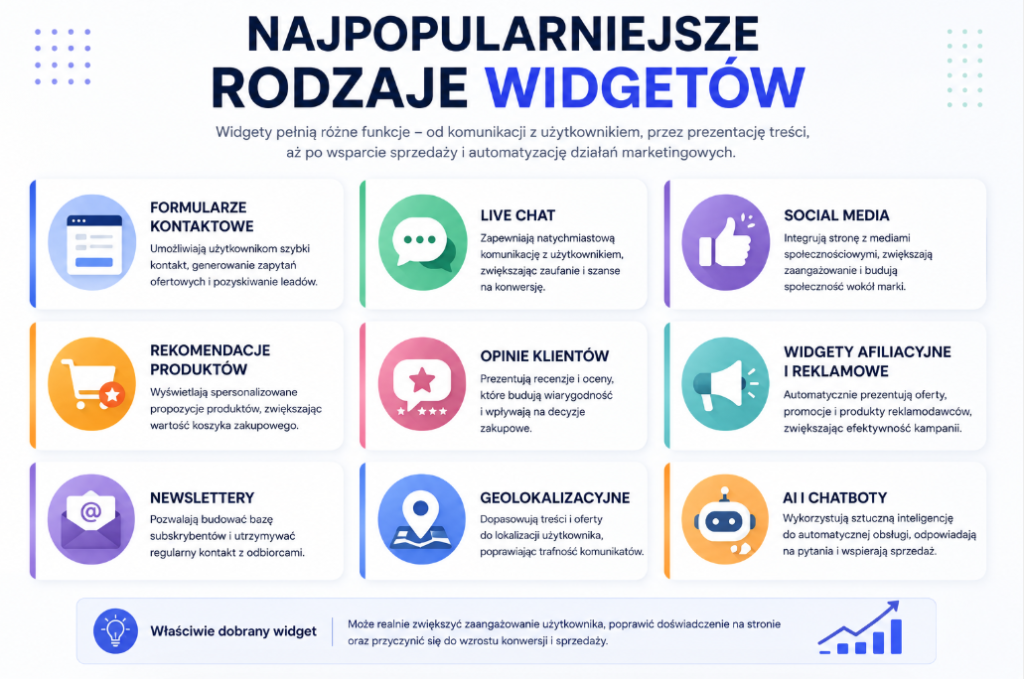
Contact forms remain one of the most commonly used widgets on corporate websites and landing pages. Despite their simplicity, they are extremely important from a lead generation perspective.
A well-designed form is no longer just a way to contact a company. It is part of the sales funnel. A streamlined form completion process, proper field placement, and well-thought-out CTAs can significantly increase the conversion rate.
In performance marketing campaigns, form widgets are often integrated with CRM systems and marketing automation tools, allowing leads to be immediately passed on for further sales follow-up.
More and More Advertisers Are Using Affiliate Marketing to Scale Online Campaigns
Live chat widgets have become a standard feature of modern websites, particularly in the service and e-commerce sectors. Users today expect fast communication, and the ability to contact a brand instantly often influences purchasing decisions.
Modern live chat systems are no longer limited to customer support. They are increasingly used as sales tools. Thanks to integrations with AI and analytics systems, they can automatically qualify leads, recommend products, or answer frequently asked questions.
From an advertiser’s perspective, this means a shorter customer journey and more effective marketing activities.
One of the most effective types of widgets in e-commerce is product recommendation systems. They work by analyzing user behavior and sales data.
Recommendation algorithms can display:
This solution not only increases the average order value, but also improves the user experience and extends the time spent on the website.
In affiliate models, recommendation widgets are particularly valuable because they enable the automatic display of current advertiser offers without the need for manual content management. This allows publishers to monetize traffic more effectively, while advertisers can scale their campaigns.