
In a world where the cost of acquiring customers is rising faster than inflation and users are becoming increasingly resistant to advertising, affiliate programs are returning to the top as one of the most cost-effective marketing tools. But will they really work in your industry? The answer is not universal, which is why we have prepared a practical guide to help you evaluate it using concrete examples, numbers, and strategies. We will show you not only the potential, but also the real limitations and the conditions for successful implementation.
An affiliate program is a way to distribute your products or services through external partners – bloggers, website owners, influencers, comparison sites, or other entities operating online. The key difference compared to traditional advertising is that you pay them only for results: a sale, acquiring a customer, a newsletter signup, or another defined goal.
It is not just an advertising channel – it is a collaboration model that allows you to build a scalable and self-sustaining sales system. Partners use special links, and every purchase made through them is automatically settled in the affiliate system. It is precisely this accuracy and transparency that makes more and more advertisers treat affiliate marketing as one of their main sources of revenue.
According to Rakuten Advertising data from 2023, the return on investment in affiliate campaigns can be anywhere from 2 to even 8 times higher than in display campaigns. What is more, a CJ Affiliate report shows that as many as 81% of brands in the US use affiliate programs. In Poland, this share is around 10–15%, which means one thing: if you enter now, you have a strong chance to gain a competitive advantage. Affiliate marketing works continuously, regardless of daily budget, Meta’s algorithm, or CPC costs.

That impressive figure is only the beginning. Astute Analytica forecasts that the market’s value will double over the coming years, reaching nearly $40 billion by 2031. This shows that affiliate marketing is an exciting industry developing at an exceptionally rapid pace.
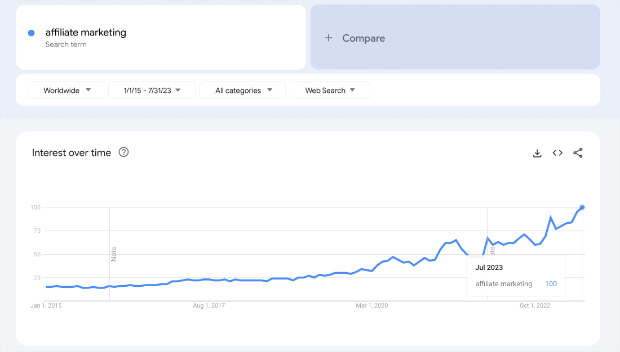
The Google Trends chart below shows how much interest the phrase “affiliate marketing” generates on a scale from 0 to 100. At the end of July 2023, interest in this term reached 100 – the highest level in history.
Affiliate marketing is easiest to implement where the purchase cycle is short and the offer is easy for the end user to understand. E-commerce (fashion, beauty, electronics), digital products (ebooks, courses), financial leads (bank accounts, cards), as well as supplements, cosmetics, and health are all areas where partners can quickly generate sales.
Why? Because in these segments, so-called affiliate content works: rankings, reviews, guides, and product comparisons. A customer searches for “best face serum 2025” – and the partner directs them straight to your store. Thanks to this, affiliate marketing allows you to monetize purchase intent in a natural way.
Of course. An affiliate program can also work successfully in B2B industries—especially in online services and SaaS subscriptions, where customer value is high and acquisition costs are significant. You can collaborate with industry bloggers, forum owners, LinkedIn communities, or specialized newsletters. Even if the purchase cycle is longer, each lead directed into your sales funnel can have high value.
Local businesses (for example, language schools, personal trainers, and beauty salons) can also operate successfully in a CPL model, meaning payment for each lead. All you need is to find partners active in your region – city websites, local bloggers, or industry directories. There are more possibilities than it may seem – it simply takes a creative approach.
Before you begin, ask yourself a few questions:
If at least four out of five answers are “yes,” you have strong potential. An affiliate program does not work in a vacuum. It needs a solid foundation – technical, operational, and communication-based.
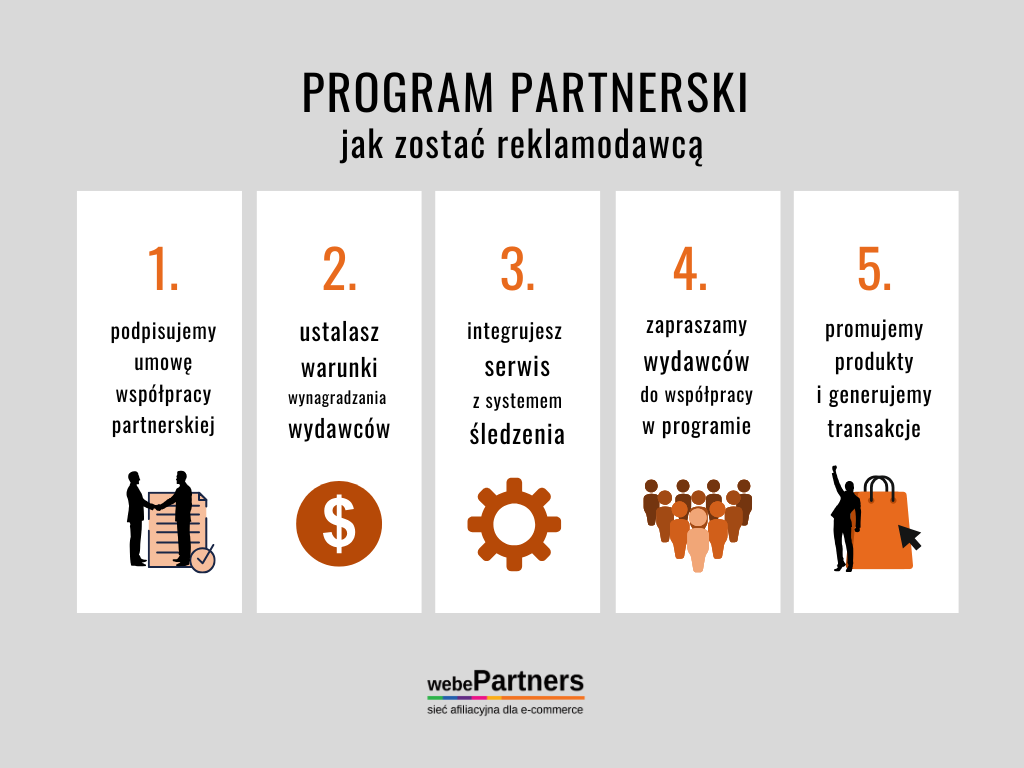
First, choose an affiliate platform. An example? WebeAds – it provides the infrastructure, an existing partner base, and a reporting system. Next, decide on the payment model – most often CPS, but CPL and CPC are also possible. Prepare the program rules: commission rates, materials (banners, feeds, links), and transaction approval policies.
Integration is the technical step – if you use popular platforms (Shopify, WooCommerce, Shoper), it will take only a few hours. The key is transparency and automation.
Partner recruitment is a process: it is worth preparing a welcome pack, sending newsletters to publishers, and motivating them with additional bonuses. The best programs have dedicated managers who take care of onboarding and the quality of cooperation.
Ready to launch your own affiliate program?
A commission that is too low is a classic mistake. If a publisher gets 2% on a 40% margin, they will have no motivation. The second problem is a lack of updates to materials: broken links, outdated prices, and no seasonal promotions. Partners need support, just like any sales department. The third issue is a poor landing page. If a customer clicks the link but does not buy because of bad UX or technical errors, the whole affiliate program loses its point.
The good news? All of this can be fixed. Treat your affiliate program as a separate sales channel. Regularly analyze results, test different creatives, and reward your top partners. It works.
If you want to:
…then yes – an affiliate program can work in your industry too. Especially if you treat it strategically rather than as an add-on. Start on a small scale, test, optimize, and then scale up. The potential of affiliate marketing grows with every successful partnership.