

Just a few years ago, e-commerce marketing was relatively straightforward. It was enough to launch Google Shopping campaigns, add Facebook ads, and make sure the ROAS added up. Click costs were lower, competition was smaller, and attribution was more transparent.
Today, the situation looks completely different. Media costs are rising faster than margins, data privacy limits precise user tracking, and consumers are becoming increasingly demanding. As a result, e-commerce marketing is no longer just about “setting up campaigns.” It has become a system for managing revenue, margin, and risk.
In this article, we will analyze which channels actually work in e-commerce today and how to approach them strategically — not only in terms of revenue, but above all profitability.
Google Ads remains one of the most important channels in e-commerce marketing, mainly because it is built around user intent. Someone who types a specific product name into a search engine is just one step away from buying. That’s a huge advantage compared to demand-generation channels.
Product campaigns (Shopping, Performance Max) allow stores to capture that demand at the moment of purchase decision. In practice, however, Google’s effectiveness in e-commerce marketing today depends not only on campaign settings, but above all on the economics of the business.
In low-margin industries such as electronics or consumer appliances, even a small increase in cost per click can completely wipe out profit. Stores often focus on ROAS without analyzing the true customer acquisition cost in relation to gross margin and operating costs.
Example:
A store achieves an 800% ROAS in a Google campaign. It looks great. However, after subtracting margin, logistics, service costs, and returns, it turns out the real profit is minimal. In such a case, e-commerce marketing isn’t optimized for financial performance, but for an advertising metric.
Google works — but it requires managing margins, not just the budget.
More transactions. Fewer wasted clicks.
Meta (Facebook and Instagram) was for years the main growth engine for DTC brands. Interest-based targeting, dynamic product ads, and precise remarketing delivered very high efficiency.
Today, e-commerce marketing on Meta looks different. Restrictions on user tracking, changes in data privacy, and growing competition have made campaigns require much better creative, testing, and funnel strategy.
Meta still works, but under different conditions:
In many industries, Meta has stopped being a “scaling machine.” It has become a supporting channel — building interest and generating first touchpoints with the brand.
In modern e-commerce marketing, Meta often plays the role of the top of the funnel, while sales are finalized through remarketing, email, or higher-intent channels.
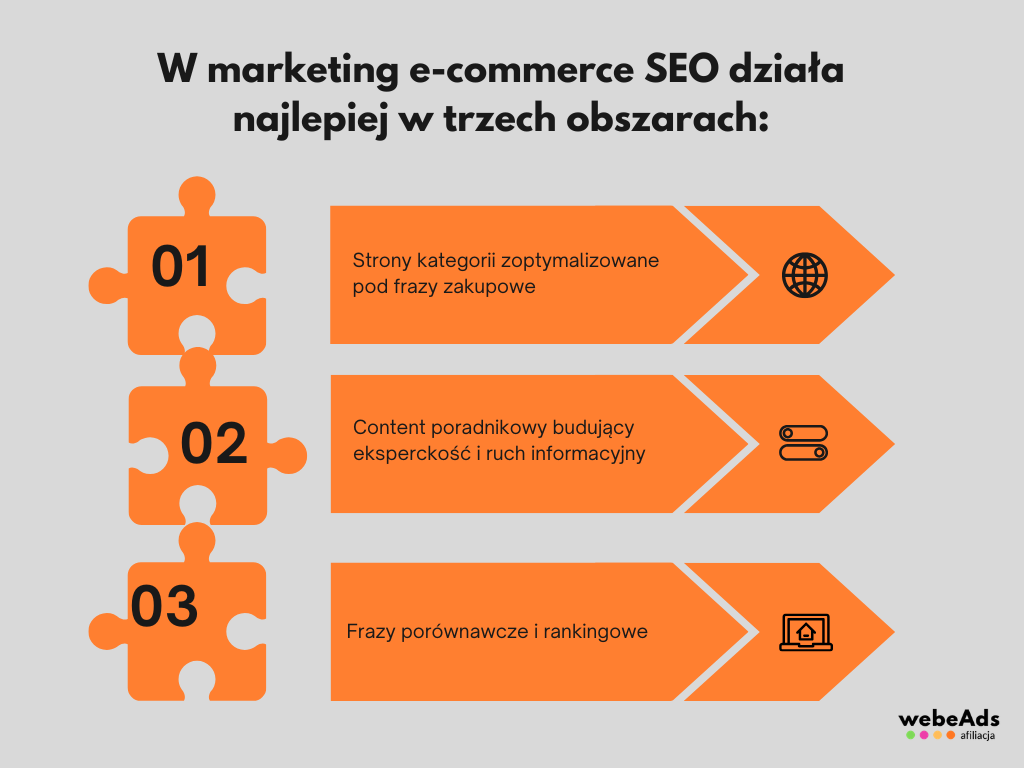
SEO in e-commerce is a long-term game, but one of the most profitable. Unlike paid channels, organic traffic does not generate a cost per click. Of course, it requires investment in content, site structure, and technical optimization, but in the long run it builds a stable source of sales.
Example:
A home furnishings store creates guides such as “How to choose a mattress for sleeping?” and builds informational traffic. A user lands on the site through the guide, signs up for the newsletter, and then converts a few days later through email marketing.
SEO doesn’t deliver immediate results, but in e-commerce marketing it is the foundation of stable growth and reducing dependence on paid campaigns.
One of the most common mistakes in e-commerce is focusing exclusively on acquiring new customers. Meanwhile, real profitability often lies in retention.
Email marketing in e-commerce marketing plays the role of a tool for increasing LTV (lifetime value). Abandoned cart automations, product recommendations, cross-sell campaigns, and reactivation campaigns can generate a significant portion of a store’s revenue.
A well-designed email marketing system can account for 20–40% of sales in a mature e-commerce business. Importantly, the cost of sending emails is marginal compared to the costs of paid campaigns.
Email is not an acquisition channel — it is a monetization channel. In an e-commerce marketing system, its role is hard to overstate.
Take your e-commerce profitability to the next level
With rising advertising costs, more and more stores are looking for models that reduce financial risk. This is where affiliate marketing appears as a performance-based element of e-commerce marketing.
In an affiliate model, partners promote a store’s products in exchange for a commission on sales. The cost only appears when a transaction occurs.
For e-commerce, this means:
Affiliate marketing works especially well in lifestyle, beauty, and fashion industries, as well as with niche specialist products, where a publisher’s recommendation carries significant weight.
In the context of e-commerce marketing, affiliate marketing is a cost stabilizer — it allows you to increase sales without a proportional increase in risk.
See also: https://webeads.pl/5-bledow-w-marketingu-afiliacyjnym/
The biggest mistake in e-commerce is treating channels in isolation from one another. Google, Meta, SEO, email, and affiliate marketing do not compete — they complement each other.
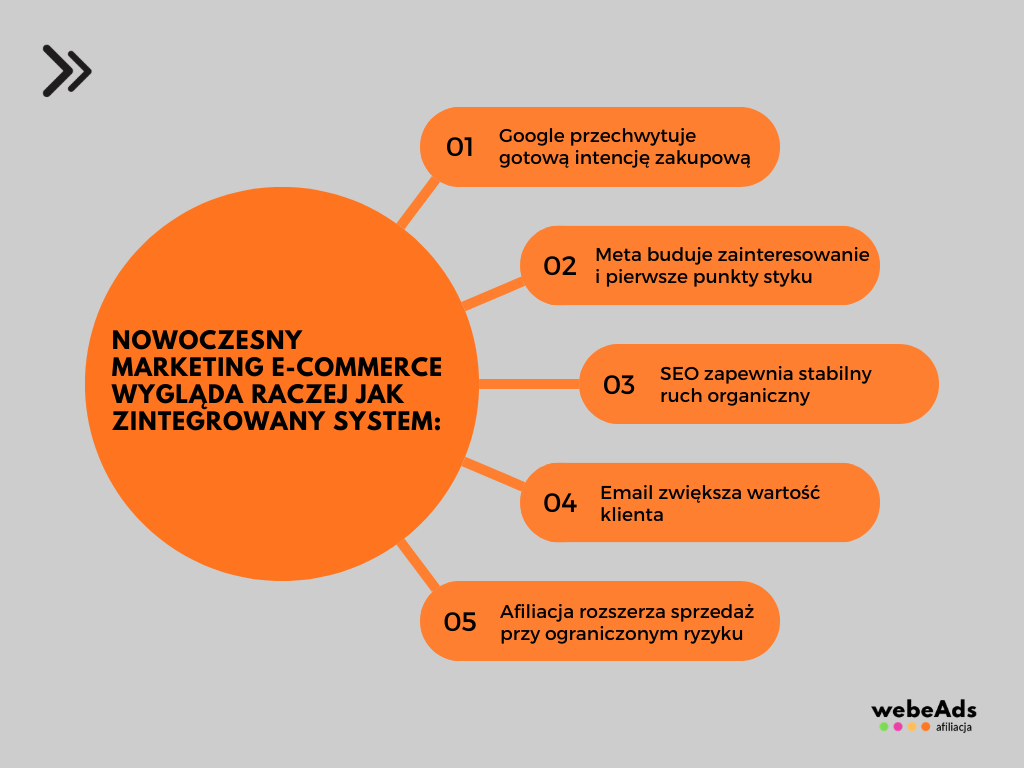
Stores that rely on a single channel are more exposed to cost fluctuations and algorithm changes. Diversification and margin control are the foundation today.
Read also: https://webeads.pl/czy-program-partnerski-sprawdzi-sie-w-twojej-branzy-sprawdz/
We are seeing a clear trend: a shift from thinking about reach to thinking about profitability. More and more companies are analyzing not only ROAS, but the actual net profit from campaigns.
E-commerce marketing is becoming more financial than creative. Data, automation, and performance models are gaining importance. Traffic without conversions is no longer acceptable.
In the coming years, the key factors will be:
Start selling more, not spending more.
There is no single best channel for e-commerce marketing. There is, however, a better or worse designed system.
Stores that view marketing solely through the lens of revenue will increasingly struggle with profitability. Those that design e-commerce marketing as a system for managing revenue and costs will win.
It’s not the channel that determines success. It’s the strategy — and the ability to connect them into a coherent whole.