
Affiliate marketing has undergone a significant transformation in recent years — from simple partner link systems to advanced sales ecosystems based on data, automation, and personalization.
The year 2025 will mark a new phase for affiliate marketing: technological, ethical, and strongly focused on performance. If you are an advertiser wondering how to promote your offer through affiliate marketing in the coming year, this article will provide you with clear answers.
Affiliate marketing is currently one of the most predictable performance marketing channels. Unlike display campaigns, affiliate marketing is based on performance-based payment models: CPS (cost per sale), CPL (cost per lead), and CPC (cost per click) — which means you pay only when you achieve a real result. For advertisers, this means greater control over the budget, lower customer acquisition costs, and a reduced risk of wasting funds.
According to CJ Affiliate data, as many as 81% of brands in the United States use affiliate programs. In Poland, this share is only 10–15%, which creates enormous opportunities for advertisers who decide to act early and build strong partnerships in a less saturated environment.
According to forecasts from Astute Analytics, the value of the affiliate marketing market is expected to exceed $40 billion by 2031. This growth highlights not only the scale of the phenomenon but also the long-term development potential of the entire industry — an opportunity worth leveraging today.
Interested in implementing an affiliate system in 2025?
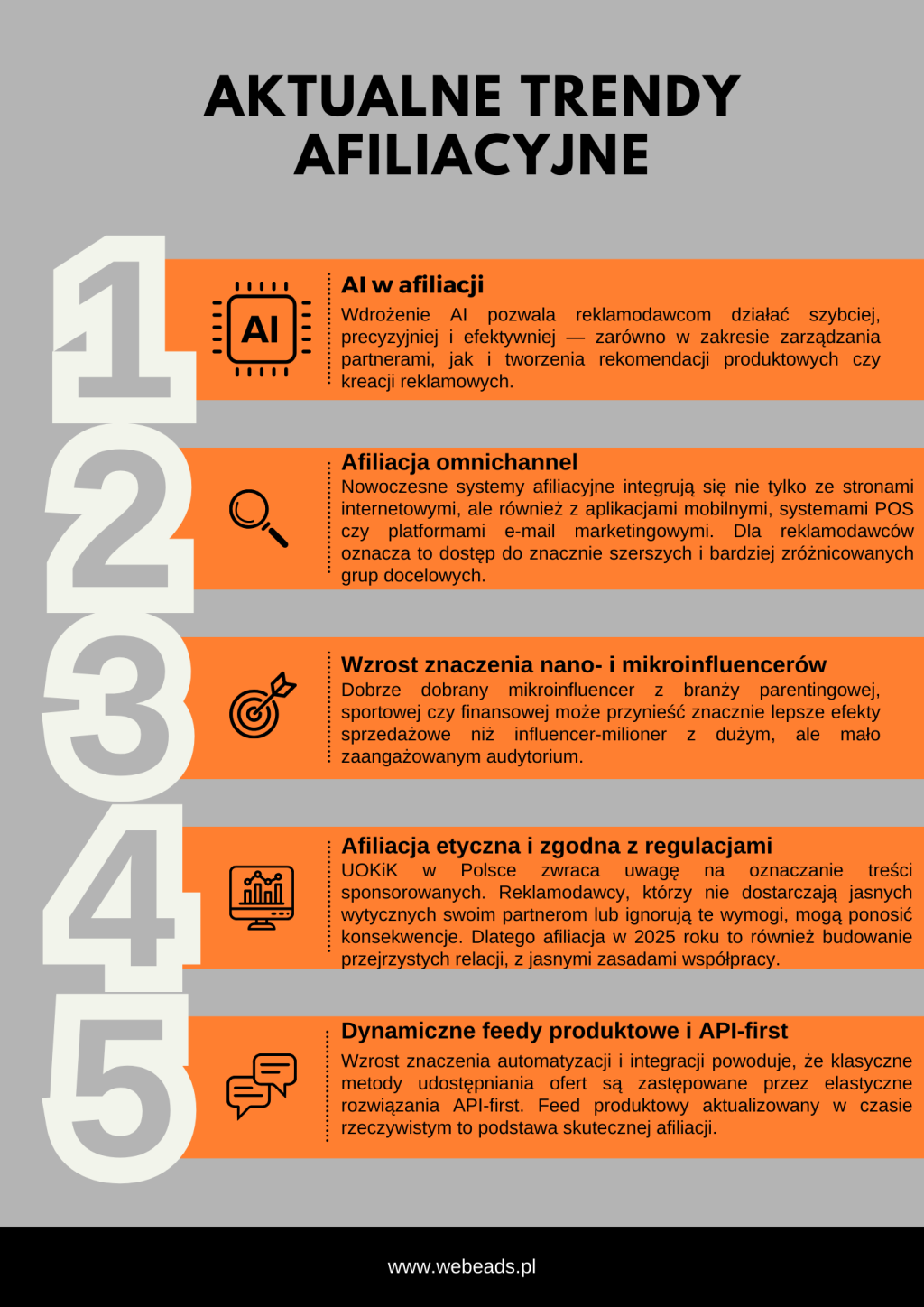
The year 2025 marks a turning point for affiliate marketing. The user is gaining more importance as a conscious consumer — more than ever, they expect authenticity, transparency, and valuable shopping experiences. At the same time, the industry is facing challenges such as the phase-out of third-party cookies, the growing role of AI, and the need for multichannel interaction.
Against this background, three phenomena are emerging that will have the greatest impact:
Before implementing an affiliate system, you need to clearly define the campaign goals. These may include increasing the number of transactions, acquiring contacts (leads), or improving brand visibility. The choice of payment model depends on the goal.
The effectiveness of a program largely depends on choosing the right technology partner. A good affiliate network should offer:
For example, WebeAds and iWebePartners are affiliate networks built on proprietary systems, with a broad base of publishers and experience in scaling affiliate programs in Poland.
A publisher who does not receive the right promotional resources will not be able to effectively support your offer. The key elements are:
Equally important is the proper integration of tracking — from conversion pixels to full API integrations or plugins for popular e-commerce platforms.

Active communication with publishers and their engagement are key to a program’s success. A good business partner should be well informed and feel they have a real impact.
Start affiliate marketing with an edge
Imagine an online store selling sportswear. In 2025, you no longer need to limit yourself to traditional Google or Meta Ads. Instead, you can:
Such an integrated program allows you to diversify your sales sources and become less dependent on increasingly expensive paid campaigns.
The year 2025 marks the era of mature affiliate marketing — built on data, automation, and partnerships. A well-designed affiliate system can become a real source of sales, not just an addition to a marketing strategy.
Affiliate marketing is not a one-off campaign, but a long-term investment in relationships and performance. If you want to start doing affiliate marketing professionally, choose a platform that supports the advertiser not only technically, but also operationally. Start with a simple pilot, test different models, and build relationships with publishers. In affiliate marketing, it is not just about clicks, but about the value you create together.