

In an era of rising advertising costs, increasing competition in search engines, and an overload of promotional messages, advertisers are looking for ways to reach customers effectively without wasting their budget. One of the most effective performance marketing models is affiliate marketing, which—when combined with a well-designed affiliate system—gives advertisers a tool to build sales with minimal risk. In this article, we explain what it means to “affiliate,” how an affiliate system works, and why it is worth implementing in your marketing strategy.
To affiliate means to introduce your offer into a partner system in which external publishers promote products or services in exchange for a commission based on results. This is not about traditional advertising, but about cooperation built on outcomes. Publishers direct traffic to the advertiser’s store through unique affiliate links, and they receive a commission only when their activity leads to a specific goal: a purchase, registration, or another conversion.
Affiliating your offer therefore means opening up to cooperation with partners who have access to their own communities and communication channels. It is not only a way to reduce advertising costs, but also a method of increasing reach and the authenticity of your message.
An affiliate system is the technological backbone that enables automated management of a partner program. It consists of a platform that registers publishers, assigns them unique identifiers (tracking), monitors their activity, and calculates commissions in real time. Thanks to the affiliate system, the advertiser has full control over who promotes their offer, how they do it, and what results they generate.
This system is responsible for transparency in the collaboration – both for the advertiser and for the publisher. Without such a tool, it would be difficult to work with a larger number of partners and analyze what actually works. In practice, an affiliate system acts as the operational engine of the entire affiliate strategy.

Traditional campaigns—such as display, Google Ads, or social media advertising—are based on paying for exposure, regardless of the outcome. This creates risk, especially for smaller companies or new brands. Affiliate marketing eliminates this problem: the advertiser pays only for what delivers real business value.
Affiliate marketing is also a model that scales exceptionally well. Publishers can be acquired gradually, and the program can grow alongside the business. Importantly, affiliate marketing is a channel built on trust – publishers promoting a product often create content around it, such as tests, reviews, or guides, which builds a stronger relationship with the audience than traditional advertising.
The first step is choosing an affiliate platform – for example, webeAds – which provides the appropriate technological infrastructure and access to a database of verified publishers. Next, the store integrates with the system using a conversion tracker, an XML product feed, or an API.
The key step is to define the program terms: the payment model (e.g. CPS – cost per sale), the commission rate, the rules of cooperation, and prohibited elements (e.g. SEM, coupons from outside the program). Once the program is launched, the advertiser can recruit publishers who apply to the campaign on their own. The entire process is managed through the system – from distributing materials to processing payouts.
Start affiliating with webeAds and pay only for results
Affiliate marketing is most commonly used by online stores that have a repeatable offer, high conversion rates, and a stable order fulfillment process. It works particularly well in industries such as:
In each of these industries, affiliate marketing enables precise targeting – for example through industry bloggers, YouTubers, comparison sites, or niche newsletters. This is a major advantage over mass channels, which reach a broad but often random audience.
Although affiliate marketing sounds simple, it requires careful execution. One common mistake is setting the commission too low, which discourages valuable publishers. Another problem is failing to update materials regularly (for example, product feeds) and lacking communication with partners. The affiliate system should be monitored regularly, and the program should be developed based on data analysis.
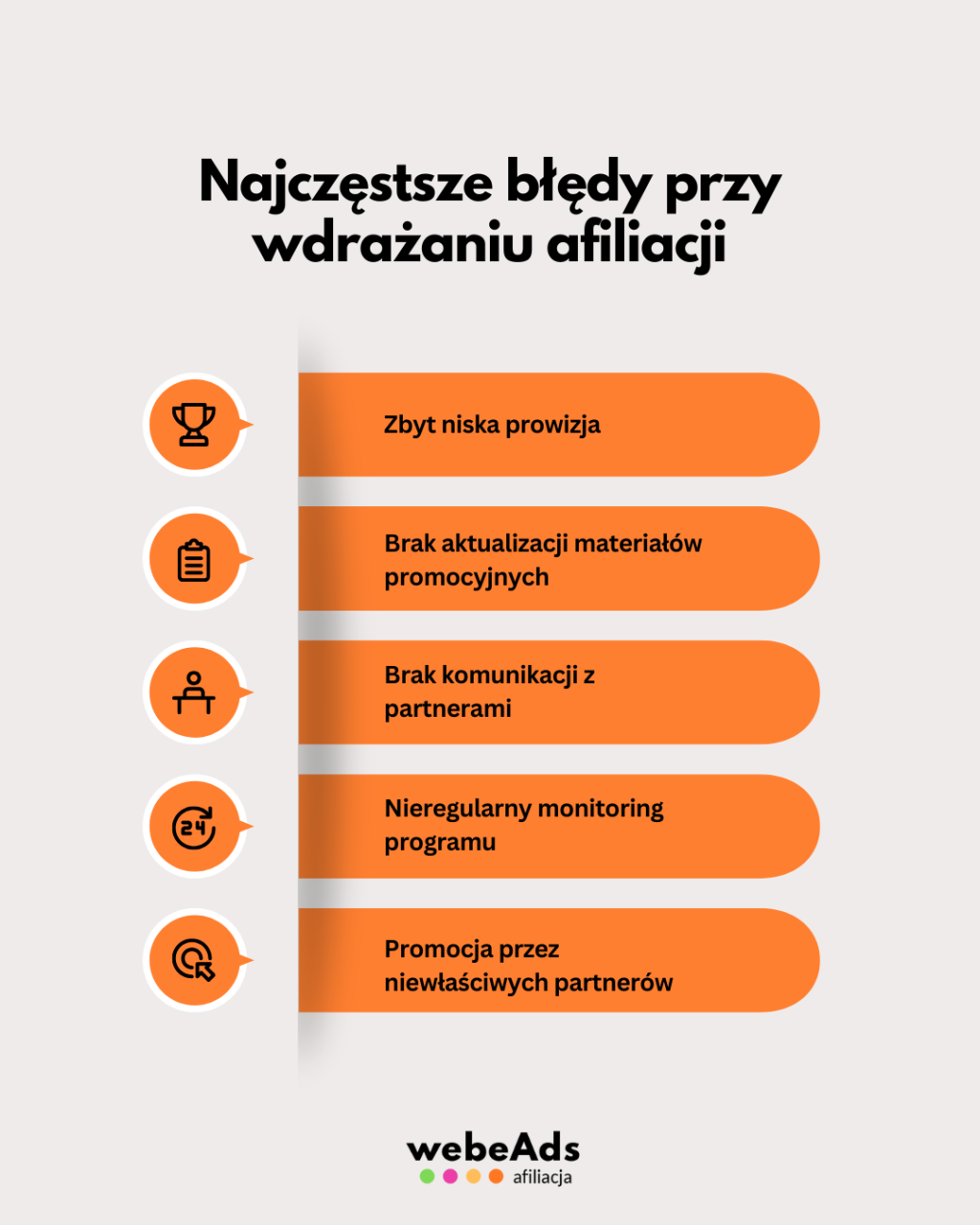
Neglecting these areas can result in low program activity or the promotion of your offer by the wrong partners. It is worth investing time in onboarding partners, providing them with up-to-date resources, and analyzing results.
Affiliate marketing and an affiliate system are not just trendy buzzwords – they are practical tools that help build a scalable, measurable, and profitable online sales channel. For advertisers, this means greater control, lower risk, and the ability to respond quickly to market changes.
To affiliate your offer means to include it in an ecosystem where everyone benefits: you as the advertiser, publishers as partners, and consumers who discover your products through credible recommendations.
Contact us and find out how quickly you can launch your own affiliate program tailored to your business