
In theory, online marketing gives you full control over spending. You can see every click and every conversion, and measure return on investment almost in real time. In practice, however, many companies — from startups to mature e-commerce businesses — regularly burn through budgets, often without even realizing it.
The problem rarely lies in the tools or channels themselves. Most often, it comes down to wrong assumptions, poorly set priorities, and focusing on the wrong metrics. Online marketing doesn’t forgive chaos — every decision quickly translates into real costs.
One of the most common reasons for losing budget is the lack of a coherent strategy. Many companies start their activities by choosing a channel — for example Google Ads campaigns or social media ads — instead of defining the goal and the business model first. As a result, online marketing becomes a collection of random actions that are difficult to scale and even harder to optimize.
If it’s not clear whether the goal is sales, leads, or perhaps building a user base, it’s impossible to properly assess campaign effectiveness. In such a scenario, the budget is “working,” but not necessarily toward the company’s growth. That’s the moment when marketing starts generating costs instead of value.
Stop wasting budget
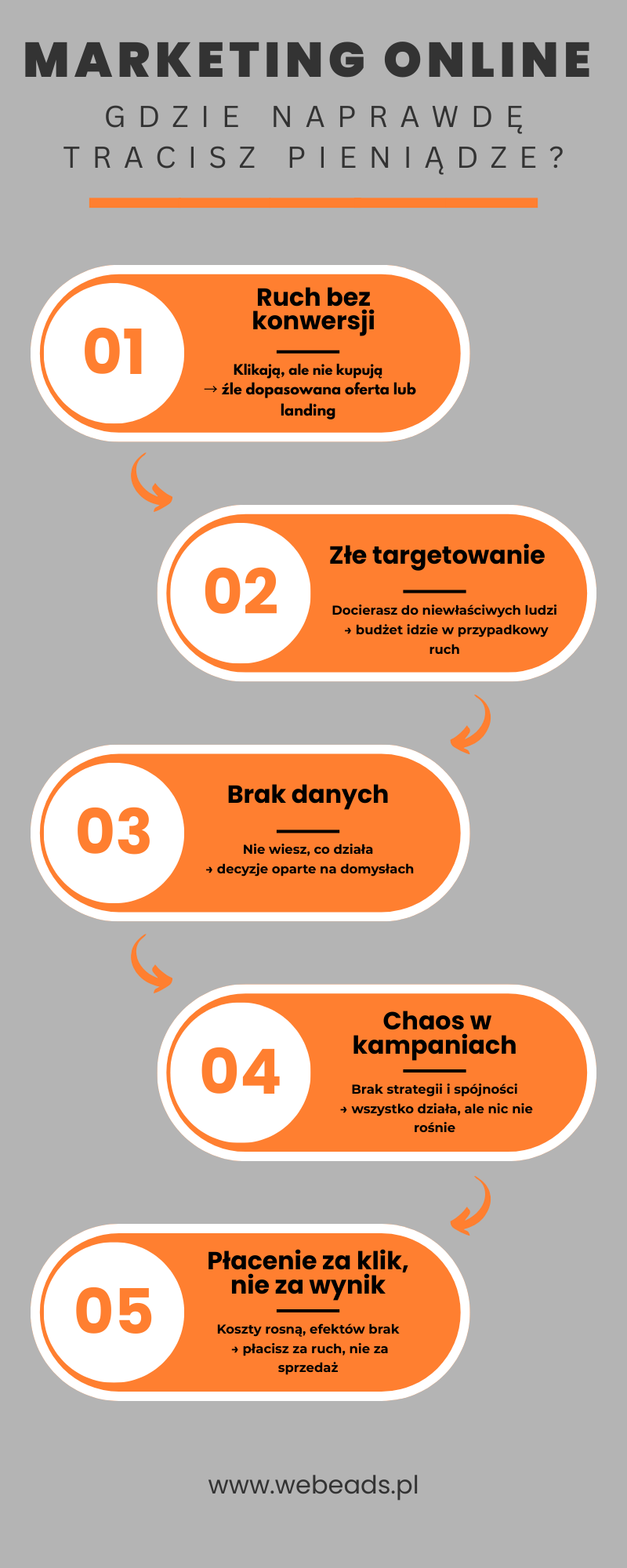
At first glance, everything looks good: the campaign generates traffic, the cost per click is low, and the metrics are going up. The problem only appears when you compare those numbers with real business results.
Online marketing very often falls into the trap of optimizing for traffic rather than conversions. This leads to a situation where users land on the site but have no real need to buy. There’s a mismatch between the ad message, the audience’s intent, and the offer.
As a result, the company pays for interest that will never translate into revenue. And even if a single click is cheap, the customer acquisition cost rises dramatically.
Online marketing offers huge possibilities for precise targeting, but paradoxically many companies don’t use them. Instead, they choose broad audience groups, assuming that greater reach means greater sales.
In reality, it works the other way around. The less precise the message, the lower the campaign effectiveness. The message reaches people who aren’t interested in the offer, which lowers the conversion rate and increases customer acquisition cost.
Precision in online marketing isn’t optional — it’s a necessity. Companies that truly understand their target audience can spend less and achieve better results. The rest pay for scale that doesn’t translate into sales.
Stop wasting budget
Online marketing provides access to a huge amount of data, but availability alone doesn’t mean it’s being used. In practice, many companies analyze metrics that have no real business value.
Clicks, reach, or the number of website visits may look impressive, but they say nothing about campaign profitability. Without focusing on metrics such as customer acquisition cost or return on investment, marketing becomes guesswork.
An even bigger problem is incorrect analytics setup. If you don’t know exactly where sales are coming from, which campaigns are working, and which ones only generate costs, you can’t make rational decisions. In such an environment, the marketing budget starts to blur — often without anyone noticing.
One of the less obvious sources of losses is the way decisions are made. In many cases, campaigns are changed or turned off too quickly—before they’ve had time to generate enough data.
Online marketing is built on a learning process—both on the side of ad algorithms and the strategy itself. Without time and data, you can’t evaluate what works and what doesn’t. As a result, companies make decisions based on short-term results, which are often misleading.
This leads to a vicious cycle: no stable campaigns → no data → bad decisions → more losses.
Online marketing that pays off
Many companies build their online marketing around a single traffic source — most often paid campaigns in one ad system. As long as everything works, the model seems effective. The problem arises when conditions change: costs go up, performance drops, the algorithm changes.
A lack of diversification means the company loses control over costs and results. Online marketing should be a system, not a single channel. Only combining different traffic sources makes it possible to stabilize performance and reduce risk.
The most underestimated source of losses in online marketing is the billing model. In many cases, companies pay for actions — impressions, clicks, visibility — rather than for a real business outcome.
This creates a natural asymmetry: the budget is spent regardless of whether the campaign generates sales. In such a model, the risk rests entirely on the advertiser.
That’s why performance-based approaches are becoming increasingly important — where the cost occurs only when the result occurs. In particular, in affiliate models, part of the efficiency burden shifts to partners, which significantly reduces the risk of wasting budget.
Stop wasting budget
The biggest change in the approach to online marketing is that it is no longer treated as a “promotional department,” but starts functioning as an investment management system.
Every złoty spent should be justified by data and return potential. This requires not only tools, but above all a shift in mindset — from “how much did we spend” to “how much did we earn.”
Companies that treat online marketing as a process based on measurement, testing, and optimization can not only reduce losses, but above all systematically increase profitability.
Budgets in online marketing rarely “disappear by accident.” Most often, they are the result of decisions made without data, without strategy, or without understanding how the channels actually work.
Where marketing is precise, measurable, and performance-based, costs start working toward results. Where it’s chaotic, the budget becomes an expense, not an investment.
That’s why more and more companies are moving away from models based solely on media delivery and toward solutions where performance is the basis for settlement.
And that is exactly the direction online marketing is heading today.